
Exhibition in Mumbai Revives Jamshedpur's Vanishing Parsi Heritage
Discover how a box of keepsakes reveals the vibrant early history of Jamshedpur through the lens of the Parsi community.

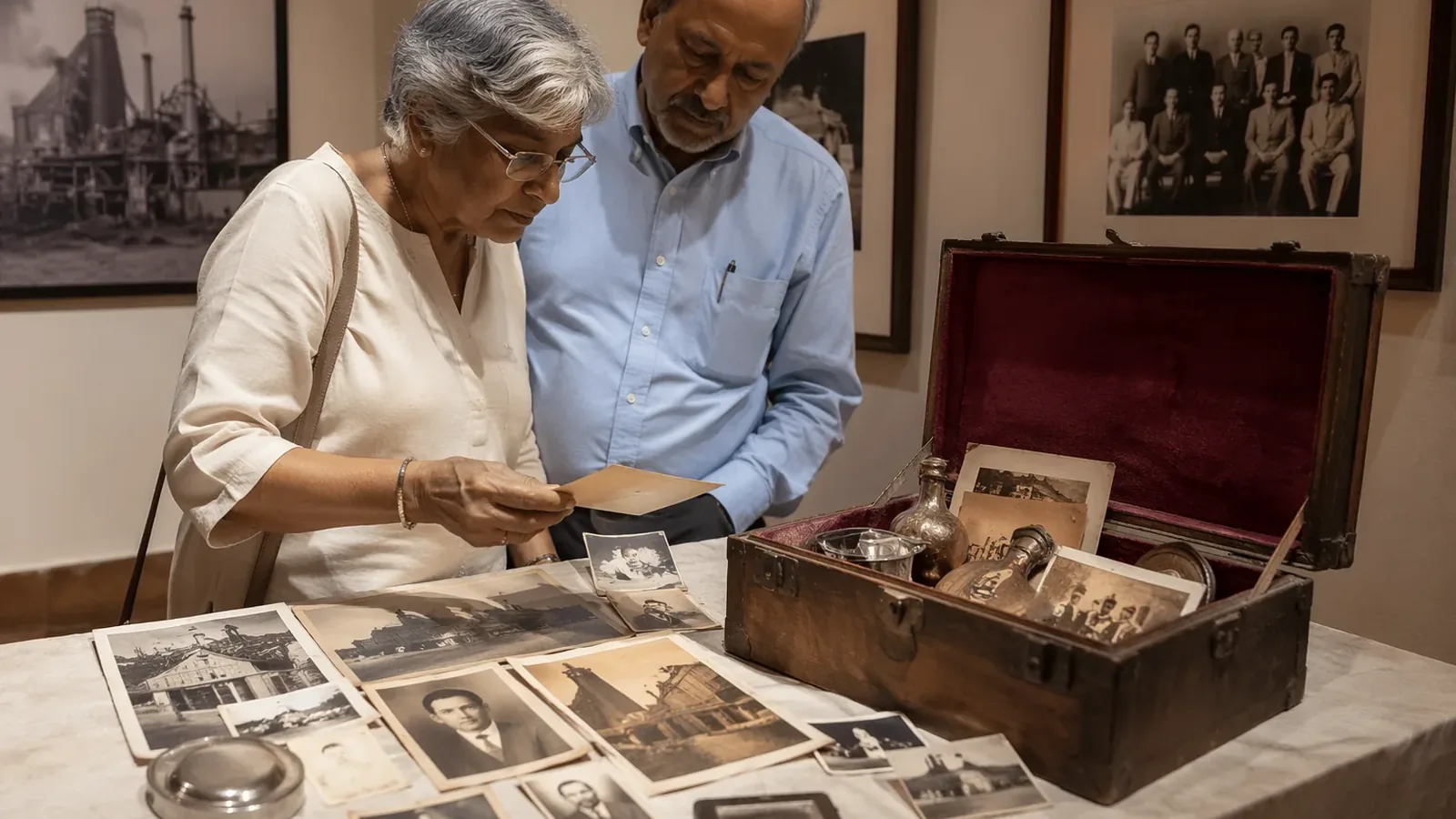
Echoes in a Parsi Attic: A Box of Keepsakes Unveils Early Jamshedpur's Story Through Mumbai
In 1935, Khurshed Maneckji Bharucha, the first Indian chief cashier of Tata Steel in Jamshedpur, borrowed Rs 3.5 lakh from a friend who owned an island near Bombay. With this loan, he constructed a four-storey building at the Bistupur junction, using 'surkhi,' a mix of burnt clay and limestone, for its partition walls.
The building was designed to house the influx of Parsi workers arriving from cities like Bombay, Surat, Karachi, and even from as far as Birmingham and Munich, following the founding of Tata Steel in 1907. Over time, it also became home to Regal Cinema, Jamshedpur's first single-screen theatre, located on its ground floor. Today, however, the once-thriving Parsi community in Jamshedpur has dwindled to around 200 individuals due to migration, interfaith marriages, and declining population numbers.
Fragments of this community's vibrant history have been preserved in a box of photographs, letters, and notes maintained by Bharucha's son-in-law, Keki Gazder. A mechanical engineer with a passion for photography, Keki's collection has transformed Cymroza Art Gallery in Mumbai's Cumballa Hill into a 1950s-style Parsi attic. The exhibition, titled "Sparseeing", a term coined to mean "seeing things as though they were disappearing", features over 70 images from the Gazder-Bharucha family archive.
Although many of the photographs lack names and dates, they provide a rare glimpse into Parsi domestic life and the evolution of Jamshedpur around India's first steel plant. A descriptor at the exhibition highlights the Gazder-Bharucha family's role as "inveterate archivists" of the city's history. The exhibition will run until June 20.
The Bharucha Mansion was once presided over by Goolbanu Bharucha, the first woman to drive a car in Jamshedpur and a tea-loving matriarch. However, the exhibition's central figure is Keki, an introverted chief electrical officer at Tata Engineering and Locomotive Company (TELCO). Growing up as an observer, Keki meticulously documented the world around him.
Keki's career took him to industrial hubs in Brussels, Belgium, and Berlin, where he filled a red hardbound diary with observations. Letters and postcards from relatives in Birmingham and family members working in Tata's locomotive division further chronicled lives intertwined with industrial progress. The idea for the exhibition began with a shoebox of photographs, negatives, and other memorabilia discovered by documentary photographer Abhishek Basu and researcher Joyona Medhi at Regal Cafe, a business now run by Keki's grandson, Varun Gazder, in the same Bistupur building.
Rather than impose a strict chronology on the archive, the curators embraced its gaps, using flipbooks, lightboxes, and fragments of fiction to weave an unfinished narrative. "Sometimes, fiction is the best way to get close to the truth," Medhi explained. The project, which won the Alkazi Grant in 2022, captures intimate moments such as children playing, factory workers at their jobs, and women in studio portraits adorned with pearl necklaces and lace sarees featuring Iranian motifs.
One photograph is believed to depict Keki's aunt Perim, possibly taken before her marriage to Adi Hodiwala of Tata Trusts. Another artifact, a handwritten ledger, lists Keki's millwright staff, including foremen, chargemen, dockyard workers from Kerala, and a clerk-cum-typist.
Photography was Keki's true passion. A member of an amateur photography club, he contributed images to TELCO publications and spent hours in the family attic capturing everyday life. Among his works is a self-portrait, taken decades before the selfie era, showing him in a dramatic pose, gazing skyward.
His photographs also document unique moments, such as bodybuilders performing during wrestler Dara Singh's visit to Jamshedpur and women engaged in industrial work. One image shows a woman in a polka-dotted saree speaking into a microphone, while another features a female operator dwarfed by a massive switchboard, both subjects remain unidentified.
Keki's journals also reference Otto Konigsberger, the German architect who designed Jamshedpur's development plan for Tata & Sons and contributed to MARG magazine. These connections reveal unexpected insights into the city's history.
While Regal Cinema has long since closed its doors, its legacy endures in the memories preserved by the Gazder family. Varun Gazder continues to run Regal Cafe in the same building, where the mansion and the box of keepsakes still stand as silent witnesses to a bygone era.
Frequently asked questions
What is the title of the exhibition in Mumbai that showcases Jamshedpur's Parsi heritage?
The exhibition is titled 'Sparseeing,' which means 'seeing things as though they were disappearing.'
Who is the central figure of the exhibition and what is his background?
The central figure is Keki Gazder, an introverted chief electrical officer at Tata Engineering and Locomotive Company (TELCO), who has a passion for photography and documenting history.
What does the exhibition feature from the Gazder-Bharucha family archive?
The exhibition features over 70 images, photographs, letters, and notes that provide a glimpse into Parsi domestic life and the history of Jamshedpur.
How long will the exhibition run?
The exhibition will run until June 20.
What historical significance does the building at Bistupur junction hold?
The building was designed to house Parsi workers arriving for Tata Steel and became home to Regal Cinema, Jamshedpur's first single-screen theatre.
You may also like
 Kerala
Kerala's unique Malayalam calendar revives Vattezhuthu script and culture
 Religious
Ancient Cannons Unearthed at Adoor Mahalingeswara Temple in Kerala
 Business
Exploring India's Oldest Markets: A Journey Through Time
 National
Parthenon's Western Facade Fully Restored for First Time in 220 Years
Most read
- 1
Air China Adds Extra Flight for Passengers Stranded in Fuel-Starved Cuba
- 2
Western disturbance to bring rain, hail and strong winds across north India
- 3
Yogi Adityanath Directs No Occupied Houses Be Demolished for Achhalda Bridge
- 4
Schools Shut in Five Tamil Nadu Districts, Including Chennai, Amid Heavy Rain
- 5
Gwalior Temple Truck Crash Kills 12, Injures 28-29 Devotees During Navratri
Comments
No comments yet. Be the first to comment.