
Red-Wattled Lapwing: The Bird That Predicts Monsoon Rainfall
Discover how the red-wattled lapwing helps farmers predict monsoon rains in India through its nesting behavior and traditional knowledge.

Which Bird is Known as the ‘Monsoon Forecaster’ That Helps Farmers Predict Rainfall?
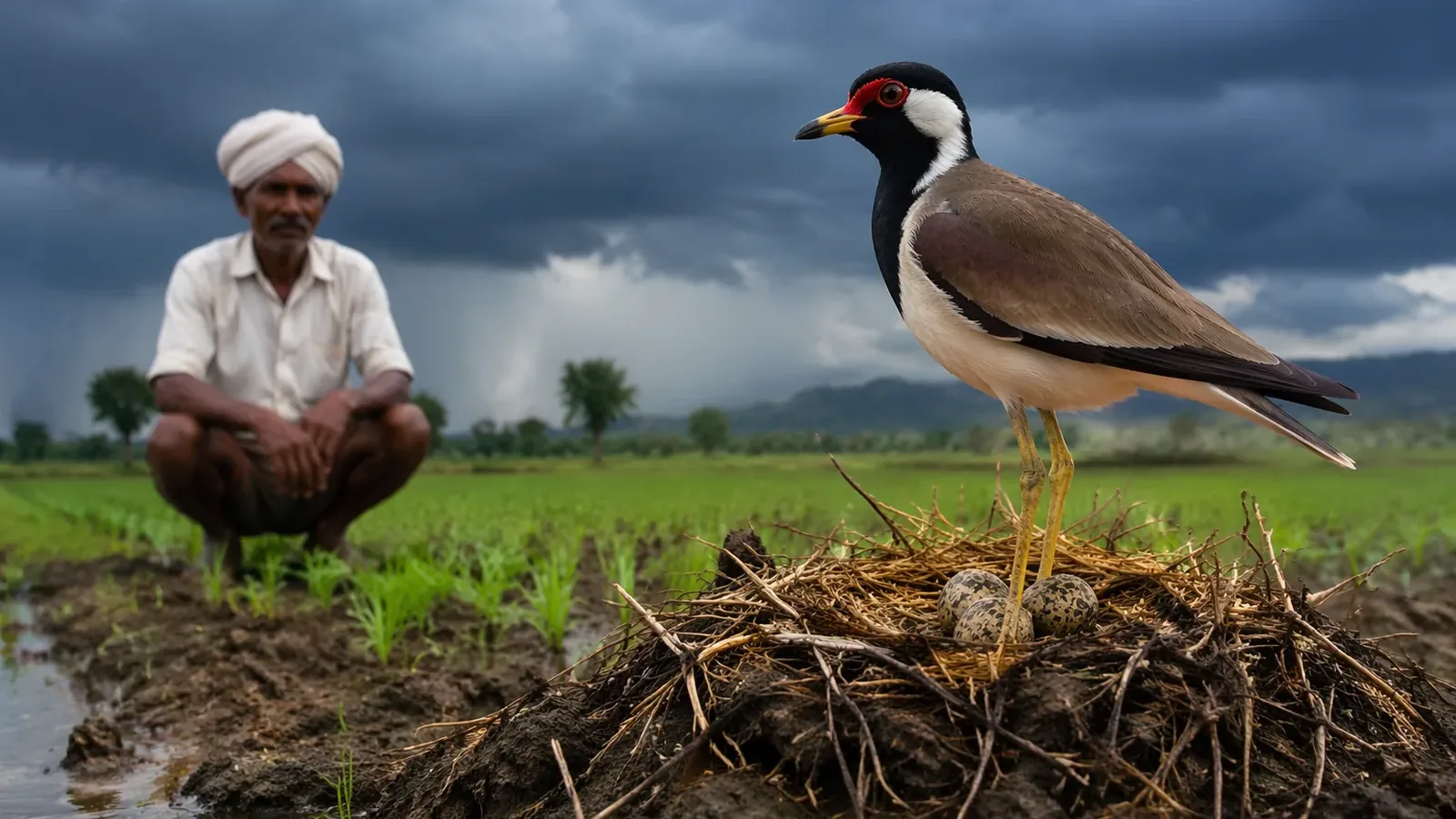
Long before the advent of weather apps and satellite imagery, farming communities across India relied on natural indicators to predict environmental changes. Observations of clouds, winds, insects, flowering plants, and birds formed a practical system for anticipating seasonal shifts. Among these traditional methods, the red-wattled lapwing holds a unique place in parts of western India, where its behaviour is closely watched to forecast the monsoon.
The Red-Wattled Lapwing: A Natural Rain Forecaster
The red-wattled lapwing, a ground-nesting bird commonly found near fields and wetlands, has long been considered a reliable signal of impending rainfall. Farmers have traditionally observed its nesting behaviour, including the choice of nesting site, egg arrangement, and materials used in its nest. These observations were not mere folklore; they often influenced critical agricultural decisions, such as sowing, crop selection, and water management, ahead of the monsoon season.
Recognisable by its striking red facial wattles and loud alarm calls, the lapwing frequently nests in open fields, dry ground, and areas close to human settlements. Its widespread presence across the Indian subcontinent makes it an accessible indicator for many rural communities.
Scientific Validation of Traditional Knowledge
A recent study published in the American Meteorological Society examined the long-held beliefs surrounding the lapwing’s ability to predict rainfall. Conducted over eight years in southwestern Rajasthan, the research involved 200 tribal farmers, ornithologists, agricultural scientists, and field observations of lapwing nests. The study found that older farmers possessed detailed knowledge about the bird’s behaviour, including nesting sites, egg placement, and egg-laying patterns, which correlated closely with modern meteorological data.
How Lapwing Nests and Eggs Predict Rainfall
Farmers interviewed in the study highlighted specific aspects of lapwing behaviour that serve as rainfall indicators. The location of the nest is considered particularly significant. Nests built on elevated ground are traditionally interpreted as a sign of substantial rainfall later in the season, while those in dry streambeds or low-lying areas are seen as warnings of weak rainfall or drought.
Egg placement and arrangement offer additional clues. Vertically positioned eggs are believed to signal stronger or longer-lasting rainfall, whereas horizontally placed eggs suggest limited precipitation. Similarly, eggs clustered closely together are associated with a favourable rainy season, while widely scattered eggs point to patchier rainfall. The researchers noted that many of these traditional observations aligned with rainfall patterns recorded during their field investigations.
Why the Lapwing Matters to Farmers in Rajasthan
In Rajasthan’s tribal regions, where farming is highly dependent on rainfall, access to modern weather forecasts is often inconsistent due to limited network connectivity. For older farmers, lapwing behaviour remains integral to agricultural planning. Decisions about crop choice, seed investment, water conservation, and field selection are frequently influenced by the bird’s nesting patterns.
However, the study found that traditional knowledge is unevenly distributed across generations. Farmers aged 50 to 70 were far more familiar with lapwing indicators than younger farmers, who tend to rely more on meteorological forecasts. This generational gap highlights the gradual disappearance of valuable local knowledge as traditional practices are passed down less frequently.
Bridging Traditional and Modern Forecasting
While the researchers do not advocate replacing scientific forecasting with bird behaviour, they suggest that both systems can complement each other. Their findings revealed that rainfall predictions based on lapwing observations often corresponded with meteorological data collected during the study. While modern forecasts provide regional-scale information, traditional observations offer highly localized insights rooted in generations of experience.
The authors concluded that farmers who combine traditional knowledge with modern forecasts are better equipped to make informed agricultural decisions. As they noted, "Rain forecasting can be improved by blending modern meteorological information with traditional proven indications."
A Testament to Generational Environmental Knowledge
The red-wattled lapwing may not feature in official weather bulletins, but its role in rural communities underscores the enduring relevance of traditional environmental knowledge. Across many parts of the world, such knowledge continues to shape how people interpret changing seasons. For countless farmers in Rajasthan, the arrival of the monsoon is not judged solely by meteorological models, it often begins with watching where a lapwing chooses to lay its eggs.
Frequently asked questions
Which bird is known as the 'monsoon forecaster' in India?
The red-wattled lapwing is known as the 'monsoon forecaster' in parts of western India. Farmers have traditionally observed its nesting behaviour, including nest location, egg arrangement, and materials used, to predict rainfall and make agricultural decisions.
How do farmers use the red-wattled lapwing's nesting location to predict rainfall?
Nests built on elevated ground are traditionally interpreted as a sign of substantial rainfall later in the season, while nests in dry streambeds or low-lying areas are seen as warnings of weak rainfall or drought.
What scientific research supports the lapwing's ability to predict monsoon rainfall?
A study published in the American Meteorological Society, conducted over eight years in southwestern Rajasthan with 200 tribal farmers and ornithologists, found that older farmers' detailed knowledge of the bird's behaviour, including nesting sites and egg-laying patterns, correlated closely with modern meteorological data.
What characteristics make the red-wattled lapwing easily recognizable?
The red-wattled lapwing is recognizable by its striking red facial wattles and loud alarm calls. It is a ground-nesting bird commonly found near fields, wetlands, open fields, and areas close to human settlements across the Indian subcontinent.
You may also like
 Weather
India Braces for Below-Normal Rainfall; Telangana Set for Above-Average Precipitation
 Weather
Monsoon progress stalls in India as rainfall remains 38% below average
 Weather
Low-pressure system may bring rain to Andhra Pradesh from October 15
 Weather
India's Southwest Monsoon Ends 12.6% Below Normal, Driest Since 2015
Most read
- 1
Air China Adds Extra Flight for Passengers Stranded in Fuel-Starved Cuba
- 2
Western disturbance to bring rain, hail and strong winds across north India
- 3
Yogi Adityanath Directs No Occupied Houses Be Demolished for Achhalda Bridge
- 4
Gwalior Temple Truck Crash Kills 12, Injures 28-29 Devotees During Navratri
- 5
Schools Shut in Five Tamil Nadu Districts, Including Chennai, Amid Heavy Rain
Comments
No comments yet. Be the first to comment.