
axolotls' unique regeneration abilities could transform human medicine
Discover how the axolotl's ability to regrow limbs and organs could transform human medicine and regenerative therapies.

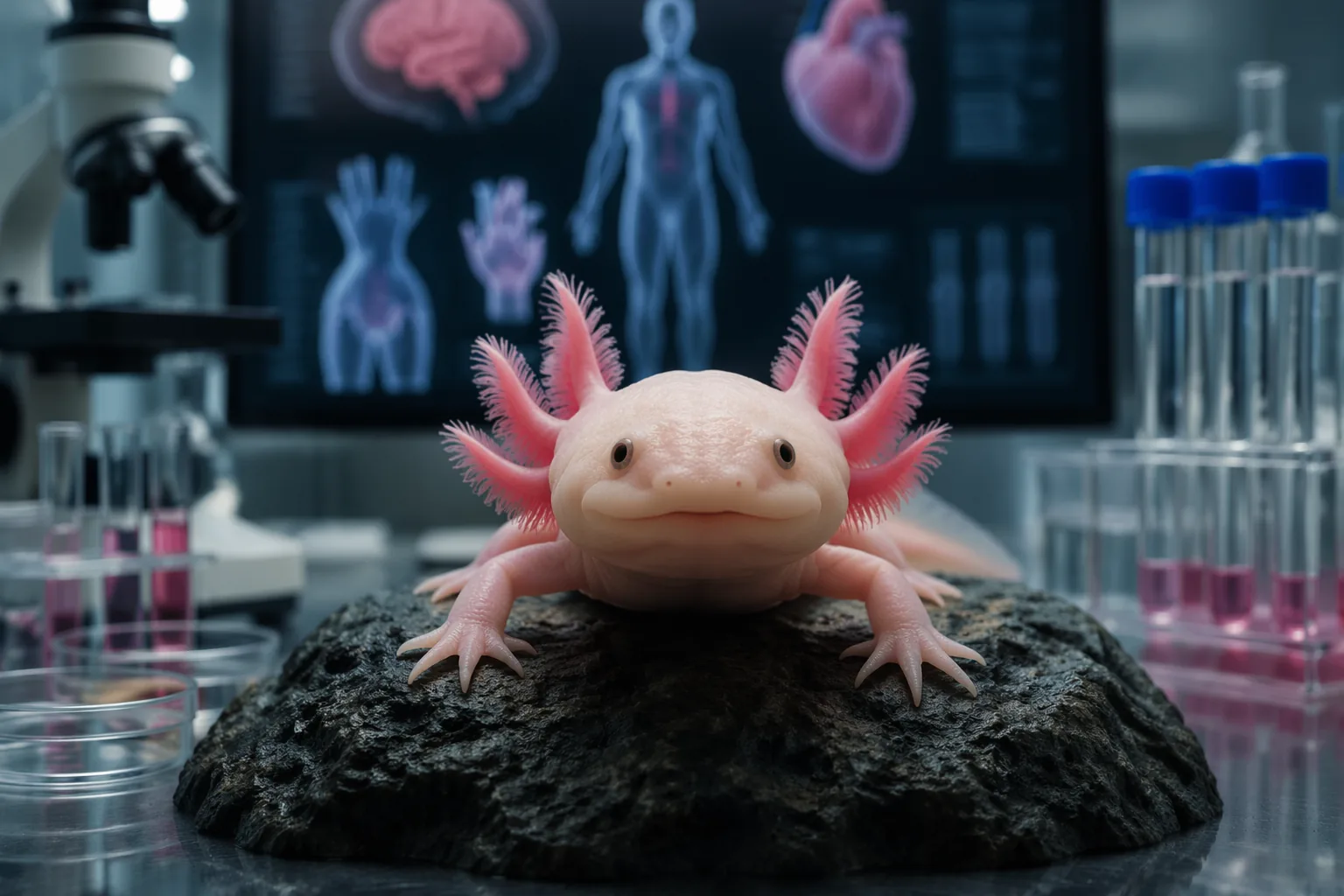
The Smiling Salamander That Can Regrow Its Brain, Heart, and Limbs: Could It Revolutionize Human Medicine?
At the bottom of Lake Xochimilco in Mexico City lives a creature that defies biological conventions. Known as the axolotl (Ambystoma mexicanum), this juvenile salamander can regenerate lost limbs, repair its spinal cord, heart, and even parts of its brain without scarring or functional loss. Its extraordinary regenerative abilities have made it a prized model organism for scientists studying tissue repair and regeneration.
What Makes the Axolotl Unique?
The axolotl is a paedomorphic salamander, meaning it retains juvenile characteristics throughout its life and never undergoes the metamorphosis typical of other salamanders. Unlike most amphibians, which transition to land-dwelling adulthood, axolotls remain aquatic, keeping their external gills and larval tissue structure. This biological trait, known as neoteny, is central to their regenerative powers.
When an axolotl loses a limb, cells near the injury revert to an earlier developmental state and form a structure called a blastema. This structure essentially restarts the growth process, rebuilding bone, muscle, nerve, and skin in their correct positions. The same regenerative capacity extends to its spinal cord, heart, and brain, making the axolotl one of the few vertebrates capable of large-scale tissue regeneration throughout adulthood.
Unlocking Regeneration in Humans
Recent genetic research has revealed that the axolotl's regenerative abilities may not be entirely unique. A study from Wake Forest University identified a gene called SP8, working alongside its partner SP6, as a shared genetic switch for limb regeneration across axolotls, zebrafish, and mice. Using CRISPR gene-editing, researchers removed SP8 from axolotls, preventing proper regrowth of limb bones—a result mirrored in mice missing the same genes.
Further experiments used zebrafish-derived gene therapy to partially restore digit regeneration in mice, suggesting that the genetic instructions for regeneration might already exist, dormant, in mammals, including humans. These findings have sparked hope that understanding the axolotl's biology could one day lead to breakthroughs in human tissue repair and organ regeneration.
A Species on the Brink
While the axolotl's biology holds immense promise for science, its wild population is critically endangered. Native to Lake Xochimilco, the species has suffered a dramatic decline due to habitat loss, pollution, and invasive species like tilapia and carp, which prey on axolotl eggs and compete for food. Surveys recorded 6,000 axolotls per square kilometre in 1998, but by 2014, this number had plummeted to just 36 per square kilometre.
Conservation Efforts to Save the Axolotl
Efforts to save the axolotl are underway at Lake Xochimilco, a UNESCO World Heritage Site. Mexico's National Autonomous University, led by biologist Luis Zambrano, has developed "chinampa-refuge" canals that combine traditional floating farm islands with biofilters and barriers to protect the species from invasive predators. Conservationists are also using environmental DNA sampling alongside traditional fishing methods to monitor axolotl populations and update estimates that have not been revised since 2014.
Although the future of the axolotl in the wild remains uncertain, these restoration efforts offer hope for preserving one of biology's most fascinating creatures. As scientists continue to unlock its secrets, the axolotl may not only survive but also revolutionize human medicine.
Frequently asked questions
What unique abilities do axolotls have?
Axolotls can regenerate lost limbs, repair their spinal cord, heart, and parts of their brain without scarring or functional loss.
What is the significance of the gene SP8 in axolotls?
The gene SP8, along with SP6, is a shared genetic switch for limb regeneration, and its removal prevents proper regrowth of limb bones.
Why are axolotls considered critically endangered?
Axolotls are critically endangered due to habitat loss, pollution, and competition from invasive species like tilapia and carp.
What conservation efforts are being made to protect axolotls?
Conservation efforts include the development of 'chinampa-refuge' canals at Lake Xochimilco to help preserve the species.
You may also like
 National
Cockroach DNA reveals 150 million years of bacterial partnership
 Kerala
Chokramudi Hills to Open for Tourists as Neelakurinji Blooms Begin
 National
FTII's Jagat Murari: Shaping India's Filmmaking Rebels Since the 1960s
 West Bengal
Suvendu Adhikari vows 'Vikshit Bharat' vision relies on 'Viksit Bengal' by 2047
Most read
- 1
Raja Mahendra Pratap Singh University launches 'Free Thinkers Club' for students
- 2
Andhra Pradesh Cabinet Ministers List 2026 with Contact Numbers and Portfolios
- 3
Teacher arrives drunk at Firozabad school, sparks chaos and protests
- 4
Hamirpur stenographer rescued after suicide attempt from bridge
- 5
Tamil Nadu Cabinet Ministers List 2026 with Portfolios
Comments
No comments yet. Be the first to comment.