
Assam-made Chinese-style puer tea fetches record price at Guwahati auction
Assam produces Chinese-style pu'er tea cakes, selling for Rs 12,000 per kg at the Guwahati Tea Auction Centre, opening new avenues for specialty teas.

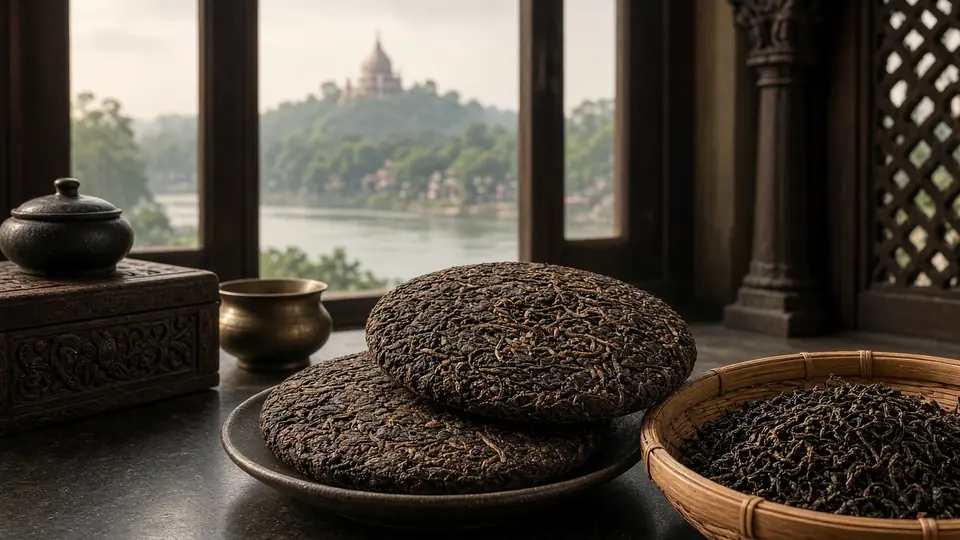
Assam’s experiment with Chinese-style pu’er tea has reached the Guwahati Tea Auction Centre, where a locally made batch sold for ₹12,000 per kg and strengthened the case for auctioning other fermented speciality teas from the State.
Assam pu’er reaches GTAC
A 5-kg batch of pu’er tea made by Gauripur Tea Industry in eastern Assam’s Golaghat district was sold at the Guwahati Tea Auction Centre on Friday (September 25, 2026).
Assam Tea Traders bought the lot through brokers J. Thomas & Co. Pvt Ltd.
The sale is significant because pu’er tea is traditionally produced in China’s Yunnan province, while this batch was made in Assam.
The auction also paves the way for varieties such as ‘phalap’, prepared by the Singpho community, to be offered through the auction system.
GTAC became the second auction centre to sell pu’er tea after the same producer sold a lot at the Jorhat Tea Auction Centre in 2023 at ₹9,000 per kilo.
The Guwahati price of ₹12,000 per kg marks a higher auction value than the ₹9,000 per kilo recorded at Jorhat in 2023 for the same producer’s pu’er tea.
How the Assam-made pu’er is produced
Aparaj Saikia of Gauripur Tea Industry said his firm began producing the Sheng-style pu’er tea, which takes a week from plucking leaves to processing and compressing into circular cakes.
“Sheng style is faster than the Shou style, which requires ageing for three to four years and controlled post-fermentation techniques,” he told The Hindu.
“We adapted the Chinese style with the assamica variety of tea leaves found naturally in Assam,” he told The Hindu.
“Our process is entirely handmade, and it began with small batches for personal consumption before the commercial launch three years ago,” Mr Saikia, a member of the North Eastern Tea Association (NETA), said.
Pu’er is traditionally pressed into cakes or bricks and develops its distinctive character through fermentation and ageing.
It has a deep, rich and smooth taste, with earthy and woody flavours, sometimes accompanied by subtle leathery or sweet notes.
Why the auction matters for speciality teas
“The pu’er auction is a milestone for Assam tea, which has been experimenting beyond the conventional black and green teas,” NETA advisor Bidyananda Barkakoty said.
“It points to immense possibilities, creating higher-value products from tea resources in the State,” he said.
Mr Barkakoty said the auction development could also open space for phalap tea, the traditional tea of the Singpho community.
“This opens the auction doors for phalap tea, the traditional tea of the Singpho community, particularly in the Margherita region of Tinsukia district,” he said.
Phalap is traditionally packed in bamboo and aged to give it a distinctive earthy, woody and smoky character, somewhat similar to pu’er, or pu-erh, Mr Barkakoty said.
The development comes shortly after the Assam government increased the subsidy on the production of orthodox and other speciality teas from ₹10 to ₹15 per kg.
The increased subsidy is effective from financial year 2026-27.
The GTAC sale therefore links three strands of Assam’s speciality tea push: a Chinese-style pu’er made with assamica leaves, the possible auction entry of Singpho phalap, and a higher subsidy for orthodox and other speciality teas.
The report was published on September 26, 2026, at 04:26 pm IST.
Source: The Hindu
Frequently asked questions
What price did the Assam-made pu'er tea fetch at the Guwahati Tea Auction Centre?
The Assam-made pu'er tea sold for a record price of ₹12,000 per kg at the Guwahati Tea Auction Centre.
Who produced the batch of pu'er tea sold at the Guwahati auction?
The 5-kg batch of pu'er tea was produced by Gauripur Tea Industry located in eastern Assam's Golaghat district.
How long does it take to produce the Sheng-style pu'er tea made by Gauripur Tea Industry?
It takes a week from plucking leaves to processing and compressing the Sheng-style pu'er tea into circular cakes.
Which community prepares the traditional 'phalap' tea mentioned in the article?
Phalap tea is traditionally prepared by the Singpho community, particularly in the Margherita region of Tinsukia district.
You may also like
 Technology
Assam ASHAs’ field inputs to shape AI cervical cancer screening tool
 National
Assam Cabinet approves Rules for compulsory Muslim marriage regis
 National
Rescue team frees young elephant trapped by discarded truck tyre in Assam
 Politics
Assam Cabinet Ministers List 2026 with Portfolios and Contact Details
Most read
- 1
Former minister Lakhan Singh Rajput to inaugurate temple bhandara at Shri Chakreshwar Mahadev
- 2
InnoCare, Eli Lilly Sign Research And Licensing Deal Worth Up To $3.35 Billion
- 3
Firozabad BSA finds four government schools locked during inspection
- 4
Tamil Nadu dengue cases fall for third consecutive year to 17,049
- 5
Dibiyapur's Chakreshwar Mahadev Temple Holds Budhwa Mangal Prasad Distribution
Comments
No comments yet. Be the first to comment.