
Rescue team frees young elephant trapped by discarded truck tyre in Assam
Rescue teams in Assam freed elephants trapped by discarded tyres, wire snares, and trenches dug around tea estates, highlighting growing human-wildlife con
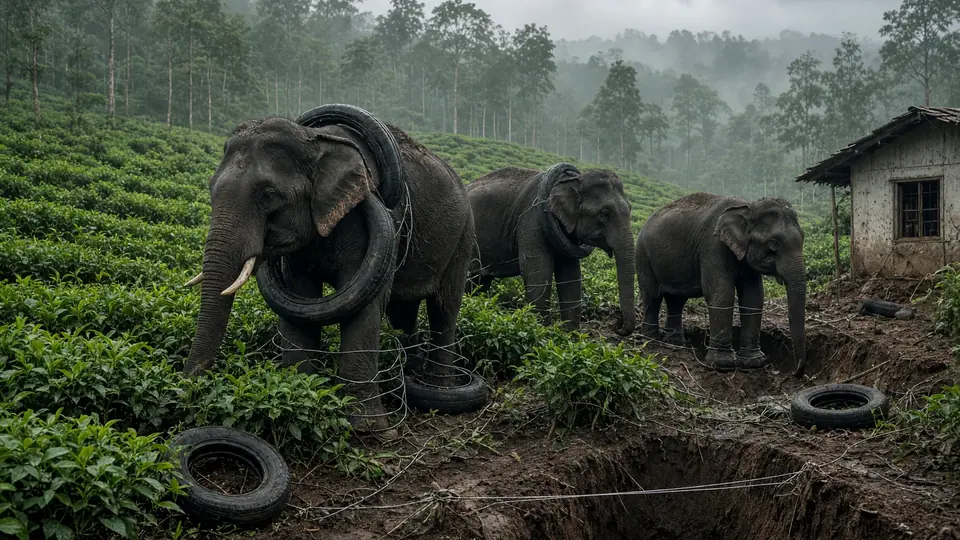
Rescue teams in Assam have pulled a sub-adult elephant free after a discarded truck tyre became wedged around its neck, the latest in a string of incidents highlighting the mounting human-driven dangers facing the state's pachyderms.
The animal was spotted struggling to dislodge the tyre while moving with its herd at Bukhial Tea Estate in Golaghat district on the morning of September 10, 2026. Officials from the Golaghat Forest Division and a specialist team from the Centre for Wildlife Rehabilitation and Conservation (CWRC) near Kaziranga responded to assess the situation and track the herd's movements.
"The rescue team carefully removed the tyre from around the distressed elephant's neck after it was chemically immobilised. The elephant later returned to its herd," said Bhaskar Choudhury, CWRC's centre head and lead veterinarian at the Wildlife Trust of India (WTI).
Wire snare and trench incidents compound threat
The tyre rescue came just days after wildlife veterinarians treated a female elephant whose trunk had been caught in a wire-mesh snare on the edges of Raimona National Park in western Assam.
On the morning of September 9, 2026, an elephant calf was discovered trapped in a muddy trench at Seconee Tea Estate near Kaziranga. The calf's herd, after attempting to guide the youngster out, eventually left the area. Deep trenches intended to keep elephants away are frequently dug around tea estates.
Tea garden workers and villagers nearby alerted Kaziranga National Park authorities, who called in a CWRC team to coordinate the rescue.
Dehydrated calf admitted for rehabilitation
The calf, estimated to be between four and six weeks old, was dehydrated and suffering from severe muscular exhaustion when rescuers lifted it from the trench and transported it to the nearest forest beat office for veterinary care. It was given fluids to aid recovery.
The team waited for the elephant herd to return in search of the calf, but the animals did not reappear. The calf was subsequently admitted to the CWRC for rehabilitation, joining ten other elephants currently under care at the centre.
"This calf's journey from isolation and distress to safety and care reflects the dedication of local communities, forest officials, and wildlife experts working together. While we always prioritise reunion with the wild herd, rehabilitation offers this calf a second chance at life," Dr Choudhury said.
The three incidents within days underscore the range of anthropogenic hazards, from snares and discarded industrial waste to man-made barriers, that elephants now routinely encounter across Assam.
Source: The Hindu
Frequently asked questions
What happened to the elephant trapped by a truck tyre in Assam?
A sub-adult elephant at Bukhial Tea Estate in Golaghat district had a discarded truck tyre wedged around its neck. Rescue teams from the Golaghat Forest Division and the Centre for Wildlife Rehabilitation and Conservation chemically immobilised the elephant, carefully removed the tyre, and the animal was able to return to its herd.
What other elephant incidents occurred in Assam around the same time?
Within days of the tyre rescue, a female elephant's trunk was caught in a wire-mesh snare near Raimona National Park, and a young elephant calf was discovered trapped in a muddy trench at Seconee Tea Estate near Kaziranga.
What was the condition of the elephant calf found in the trench?
The calf, estimated to be between four and six weeks old, was dehydrated and suffering from severe muscular exhaustion when rescued. It was given fluids for recovery and later admitted to the Centre for Wildlife Rehabilitation and Conservation for rehabilitation.
What types of hazards are elephants facing in Assam?
Elephants in Assam are encountering a range of human-driven hazards including discarded industrial waste like tyres, wire-mesh snares, and man-made barriers such as deep trenches dug around tea estates to keep elephants away.
You may also like
 Technology
Assam ASHAs’ field inputs to shape AI cervical cancer screening tool
 National
Assam Cabinet approves Rules for compulsory Muslim marriage regis
 Politics
Assam Cabinet Ministers List 2026 with Portfolios and Contact Details
 Weather
Assam floods disrupt rail services, over 30 trains affected
Most read
- 1
Tesla audits Chinese suppliers to scale up Optimus robot production
- 2
Former minister Lakhan Singh Rajput to inaugurate temple bhandara at Shri Chakreshwar Mahadev
- 3
Firozabad BSA finds four government schools locked during inspection
- 4
Tamil Nadu dengue cases fall for third consecutive year to 17,049
- 5
Social workers stage silent protest at Fufund railway station for train halts
Comments
No comments yet. Be the first to comment.