
Yibin pivots from baijiu to steel towers, shedding China's liquor legacy
Sichuan city known for Wuliangye liquor pivots toward high-tech industries, signaling China's interior cities rebranding strategy.

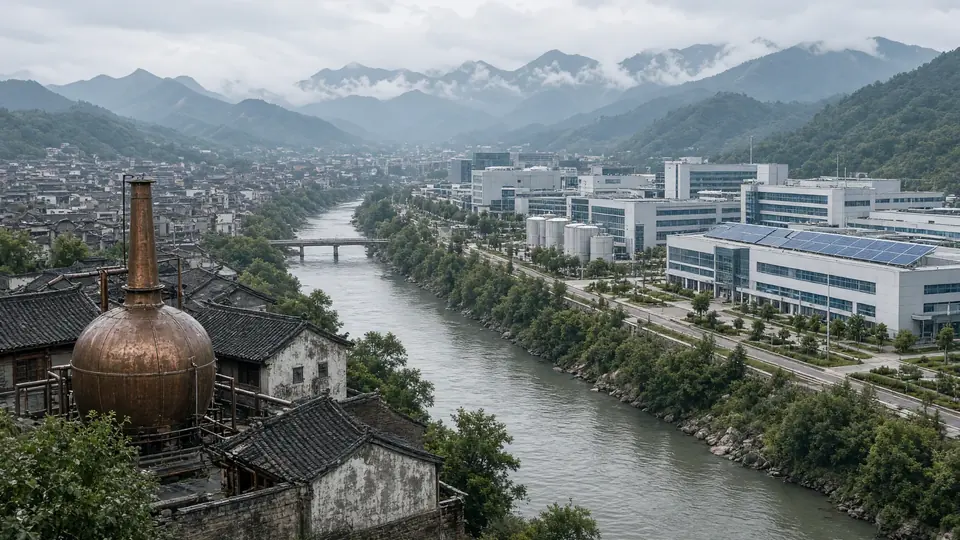
A city synonymous with China's second-largest baijiu producer is now eager to shed that identity, positioning itself instead as a manufacturing powerhouse complete with glass-and-steel towers that dwarf its old distilleries.
Yibin, the Sichuan prefecture-level city that built its reputation on Wuliangye liquor, left visiting journalists with a blunt message this month: the alcohol business is "old-fashioned," according to local cadres who organized a media tour designed to showcase everything except the spirits. Tucked in western China's hills and accessible only via a flight to provincial capital Chengdu followed by a bus transfer, Yibin has historically remained below the national radar despite housing a household-name brand.
Skyline ambitions signal shift
The clearest symbol of Yibin's pivot stands on a prime Yangtze River waterfront plot: a 288-metre, 57-storey tower that ranks among Sichuan's tallest buildings. The skyscraper is slated to open as the province's first five-star Westin hotel in 2027 after the developer secured a contract with Marriott International.
That vertical statement anchors what officials presented as a broader industrial transformation, steering the lower-tier city away from its baijiu legacy toward advanced manufacturing. Yet the tour also exposed the familiar strains of rapid urbanization: a prefecture-level municipality shouldering "many of the costs typically associated with breakneck development" as it races to rebrand itself from "sleepy backwater" to production hub.
The contrast underscores a tension playing out across China's interior provinces, where second- and third-tier cities leverage traditional industries for capital while publicly distancing themselves from those same sectors in pursuit of higher-value growth. Wuliangye remains a national name, but Yibin's government apparatus now treats the distillery as heritage rather than headline.
Source: South China Morning Post
Frequently asked questions
Why is Yibin moving away from baijiu production?
Yibin's local government considers the alcohol business "old-fashioned" and is positioning the city as a modern manufacturing powerhouse with advanced industries and higher-value growth opportunities, rather than relying on its baijiu legacy.
What is the main symbol of Yibin's industrial transformation?
A 288-metre, 57-storey glass-and-steel tower on the Yangtze River waterfront that will become Sichuan's first five-star Westin hotel, operated by Marriott International, scheduled to open in 2027.
What is Wuliangye and what role does it play in Yibin today?
Wuliangye is China's second-largest baijiu producer, located in Yibin, and was historically the city's defining industry. The government now treats it as heritage rather than a core business focus.
What economic challenge does Yibin face during its transformation?
As a prefecture-level municipality pursuing rapid urbanization and rebranding, Yibin shoulders many of the costs typically associated with breakneck development while transitioning from a "sleepy backwater" to a production hub.
You may also like
 Technology
China offers Brics nations open-source AI models and manufacturing support
 International
Chinese regulators order carmakers to prioritize safety over untested new technology features
 International
Brazil's rare earth magnet production delayed until at least 2032, China dominance persists
 International
Chinese robotics firms prioritize wheels over legs for warehouse efficiency
Most read
- 1
Tesla audits Chinese suppliers to scale up Optimus robot production
- 2
Former minister Lakhan Singh Rajput to inaugurate temple bhandara at Shri Chakreshwar Mahadev
- 3
Firozabad BSA finds four government schools locked during inspection
- 4
Tamil Nadu dengue cases fall for third consecutive year to 17,049
- 5
Social workers stage silent protest at Fufund railway station for train halts
Comments
No comments yet. Be the first to comment.