
USA and Mexico Meet in First Clash of New Coaching Era
The USA and Mexico renew their fierce CONCACAF rivalry as Mauricio Pochettino and Rafa Marquez begin new coaching eras.

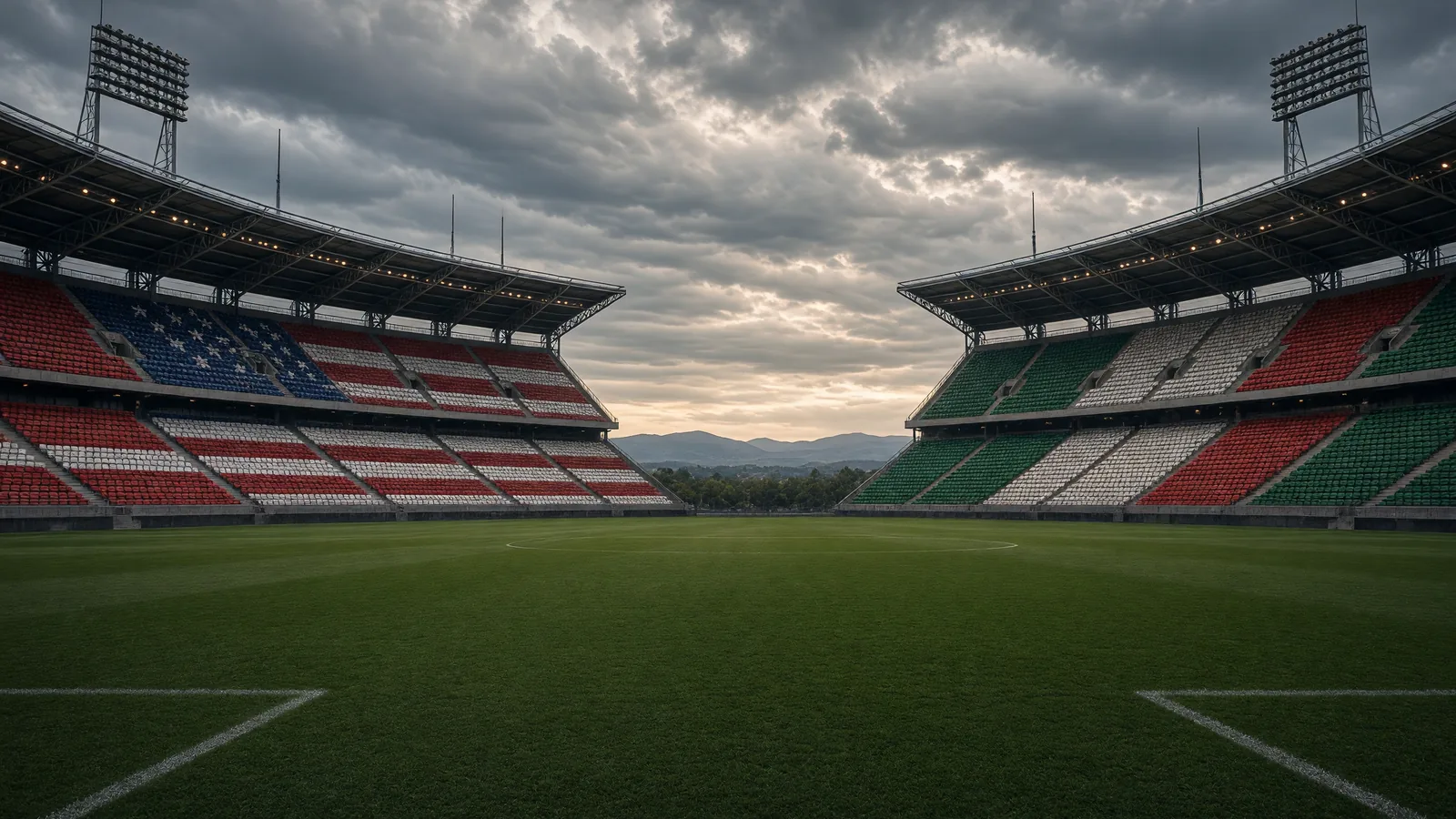
USA vs Mexico: A new era, but the rivalry is still as fierce
The United States and Mexico will meet for the first time in a new era on Saturday, with Mauricio Pochettino back in charge of the USMNT and Rafa Marquez taking over Mexico.
The changes on both benches have not softened a rivalry that remains one of CONCACAF’s most intense contests.
Nearly a year after Mexico defeated the United States in the 2025 Gold Cup final, Pochettino still carries the memory of that match with him.
“We play in our own place, our own country, and there are 70,000 Mexican people, singing ‘Cry and cry’, ‘Llorar y Llorar’ in your own country,” Pochettino said.
“I cannot accept that. It was so painful, so painful,” he added.
The USMNT is two games into its World Cup run, and the mood around the team is high, but the Gold Cup final remains a point of pain for its coach.
Now, with the first USMNT-Mexico meeting of this new phase approaching, both teams are moving through changes in leadership and personnel.
Pochettino is back with the United States, while Javier Aguirre, who led Mexico during that Gold Cup final, has been replaced by former El Tri star Rafa Marquez.
Marquez’s appointment has energised Mexico’s fanbase, adding another layer to a contest already shaped by history, emotion and repeated confrontation.
A rivalry that has not cooled
The match in Phoenix will bring together two teams that are increasingly connected away from the international game but remain fiercely opposed once the whistle goes.
The rivalry has produced trophies, intense emotion and occasional fights, with several heated collisions between the teams in recent years.
At the same time, cooperation between the two countries has become more frequent than before.
MLS and Liga MX now work together through the Leagues Cup, the Campeones Cup and the All-Star Game.
The countries are also connected through the 2026 Men’s World Cup and the upcoming 2031 Women’s World Cup.
That growing partnership has created a question around the future of the rivalry: whether the United States and Mexico are becoming CONCACAF brothers away from the field while remaining heated rivals on it.
The answer from the players and coaches is clear in one respect.
The relationship between the two football systems may be changing, but the competitive hostility has not disappeared.
“Sometimes there will be fights,” Pochettino said, “and sometimes there won’t.”
There has been no shortage of incidents between the teams throughout the rivalry.
For the players involved, meetings between the United States and Mexico are not treated like ordinary friendlies, even when a particular match is listed that way.
“It’s not friendly; it’s feisty,” the report says of the experience for players who have taken part in these games.
Controversy is common, while punches and pushes have also become familiar parts of the rivalry.
Mexico still leads the historical record
Mexico remains the more successful team in the Gold Cup, with 10 titles compared with seven for the USMNT.
Across 79 matches, Mexico has won 38 times, while the United States has won 24.
Those figures explain why Mexico was long regarded as the region’s powerhouse and why every United States victory has carried particular weight.
For some, the shift in the rivalry began with the United States’ famous “Dos a Cero” victory at the 2002 World Cup.
Others point to 2012, when the USMNT won at the Azteca for the first time.
Joe Corona understood the importance of that period from both sides of the divide.
The former USMNT midfielder had briefly represented Mexico as a youth international before switching allegiance.
He described feeling affection for both countries, as millions of Mexican-Americans do, until he put on a United States jersey.
“When I had those games against Mexico, and we beat them a few times,” Corona told GOAL, “I was playing for Xolos at the time, and when I would go back, even the Xolos fans would give it to me.”
“They would talk smack like during games, and I was their player!” he said.
Corona had been regarded as a kind of idol by those supporters after winning a championship with Xolos, but playing for the United States changed how some of them treated him.
“I was kind of an idol because I had won a championship with them,” Corona said.
“It just goes to show how the rivalry can affect you.”
The balance between the two teams has shifted more than once in recent years.
The USMNT enjoyed a period of dominance during Gregg Berhalter’s tenure.
More recently, Mexico has regained momentum and is the current holder of both the Gold Cup and the Nations League.
Mexico has also been running the show at youth level, giving younger players from both countries an early experience of the contest.
That history means the next generation is not entering an empty space.
The young players have grown up with victories, defeats, heated games and changing momentum between the two sides.
Adams takes over as USMNT captain
Just over 24 hours before the USMNT’s meeting with Mexico, Tyler Adams was named the team’s newest captain.
He replaces the recently retired Tim Ream.
Pochettino called Adams the “perfect” choice because of the leadership and experience he brings to the group.
The match will be Adams’ fifth senior appearance against Mexico.
His first came in a 2018 friendly, when he scored his first USMNT goal.
The other three matches were finals, a record that reflects how often the two countries meet when major honours are at stake.
Adams said his first encounter with Mexico was a lesson in the emotional and tactical demands of the rivalry.
“I was just running around like a madman,” Adams recalled on Friday.
“I just wanted to have an impact in any way possible, and, being 18 or 19 years old, you’re not necessarily understanding tactically how disciplined you have to be in these games or, emotionally, how controlled you need to be in these games.”
“You just go out there, have fun, and try and be yourself.”
His experience has since changed, but he said the intensity of the game has not become easier.
Adams described the feeling around the fixture as one shaped by dislike, history and the desire to gain every possible advantage.
“Dislike, hate - it’s a rivalry,” Adams said.
“It’s however you want to describe a rivalry... It’s gone on for a long time.”
“There’s a lot of history there, and history creates that rivalry, of course, but you just want that winning advantage, so you do anything you can do to win.”
The challenge for Adams now is not only to lead the team but also to help younger players understand what awaits them.
A younger US team faces its first test
The USMNT squad is loaded with teenagers, led by 17-year-old Cavan Sullivan.
Mexico also has a teenage figure emerging in Gilberto Mora, who broke out in CONCACAF before appearing largely comfortable during the World Cup.
Mora will not be 18 until October.
The match could therefore begin a longer contest between rising players who may meet repeatedly in the years ahead.
Sacha Kljestan, a former USMNT midfielder and current Apple TV analyst, said Sullivan and Mora could become the defining figures of the next phase of the rivalry.
“It could be the next 15 years of two players going up against each other,” Kljestan said, “which we haven’t had since probably Landon [Donovan] against ‘Chicharito’.”
For Sullivan, however, the match will be his first senior game against Mexico.
He has already experienced the rivalry at youth level and said it is not an enjoyable or ordinary contest.
“Every game against Mexico, you want to absolutely smash them,” Sullivan told GOAL.
“I don’t know how to explain the feeling. There are no friendlies against Mexico.”
“Every game, it’s like a brawl,” he said.
“All of us have been saying that we’re looking forward to this game. As soon as we got called up, all of us went, ‘There’s that game against Mexico’.”
“This is one where you want to die for the badge. You want to give it everything.”
Of the 18 players in the USMNT squad, 12 have faced Mexico at senior level.
Several of those players first met Mexico last summer in the Gold Cup final.
That leaves a substantial part of the group preparing for its first senior experience of a rivalry that older players describe as unusually demanding.
The new players have also been told not to retreat from the occasion.
Adams said he would rather see them commit themselves fully than allow the match to pass them by.
“The thing I’d express to these guys,” Adams said, “is that I’d rather you go into a tackle and run everywhere and get around the ball and be feisty and have a little tenacity to your game than sit back and just watch the game go by.”
“All of these players who have the opportunity to play tomorrow? That’s what we need from them.”
His advice reflects the central demand of the fixture: control the emotions without losing the edge that the match requires.
Phoenix will feel like a Mexico home game
The setting will add another challenge for the United States.
In the first two games of the window, against Peru and Chile, sections of the USMNT support were hostile.
Against Mexico, the United States will effectively be the road team.
That introduces the younger players to one of the most distinctive dynamics of American soccer: a USMNT match on home soil that can feel like an away game.
The crowd in Phoenix is expected to be split, with both sets of supporters bringing their own victory songs.
Mexico has “El Rey”, while the USMNT now has “Country Roads”.
Pochettino’s memory of Mexico supporters singing during the Gold Cup final has made the atmosphere an especially personal subject for him.
The match is being played in Phoenix, close enough to the United States-Mexico border to underline the geographical and cultural overlap around the fixture.
But the wider point is that there are few places in the United States where a match against Mexico would not become an away game for the USMNT.
Pochettino joked at his pregame press conference that he hoped the crowd would be 50-50.
He is approaching his third game against Mexico and his second on United States soil, so he is aware of how unlikely that balance may be.
The crowd will include Americans and Mexicans, but Mexican-Americans will be among the most significant groups in the stands.
Their relationship with the two teams is not always straightforward.
Corona said he understood why some supporters might back both countries because he identified with both cultures himself.
“I think it’s not easy,” Corona said.
“I step in their shoes, and I don’t blame them for maybe supporting both countries because I identified with both cultures. Maybe that’s the reason behind it.”
He also acknowledged that the history of the rivalry can make that position difficult for others to accept.
“Of course, because of the rivalry and just the history overall with Mexico and the U.S., I believe that just makes it hard to accept that there are fans out there rooting for both countries at the same time,” Corona said.
“At the end of the day, as long as they’re honest and they support, we’re here for them. We’re here for the fanbase.”
The USMNT’s task will be to deal with the noise rather than allow it to become a distraction.
For the younger players, the atmosphere may also provide an important introduction to the conditions they could face in future meetings.
A necessary lesson before qualifying
The USMNT’s younger players will need to become familiar with this environment ahead of possible games at the Azteca, the Gold Cup and the Nations League.
World Cup qualifying is also on the way.
Because of the complications of the previous cycle, which included the home World Cup, the United States and Mexico have not played as many competitive matches as usual, particularly against each other.
That pattern is about to change.
Antonee Robinson said the late confrontation during the Chile game had offered a preview of the intensity that could arrive against Mexico.
“There was a glimpse of the fire that teams can bring at the end of the Chile game,” Robinson said.
He said the players had been warning the younger members of the squad that they should expect more when they face Mexico.
“We’ve just been saying to the young boys that you’re going to expect that and a lot more when we play against Mexico,” Robinson said.
“The crowd can be a big factor. It’s probably going to be a lot more Mexican fans than we’d expect to be there.”
Robinson said the match would show how the new players respond during their first camp involving the rivalry.
“We know how much this game means to both teams, and the boys getting to experience that in their first camp is going to be interesting to see,” he said.
“I hope they all embrace it, enjoy it, and are ready to put the fight in.”
The younger players have been told what to expect, but they have also grown up watching the rivalry move back and forth.
They know what it looks like when the United States beats Mexico in important matches.
They also know what it looks like when the USMNT struggles against its regional rival.
That shared history has helped shape the next generation before many of its members have faced Mexico at senior level.
Cooperation away from the national teams
The national-team rivalry exists alongside a relationship between the two football systems that is more collaborative than ever.
The two federations have become closer, while their leagues and major events are increasingly connected.
MLS and Liga MX are partners in the Leagues Cup, the Campeones Cup and the All-Star Game.
Liga MX clubs are also spending significant time in the United States, including through friendlies and the Leagues Cup.
The league’s top stars appeared in Charlotte for the All-Star Game.
Even World Cups are described as a joint effort between the CONCACAF rivals.
That movement has changed how supporters in the United States encounter Mexican clubs.
More fans now have opportunities to watch and support their clubs in the United States, whether through friendlies or shared competitions.
Club America is one of the clearest examples of that overlap.
The club, which is celebrating its 110th anniversary, played a friendly against Cruz Azul in San Diego.
America is one of Mexico’s biggest brands and also has a significant presence in American soccer.
The club is estimated to have 44 million fans across the United States and Mexico.
The fact that the figure combines supporters from both countries is itself significant.
Corona recalled arriving in the United States with Club America and seeing thousands of people waiting at the airport in yellow shirts.
“They were diehard fans,” Corona said.
“It shows how big the club is...”
He said the support did not come only from Mexicans or Mexicans living in the United States.
“It’s also Americans,” Corona said.
“For me, that’s very impactful.”
The same crossover that helps clubs expand their audiences does not erase the national-team contest.
Corona said the growing cooperation was a sign of where football was heading in both countries.
“I think it’s definitely a sign of where the sport is going in both countries,” he said.
He also said he would not be surprised if the two countries eventually had a large league involving teams from both nations on a weekly basis.
“But for the national team? The rivalry is always going to exist,” Corona said.
The rivalry and the partnership can coexist
The United States and Mexico are more intertwined than before through their leagues, federations and major events.
The two football nations may need each other more than ever as the wider game changes.
That does not require the rivalry to become less meaningful.
Increased contact between the countries could create more opportunities for the two sides to meet at club, youth and senior international level.
Those meetings may become more common precisely because the relationship away from the national teams is becoming closer.
The partnership therefore provides more settings for competition rather than removing the competition altogether.
The distinction will be most visible when the teams meet in Phoenix.
Whatever cooperation exists between the federations and leagues will not decide the contest once the match begins.
“There are no friends when the whistle blows,” the report says.
The two teams may be entering a new era with new coaches, a new captain and a group of emerging stars, but the rivalry itself remains intact.
As Dest put it, the match will feel like “a little war on the field”.
“These are the toughest games, and you will feel it,” Dest said.
Whether there are fights or not, the history, the crowd and the stakes will ensure that the United States-Mexico rivalry does not lose its edge.
Frequently asked questions
When will the United States and Mexico meet in the new coaching era?
They will meet on Saturday in Phoenix.
Who are the coaches leading the United States and Mexico?
Mauricio Pochettino is back in charge of the United States, while Rafa Marquez has taken over Mexico.
Why does the Gold Cup final remain painful for Pochettino?
Mexico defeated the United States in the 2025 Gold Cup final, and Pochettino said the loss was deeply painful.
Has the rivalry between the United States and Mexico cooled?
No. Despite growing cooperation between the countries, their competitive hostility remains intense.
You may also like
 National
Inter Miami seeks dominant win over struggling Atlanta United with Messi in prime form
 National
Messi scores four as Inter Miami demolish Montreal 7-1 in dominant display
 Sports
Gonzalez and Koopmeiners strike off the bench as Juventus beat Parma
 Sports
MLS fines Lionel Messi for slapping opponent during Inter Miami match
Most read
- 1
Air China Adds Extra Flight for Passengers Stranded in Fuel-Starved Cuba
- 2
Western disturbance to bring rain, hail and strong winds across north India
- 3
Yogi Adityanath Directs No Occupied Houses Be Demolished for Achhalda Bridge
- 4
Gwalior Temple Truck Crash Kills 12, Injures 28-29 Devotees During Navratri
- 5
Heavy Rain Waterlogs Bengaluru, Snarls Traffic; Ride-Hailing Fares Surge
Comments
No comments yet. Be the first to comment.