
Trump Endorsement Puts IMEC Back In Focus As Analysts Urge Expansion
Trump's support revives focus on IMEC, but analysts warn the India-Europe corridor needs expansion to avoid Gulf chokepoints and conflict risks.

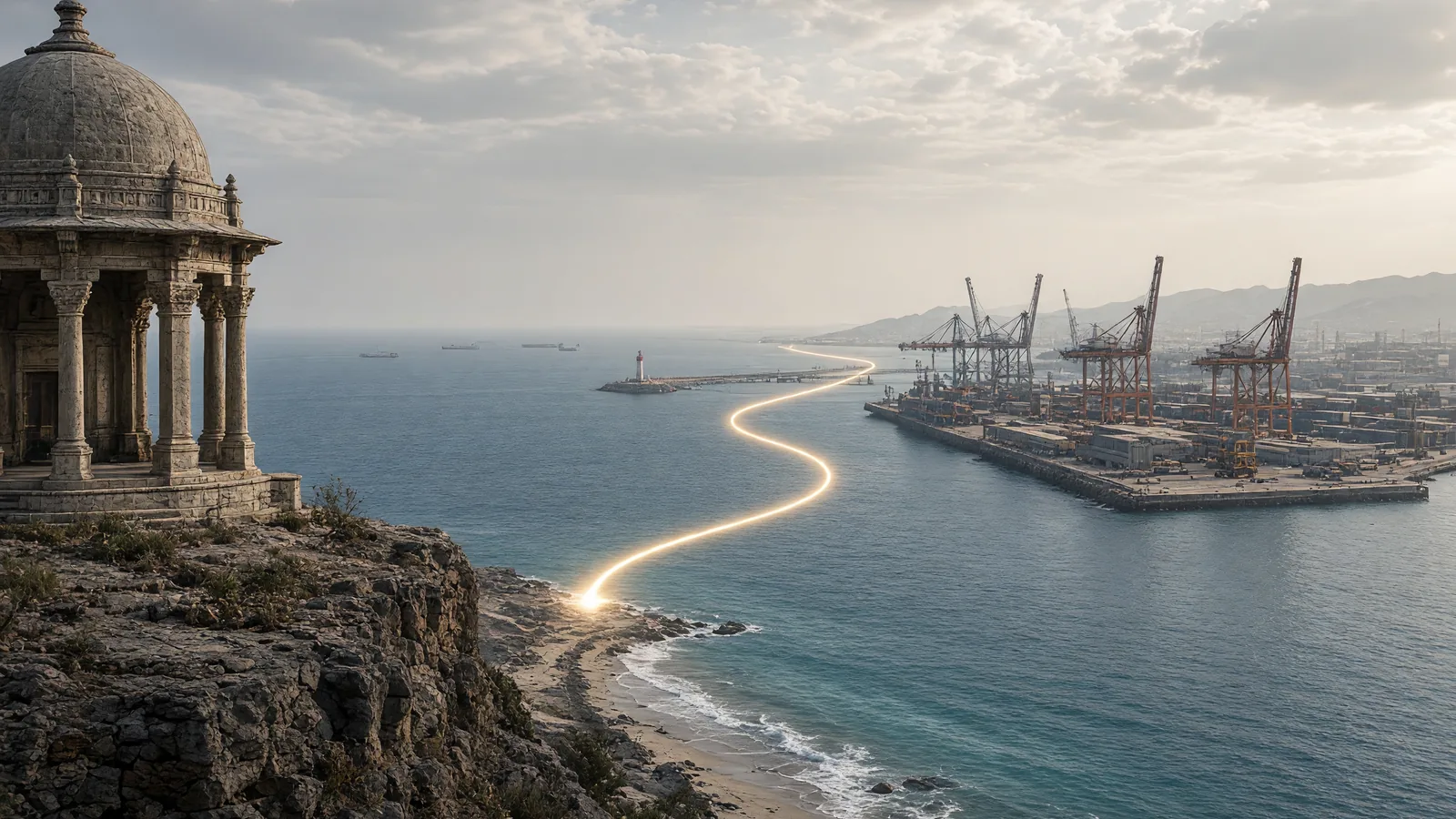
US President Donald Trump’s recent endorsement of a trade corridor connecting India to Europe through the Middle East has put the India-Middle East-Europe Economic Corridor, or IMEC, back in focus. The project, first unveiled at the G20 summit in 2023, was presented as an alternative to existing trade routes and to China’s Belt and Road Initiative. But analysts warn that the corridor, still largely a work in progress, will have to expand and avoid vulnerable Gulf chokepoints if it is ever to become operational and survive ongoing geopolitical conflicts.
IMEC is backed by India, the United States, Saudi Arabia, the United Arab Emirates, Israel and the European Union. Its proposed design brings together shipping lanes, railways, energy pipelines and data cables into a single corridor linking India with Europe through the Middle East. The plan is ambitious because it does not rely on just one mode of transport. Instead, it combines sea routes, land links, energy infrastructure and digital connectivity into one broader economic route.
The corridor was first announced at the G20 summit in 2023. At the time, it was pitched as a rival to China’s Belt and Road Initiative, which has shaped major infrastructure and connectivity projects across several regions. IMEC was also presented as an alternative to existing routes, offering another way to move trade between India and Europe via the Middle East.
Trump’s endorsement has renewed attention on the three-year-old project. His backing has brought IMEC back into the wider debate on trade connectivity, strategic routes and the future of transport links between Asia, the Middle East and Europe. However, analysts say the corridor’s political support does not automatically make it operational. Several parts of the proposed route still need to be built, connected or strengthened.
According to analysts, one of the biggest challenges is the corridor’s exposure to vulnerable Gulf chokepoints. These are points along trade routes where disruption can create wider problems for movement of goods and energy. Analysts say IMEC must bypass such vulnerable Gulf chokepoints if it is ever to become operational. This concern has become more important because the project is being discussed against the background of ongoing geopolitical conflicts.
The corridor’s backers include some of the most important economies and political actors linked to the proposed route: India, the United States, Saudi Arabia, the United Arab Emirates, Israel and the European Union. Their support gives the project diplomatic weight. But the corridor remains unfinished in practical terms. The source material makes clear that while some existing infrastructure can handle parts of the proposed route, key rail links, ports and other connections are still being developed.
That gap between the vision and the ground reality is central to the debate around IMEC. On paper, the corridor brings together shipping lanes, railways, energy pipelines and data cables. In practice, the project is still largely under development. Some sections can use infrastructure that already exists, but other parts depend on new or upgraded links that are not yet complete.
Analysts therefore argue that the project must expand if it is to withstand ongoing geopolitical conflicts. Expansion, in this context, is being seen as necessary not just for scale, but also for resilience. If the corridor depends too heavily on vulnerable points, especially in the Gulf, disruptions could affect its ability to function as a reliable trade route between India and Europe.
The renewed focus after Trump’s endorsement has also revived the larger question raised around the project: can IMEC survive war and geopolitical instability? The answer, according to analysts cited in the source material, depends on whether the corridor can be made broad and resilient enough to avoid the most vulnerable chokepoints and whether the missing infrastructure can be completed.
For now, IMEC remains a high-profile but unfinished project. It has political backing from India, the United States, Saudi Arabia, the United Arab Emirates, Israel and the European Union. It has a clear strategic pitch as an alternative to existing routes and to China’s Belt and Road Initiative. It also has a proposed structure that combines shipping lanes, railways, energy pipelines and data cables.
But the practical test is still ahead. Key rail links, ports and other connections are still being developed. Some infrastructure is already available for parts of the route, but not enough to make the full corridor operational. Trump’s endorsement has brought attention back to IMEC, but analysts say the project’s future will depend on whether it can expand, bypass vulnerable Gulf chokepoints and withstand ongoing geopolitical conflicts.
Frequently asked questions
What is the India-Middle East-Europe Economic Corridor?
The India-Middle East-Europe Economic Corridor, or IMEC, is a proposed trade route linking India with Europe through the Middle East using shipping lanes, railways, energy pipelines and data cables.
Who backs IMEC?
IMEC is backed by India, the United States, Saudi Arabia, the United Arab Emirates, Israel and the European Union.
Why is IMEC back in focus?
IMEC is back in focus after US President Donald Trump recently endorsed the proposed trade corridor connecting India to Europe through the Middle East.
What challenges do analysts say IMEC faces?
Analysts say IMEC remains largely unfinished and must expand, strengthen key links and avoid vulnerable Gulf chokepoints to become operational and withstand geopolitical conflicts.
When was IMEC first announced?
IMEC was first announced at the G20 summit in 2023, where it was presented as an alternative to existing routes and to China’s Belt and Road Initiative.
You may also like
 Opinion
Big Indian AI SuperChip Dream: Bharatiya Chips Powering the Electronic Revolution
 Politics
BJP MP Gulam Ali Khatana alleges Pakistan orchestrated OIC’s anti-India resolutions
 National
Singareni revises pay scales for 1,800 officers, aligning them with Coal India
 Sports
Nandani Sharma Climbs 26 Places to 45th in ICC T20I Rankings
Most read
- 1
Air China Adds Extra Flight for Passengers Stranded in Fuel-Starved Cuba
- 2
Western disturbance to bring rain, hail and strong winds across north India
- 3
Yogi Adityanath Directs No Occupied Houses Be Demolished for Achhalda Bridge
- 4
Gwalior Temple Truck Crash Kills 12, Injures 28-29 Devotees During Navratri
- 5
Schools Shut in Five Tamil Nadu Districts, Including Chennai, Amid Heavy Rain
Comments
No comments yet. Be the first to comment.