
Telangana Urban Areas Record 6.85-Metre Groundwater Drop In One Year
Groundwater levels fell 6.85 metres across 46 Telangana urban mandals, prompting calls for tap aerators and treated water to recharge lakes.

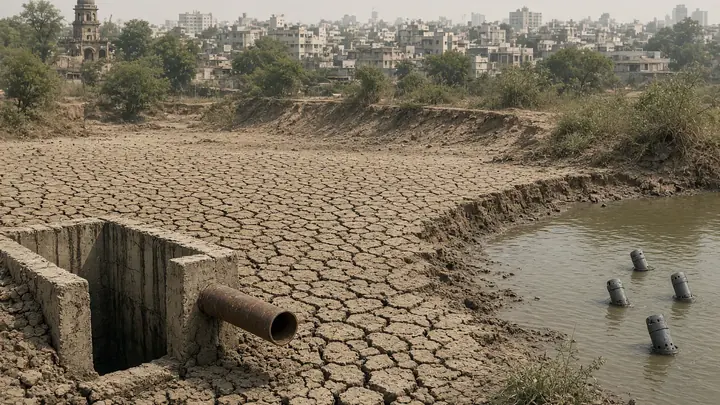
Groundwater levels in Telangana’s urban areas dip by 6.85 metres; experts suggest aerators to taps, treated water to lakes
A September report of the Ground Water Department has recorded a sharp change in the average depth to groundwater across 46 mandals in and around Hyderabad. The average depth increased from 4.73 metres below ground level (bgl) in September 2025 to 11.58 m bgl in the corresponding month this year.
The difference represents a fall of 6.85 metres in groundwater levels over one year. The decline has raised concern as groundwater availability is being closely watched because of the impact of El Nino and the potential shortage of the natural resource.
Deepest levels recorded in Kukatpally and Hayatnagar
The 46 mandals are spread across Hyderabad, Rangareddy, Medchal Malkajgiri and Sangareddy districts. The lowest level, recorded at 20.67 mgl, was reported in Kukatpally in Medchal. The source said this meant that one has to dig too deep to find water.
The next lowest figure was 19.46 m bgl in Hayatnagar in Rangareddy. Shankarpalle in Rangareddy recorded 19.25 m bgl, while Medipalle in Medchal recorded 18.23 m bgl.
Malkajgirii in Medchal recorded 17.11 m bgl. These figures were included in the Ground Water Department’s September report covering the mandals under the Greater Hyderabad Municipal Corporation, Cyberabad Municipal Corporation and Malkajgiri Municipal Corporation.
The report also showed considerable variation across the urban mandals. The best groundwater levels were recorded at 1.87 m bgl in Shaikpet, 2.90 m bgl in Himayatnagar and 3 m bgl in Ameenpur.
Why the decline matters
Environmentalist and water policy expert Donthi Narasimha Reddy said a fall in groundwater levels means people will have to dig deeper borewells. He said this could further deplete groundwater levels.
Reddy said recharging dried-up and existing waterbodies, including lakes and ponds, is crucial for replenishing groundwater levels. The recommendation places the condition of urban waterbodies at the centre of efforts to respond to the decline.
The concern is not limited to the depth at which water is found. If deeper borewells become necessary, the pressure on groundwater can increase further, according to Reddy’s explanation of the situation.
Treated water for lakes and other uses
Water conservation expert Vishwanath Srikanth said treated wastewater from Sewerage Treatment Plants should be used to fill lakes and other waterbodies. The proposal would use treated water for replenishment instead of relying only on groundwater.
Srikanth also said households can conserve water every day by using aerators. These devices mix air into the water flow and can save up to 40% water.
He advised people to water plants early in the morning or late in the evening, when there is less evaporation. The suggestion is aimed at reducing water loss during plant watering.
Srikanth also said washing machines should be used once every two to three days with a full load rather than every day. He advised people to choose eco-friendly soaps and detergents in kitchens and bathrooms.
The water that goes waste from these activities is easier to treat and can be used to water plants, he said.
Rainwater harvesting pits need maintenance
Kalpana Ramesh, founder of The Rainwater Project, said there is a focus on rainwater harvesting pits, but the structures are not maintained properly. As a result, she said, the pits become inefficient.
Ramesh said a survey conducted in Kondapur showed that 85% of rainwater harvesting pits did not work, primarily because of a lack of maintenance. Silt removal was among the maintenance requirements she identified.
She also said alternatives are available to do away with the maintenance requirement. However, the source does not provide details of those alternatives.
Ramesh cautioned that pits dug over rock may allow water to percolate into shallow aquifers but not into deeper aquifers. Water drawn through borewells comes from those deeper aquifers, she said.
Officials prepare contingency plans
Senior officials have been taking stock of groundwater levels in the State, including in urban districts. Contingency plans have been charted to avoid a water shortage.
Special Chief Secretary Vikas Raj mentioned at a recent meeting with Chief Secretary Sanjay Jaju that groundwater levels in Rangareddy were declining rapidly. He said plans were being implemented to avoid a water shortage.
Special Chief Secretary Jayesh Ranjan said permission for new borewells for construction and other activities should not be granted. Permissions are being granted only to deepen existing borewells for drinking water purposes.
The Hyderabad Metropolitan Water Supply and Sewerage Board recently announced a dial-a-green tanker service. It will supply treated water from Sewerage Treatment Plants for construction sites, industries, landscaping and other purposes that do not require potable water.
Source: The Hindu
Frequently asked questions
How much did groundwater levels fall in Telangana’s urban areas?
Average groundwater depth increased from 4.73 metres below ground level in September 2025 to 11.58 metres the following year, representing a 6.85-metre fall in groundwater levels.
Which urban mandal recorded the deepest groundwater level?
Kukatpally recorded the deepest level at 20.67 metres below ground level, followed by Hayatnagar at 19.46 metres.
What measures have experts suggested to replenish groundwater?
Experts recommended recharging lakes and ponds and using treated wastewater from Sewerage Treatment Plants to fill waterbodies.
How can households conserve water?
Households can use aerators, which may save up to 40% of water, and water plants early in the morning or late in the evening to reduce evaporation.
You may also like
 National
Telangana liquor sales cross ₹2,000 crore as beer volumes jump 41%
 National
Tirupati NCC Cadet K. Thirumal Wins Gold at Telangana Equestrian Championship
 National
Telangana to Host Gunturu Seshendra Sharma Birth Centenary Celebrations in Hyderabad
 Education
Revanth Reddy Sets November 15 Deadline for Global Summit Venue Works
Most read
- 1
Air China Adds Extra Flight for Passengers Stranded in Fuel-Starved Cuba
- 2
Western disturbance to bring rain, hail and strong winds across north India
- 3
Yogi Adityanath Directs No Occupied Houses Be Demolished for Achhalda Bridge
- 4
Gwalior Temple Truck Crash Kills 12, Injures 28-29 Devotees During Navratri
- 5
Heavy Rain Waterlogs Bengaluru, Snarls Traffic; Ride-Hailing Fares Surge
Comments
No comments yet. Be the first to comment.