
Pattanam Proposes Heritage Authority, Global Research Centre After Decade-Long Disruption
After a decade of disruption, Pattanam proposes a heritage authority and global research centre to renew archaeological work at the ancient port site.

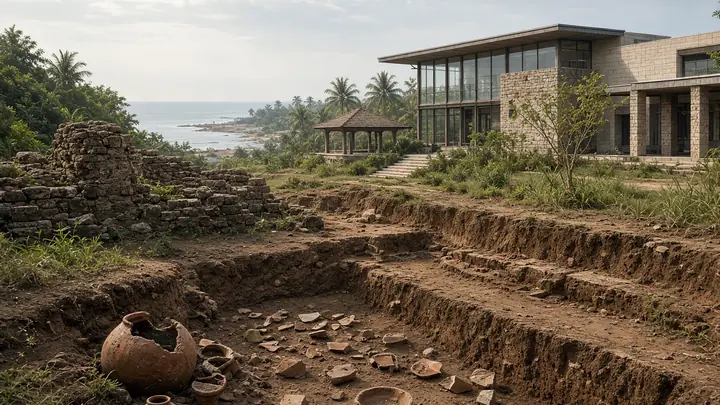
After a decade of disruption, Pattanam needs a renewed vision
The proposed next phase for Pattanam goes beyond restarting excavation: it envisages an autonomous Pattanam Heritage Authority and, eventually, a multidisciplinary global research and learning centre rooted in the village.
That vision follows a decade in which excavation, research and several related initiatives were disrupted, leaving a gap in the continuous development of Pattanam between 2016 and 2026. The immediate question is how research and allied activities can be resumed without reducing Pattanam to another excavation office or a conventional museum.
A village above a wider world
Pattanam lies near North Paravur in Ernakulam district, Keralam, on the Periyar delta in southwestern India. Houses, shops, tarred roads, pathways, a government primary school, a couple of hospitals, coconut groves and waterbodies now occupy much of this coastal landscape.
Beneath this apparently ordinary village is an archaeological record linking the eastern and western Indian Ocean worlds, extending from the Atlantic shores of western Europe to the South China Sea opening to the Pacific. The archaeological evidence broadly dates to between 300 BCE and 300 CE, with particularly substantial evidence from 100 BCE to 300 CE.
The site has produced structures, pottery, beads, metals, coins, biological and geological remains, industrial and workshop contexts, and a harbour complex containing a wooden canoe dated between 100 BCE and 100 CE. Materials from South Asia, West Asia, the Red Sea, Africa and the Mediterranean have been found alongside evidence of the movement of people, goods, technologies and ideas across considerable distances.
The evidence suggests that Pattanam formed part of the maritime world conventionally associated with Muziris, or Muciri Pattinam. Whether the entire ancient port can be identified with present-day Pattanam remains an open archaeological question. That unresolved question is one reason the excavation and scientific investigation of Pattanam must resume.
What the excavations revealed
Excavations and explorations began in 2006-07 and gradually transformed what had initially appeared to be an ordinary archaeological mound into an international multidisciplinary research laboratory. Between 2006 and 2023, 67 trenches were excavated, yielding around 1.3 lakh registered artefacts and nearly 45 lakh pottery fragments.
Those figures represent only part of the site’s archaeological potential. Less than 1% of the archaeological mound, which extends over more than 100 acres, has been excavated. The scale of the unexcavated area means that the existing record cannot be treated as a complete account of the settlement.
The importance of the discoveries lies not only in their quantity. Structures, urban features such as toilet facilities and water-drawing wells, industrial remains, artefacts and environmental evidence together point to a highly connected settlement.
Pattanam therefore emerged as more than an isolated site in Keralam or a centre of Keralam-Roman trade. The evidence instead places it as a node in a much wider network spanning the ancient world.
The Periyar and the river systems between the Western Ghats and the Arabian Sea were central to that network. Recent studies have identified nearly 51,800 rainforest islands, together with the human geographical landscapes represented by the Kurinji, Mullai, Marutham, Paalai and Neithal thinai traditions.
Pattanam occupied an ancient river-mouth landscape connected to the Western Ghats, their forests and resources. Through the Periyar, the Palakkad Gap and the Vaigai basin, the western coast was linked to the eastern seaboard and, beyond it, to the Bay of Bengal, the Andaman Sea and the South China Sea.
Archaeological parallels link Pattanam with sites extending from Corbridge in England in the west to Hepu in southern China in the east. They also connect it from Tissamaharama in Sri Lanka in the south to Kopia, near the India-Nepal border, in the north, close to the Lumbini-Kapilavastu region.
This geographical range changes the question that Pattanam poses. The site is not presented merely as evidence of a bilateral exchange between Keralam and Rome, but as part of connected movements across regions, ecological zones and cultural worlds.
A laboratory built across disciplines
The first decade of research brought together an unusually broad group of institutions and specialists. Universities and research institutions including Oxford, Georgia, Rome, Durham, UCL, the Palace Museum in Beijing and the British Museum in London participated in different aspects of the work, along with several others in Europe, North America, Asia and India.
Researchers, scientists and students worked with the local community and with specialists in archaeology, art, architecture, history, anthropology, geology, genetics, physics, petrography, environmental science, linguistics, epigraphy, literature, conservation, museum studies, photography and other fields. Pattanam consequently became a place where scholars from different parts of the world could investigate a shared human past.
The research model was intended to extend beyond excavation and publication. International research scholarships were conceived, and an interdisciplinary residential Diploma programme was launched at Pattanam in 2015.
Plans were also developed for multipurpose scientific laboratories, advanced libraries, archaeological and heritage interpretation, a Children’s Museum, household museums and other forms of public engagement. There were attempts to connect archaeology with the life of the contemporary village rather than treat heritage as something imposed upon Pattanam from outside.
That approach placed the local community, its landscape, ecology and everyday life inside the story of the site. The proposed initiatives included Green Archaeology, entrepreneurial ventures, responsible tourism, environmental awareness, local participation and heritage-sensitive development.
The larger objective was to develop Pattanam as a model site where archaeology, science, education, environment, professional opportunities and the people of Pattanam could exist in a living relationship. In that model, the archaeological record and the contemporary village were not separate subjects, but connected parts of the same heritage landscape.
The interruption after 2016
After a decade of excavation and research, the programme was disrupted in 2016. Several initiatives were stopped, interrupted or left unrealised. The international residential Diploma did not continue, while the Children’s Museum and scholarship programme were discontinued.
Plans for an $8 million multipurpose archaeo-science laboratory associated with the Palace Museum in Beijing did not materialise. The proposed in-situ museum around the ancient harbour complex, including the six-metre wooden canoe, also remained unfinished.
The Muziris Museum remained unfinished as well. A programme to purchase archaeologically significant plots from local landowners had resulted in the purchase of more than eight acres, but that programme did not continue.
Other plans for an archaeological park, advanced library, academic campus, interpretation centres and community-oriented facilities likewise remained incomplete or were not pursued further. The result was an unfortunate gap in the continuous development of Pattanam research between 2016 and 2026.
The interruption matters because the original programme was designed as a connected ecosystem rather than as a series of unrelated projects. Laboratories, scholarships, museums, interpretation centres, community facilities, land purchases and academic programmes were intended to support research while keeping the village and its environment involved.
Keeping the research alive
The establishment of the PAMA Institute for the Advancement of Transdisciplinary Archaeological Sciences in 2018 was an attempt to keep the intellectual and scientific enquiry alive. PAMA, whose name refers to paternal and maternal ancestry, grew out of a broader intellectual vision shaped by scholars such as Romila Thapar, K.N. Panikkar and R.V.G. Menon, as well as the international network of scholars involved in Pattanam research.
Its purpose was to maintain a space where archaeology could converse with history, anthropology, genetics, geology, environmental studies, conservation and other disciplines. It was also intended to allow evidence to be questioned and explored through field research and internships.
PAMA subsequently obtained excavation permissions from the Archaeological Survey of India for 2019-20 and 2021-22. Using self-generated resources, it excavated six further trenches, numbered 62 to 67, at Pattanam between 2020 and 2023.
It also undertook nearly a dozen trial trenches at Mathilakam in 2019 and conducted explorations in Idukki district in 2022. The work at Pattanam produced further discoveries, including a head statue identified as the Roman Emperor Domitian.
Another discovery was a ring-stone resembling the Greek sphinx, identified by specialists as closely related to early Roman imperial ring-stone traditions. PAMA helped keep the wider research network alive until 2023.
These efforts did not remove the larger institutional gap, but they preserved a line of investigation during the period in which several planned initiatives remained incomplete. They also demonstrated that field research and interdisciplinary enquiry could continue through an institutional framework built around transdisciplinary archaeological sciences.
From excavation site to living institution
Pattanam sits within an archaeological landscape that brings together evidence of people speaking, trading and living across nearly forty linguistic and cultural worlds between approximately 300 BCE and 300 CE. The scale and diversity of that record raise a question about the form that future development should take.
The proposed response is not limited to another excavation office or a conventional museum. One possibility is a “Viswa Bharathi of the 21st century”: a living centre where archaeology, history, anthropology, genetics, geology, environmental science, conservation, technology, literature, languages and the arts intersect.
The idea is not to transplant a conventional university onto an archaeological site. It is to build a global research and learning community that grows organically from the landscape and works in partnership with its people.
Such an institution could bring researchers and students from India and abroad into sustained engagement with Pattanam’s archaeological record and its living environment. The ancient harbour, canoe, workshops, pottery, metals and biological remains would not function merely as exhibits.
They could instead serve as starting points for exploring human mobility, technology, ecology, trade, language and social life. The village and the Periyar’s changing landscape would also be integral to the process, offering opportunities to study how communities and environments have evolved.
An autonomous Pattanam Heritage Authority could provide an appropriate institutional framework for that work. Its distant ambition would be larger still: a 21st-century Viswa Bharathi at Pattanam/Muziris, functioning as a global centre of multidisciplinary research and learning rooted in a Keralam village and in the human connections preserved beneath it.
The proposal therefore links the unfinished practical agenda with a wider institutional question. Resuming excavation would address only one part of Pattanam’s future; the larger task would be to reconnect research, education, conservation, public engagement, environment and local participation.
The archaeological record belongs to the people who lived at Pattanam 2,000 years ago, to those who live there today, and to generations yet to come. Any renewed vision for the site would have to hold those three claims together: the evidence beneath the village, the life of the village above it, and the future of the landscape that connects them.
Source: The Hindu
Frequently asked questions
What is being proposed for Pattanam's next phase?
An autonomous Pattanam Heritage Authority and eventually a multidisciplinary global research and learning centre rooted in the village.
Where is Pattanam located?
Pattanam lies near North Paravur in Ernakulam district, Keralam, on the Periyar delta in southwestern India.
What period does Pattanam's archaeological evidence broadly date to?
The evidence broadly dates from 300 BCE to 300 CE, with particularly substantial evidence from 100 BCE to 300 CE.
How much of Pattanam has been excavated?
Between 2006 and 2023, 67 trenches were excavated, but less than 1% of the archaeological mound, which extends over more than 100 acres, has been excavated.
You may also like
 National
Kasaragod Archaeological Survey 2026 Launched to Document District’s Heritage
 National
Lakkundi's hidden temples and wells revealed through six-month LiDAR survey
 Crime
400-Year-Old Cannon Stolen from Madhya Pradesh's Narwar Fort
 National
India's Para Asian Games Blazers Feature 5,000-Year-Old Indus Valley Motifs
Most read
- 1
Air China Adds Extra Flight for Passengers Stranded in Fuel-Starved Cuba
- 2
Western disturbance to bring rain, hail and strong winds across north India
- 3
Yogi Adityanath Directs No Occupied Houses Be Demolished for Achhalda Bridge
- 4
Gwalior Temple Truck Crash Kills 12, Injures 28-29 Devotees During Navratri
- 5
Schools Shut in Five Tamil Nadu Districts, Including Chennai, Amid Heavy Rain
Comments
No comments yet. Be the first to comment.