
Paranur Becomes Tamil Nadu’s First Booth-Less Toll Plaza
Tamil Nadu's Paranur toll plaza has introduced booth-less multi-lane free flow tolling using FASTag, RFID, ANPR, radar and LiDAR.

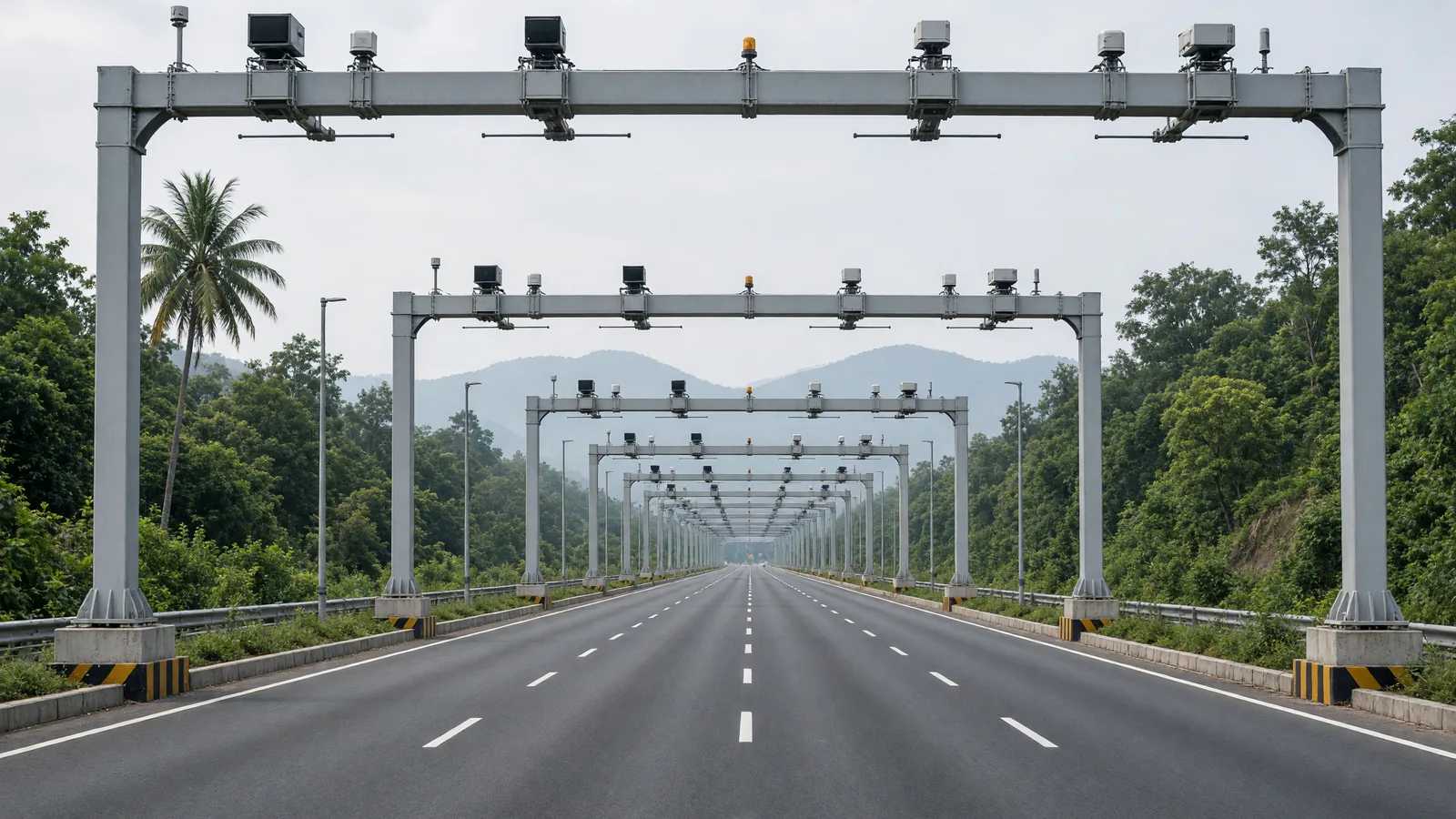
The Paranur toll plaza on the Chennai-Tiruchi National Highway became Tamil Nadu’s first booth-less facility to collect toll fee through the multi-lane free flow (MLFF) system on September 30, 2026. The system uses electronic detection and payment technologies to allow vehicles to pass through the tolling point without stopping at a booth or barrier.
What changes under MLFF
MLFF is an advanced contactless and barrierless tolling system designed to remove the need for vehicles to stop at toll plazas. It is based on FASTag, radio-frequency identification (RFID) technology and automatic number plate recognition (ANPR) technology for electronic toll collection.
The primary reason for shifting to MLFF is to maintain uninterrupted traffic flow. Since vehicles no longer need to stop or slow down at toll plazas, the system is intended to enable smoother movement and reduce congestion around tolling points.
The change also reduces reliance on physical toll booth infrastructure and manpower, which can lower operating costs. The system is therefore expected to combine traffic-flow improvements with operational efficiency and cost savings.
There is also an environmental benefit linked to the reduction in stoppages. Smoother traffic flow reduces vehicular idling, which cuts emissions and contributes to cleaner air near tolling points.
How the toll is detected and collected
Conventional fee plazas depend on physical booths, gates and lane infrastructure. Under MLFF, high-performance RFID readers detect the FASTag affixed to vehicles as they pass at high speeds.
At the same time, ANPR cameras capture the vehicle’s licence plate data. Radar and LiDAR systems also detect and classify vehicles accurately as they move through the MLFF facility.
The equipment creates a toll transaction by reading both the FASTag and the vehicle number plate. The applicable fee is then deducted from the FASTag.
The system also captures evidence of vehicles in cases where payment fails. It is designed to operate across all weather and lighting conditions and around the clock.
This makes MLFF different from a system that depends on a vehicle reaching a booth, stopping for a transaction and then moving through a gate. The stated objective is to provide a fast, transparent and high-integrity revenue process while replacing traditional toll collection systems that cause delays and frustration.
What vehicle users must do
A road user must maintain an active FASTag with sufficient balance while using an MLFF toll plaza. The vehicle must also have clearly visible HSRP licence plates.
Vehicles without FASTags or with insufficient balance will be issued challans. If a vehicle fails to pay the applicable user fee while crossing an MLFF plaza, an electronic notice, or e-notice, will be issued to recover the unpaid fee.
The e-notice process is governed by Rule 14 of the National Highway Fee Determination of Rates and Collection Rules 2008. The notice will be sent by SMS to the registered mobile number of the vehicle owner listed in the Vaahan database.
It will also be sent to the mobile number linked to the vehicle’s FASTag, according to the issuer bank’s records. The e-notice amount will be twice the applicable user fee.
However, a 50% discount will apply if the payment is made within 72 hours of the e-notice being issued. After 72 hours, the road user will have to pay the full e-notice amount.
What happens if the notice is not cleared
If the road user takes no action within the stipulated period, related Vaahan services will be restricted under CMVR 1989. These services include NOC, Transfer of Ownership, National Permit and Fitness Certification.
The FASTag will also remain suspended until all e-notices are cleared. During the suspension, it will be non-functional at all toll plazas, including State fee plazas and parking facilities across India.
The consequences mean that an unpaid MLFF transaction can affect more than a single toll crossing. The notice, payment and suspension process links the toll transaction with vehicle-related services and the wider use of the FASTag.
How users can challenge an e-notice
An aggrieved road user can raise a grievance through the NIC portal within 72 hours of the e-notice being issued. The grievance must be submitted along with supporting evidence.
After submission, the grievance is forwarded to the fee plaza or bank for review and necessary action. The fee plaza will have five days to examine the grievance and either accept or reject it.
If the fee plaza takes no action within the stipulated period, its claim to the unpaid user fee will cease. The grievance will then be automatically deemed accepted in favour of the road user.
If the grievance is accepted, the e-notice will be revoked. If it is rejected, the road user will have to pay the e-notice amount.
Safety checks at the MLFF facility
The National Highways Authority of India’s Project Implementation Unit will ensure proper illumination at the MLFF equipment location. The lighting is intended to improve the efficiency of the equipment and the toll revenue associated with it.
Other road-safety aspects will also be examined, including the closure of medians, illumination at the existing toll plaza, road markings and signages. These checks are significant because MLFF tolling involves vehicles moving at high speed near the MLFF toll plazas, as they do on other sections of the highway.
NHAI will ensure that the MLFF toll plaza and gantry locations are thoroughly audited by the road-safety auditor of the Project Implementation Unit. The Paranur facility thus combines booth-less toll collection with FASTag-based payment, vehicle identification, e-notice provisions and specified road-safety audits.
Source: The Hindu
Frequently asked questions
What is MLFF toll collection at Paranur?
It is a booth-less, barrierless tolling system that allows vehicles to pass without stopping at a toll booth or barrier.
How does the MLFF system detect and collect tolls?
RFID readers detect the vehicle’s FASTag, while ANPR cameras capture its licence plate. Radar and LiDAR systems also detect and classify vehicles, after which the applicable fee is deducted from the FASTag.
What must vehicle users have to use the Paranur MLFF toll plaza?
They must have an active FASTag with sufficient balance and clearly visible HSRP licence plates.
What happens if a vehicle has no FASTag or insufficient balance?
The vehicle will be issued a challan, and an electronic notice may be issued to recover any unpaid user fee.
You may also like
 Tamil Nadu
 CM Vijay Gives ₹5.96 Crore Aid To Families Of Police Personnel
 Tamil Nadu
 keeps special officers in charge of rural bodies till April 2027
 Politics
Tamil Nadu guest lecturers await government order for ₹5,000 honorarium hike
 Weather
Assessment flags cyclonic wind, flood risks to telecom towers in Assam, Tamil Nadu
Most read
- 1
Air China Adds Extra Flight for Passengers Stranded in Fuel-Starved Cuba
- 2
Western disturbance to bring rain, hail and strong winds across north India
- 3
Yogi Adityanath Directs No Occupied Houses Be Demolished for Achhalda Bridge
- 4
Gwalior Temple Truck Crash Kills 12, Injures 28-29 Devotees During Navratri
- 5
Schools Shut in Five Tamil Nadu Districts, Including Chennai, Amid Heavy Rain
Comments
No comments yet. Be the first to comment.