
Assessment flags cyclonic wind, flood risks to telecom towers in Assam, Tamil Nadu
A resilience assessment finds cyclonic winds and flooding threaten telecom towers in Assam and Tamil Nadu, with storm-surge risks also noted in Tamil Nadu.

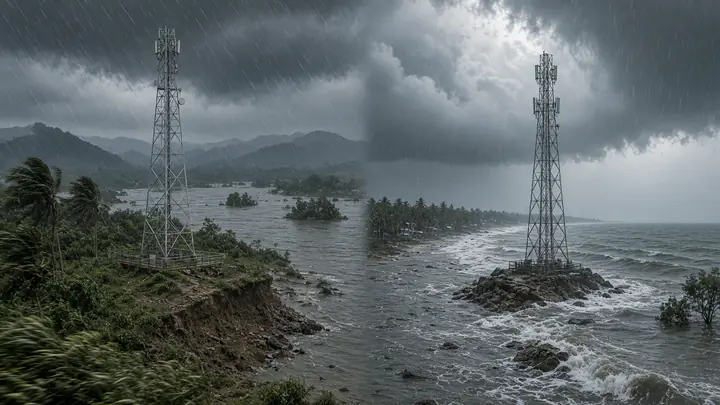
A disaster resilience assessment has identified cyclonic winds and flooding as major threats to telecom towers in Assam and Tamil Nadu, with the two States showing significant exposure to hazards that can disrupt connectivity.
The assessment was carried out under the Disaster Risk and Resilience Assessment Framework of the Coalition for Disaster Resilient Infrastructure, in collaboration with the Department of Telecommunications and the National Disaster Management Authority.
The framework assessed telecom resilience in five high-risk States: Assam, Gujarat, Odisha, Tamil Nadu and Uttarakhand.
The New Delhi-based global coalition comprises 72 members from national governments, international organisations and the private sector.
Tamil Nadu towers face wind, flood and storm-surge exposure
The study mapped 48,416 telecom towers across Tamil Nadu and found that 57% faced high or very high cyclonic wind risk.
The largest concentrations of towers exposed to this risk were found in Chennai, Chengalpattu and Tiruvallur, according to the assessment.
Chennai, Chengalpattu and Kanchipuram also emerged among the areas with the highest concentrations of towers exposed to flooding.
Across Tamil Nadu, 33% of the towers were exposed to flooding, the report said.
The assessment also found that about 14% of the towers in the State were exposed to storm surges exceeding six meters.
The areas particularly identified for such storm-surge exposure were Kanchipuram, Thanjavur and Tirunelveli.
The findings indicate that the risks to telecom infrastructure in Tamil Nadu are not limited to one type of hazard, with wind, flooding and storm surges affecting different parts of the State.
The report’s assessment of tower locations does not mean that every tower exposed to a hazard will necessarily be damaged or become non-operational during a disaster.
“These figures describe the exposure of tower locations to hazards; they do not mean that every exposed tower will sustain damage or become non-operational during a disaster,” Amit Prothi, Director General, Coalition for Disaster Resilient Infrastructure, told The Hindu.
Mr. Prothi said the assessment demonstrated the importance of understanding overlapping hazards at the local level.
Assam shows high exposure to cyclonic winds
Of the 18,388 telecom towers mapped in Assam, 83% were situated in very high cyclonic wind zones.
The assessment found that 43% of the towers in the State were in areas with high flood exposure.
A further 5% were located in areas with high landslide exposure.
The report identified Nagaon, Barpeta, Lakhimpur and Tinsukia among the districts particularly prone to flooding.
It also highlighted landslide exposure affecting telecom towers in Kamrup (Metropolitan) and Dima Hasao.
The assessment found that risks can overlap at the level of individual locations.
In Nowboicha (Revenue Circle) of Assam’s Lakhimpur district, 8% of telecommunications towers were identified as exposed to the combination of seismic Zone V, high flood and high cyclone hazards.
Mr. Prothi said field consultations in the State highlighted the inundation of diesel generator sets and associated infrastructure, alongside river erosion affecting tower foundations.
The example from Nowboicha illustrates why assessments based only on one hazard may not capture the full vulnerability of a telecom site.
The report also pointed to the importance of considering the infrastructure connected to a tower, including power systems, access routes and other facilities needed to keep communications running.
Similar risks identified in Odisha
The report said Odisha’s telecom towers faced threats similar to those identified in Tamil Nadu.
In Odisha, 57% of the towers were exposed to high and very high cyclonic winds.
Another 14% faced storm-surge exposure exceeding six metres, while 13% were exposed to flooding.
The experience of Cyclone Fani, which struck Odisha in May 2019, was cited by the coalition as an example of the consequences of connectivity disruptions.
Only four of 204 base transceiver stations in Puri remained operational during the cyclone, severely disrupting communications for citizens, government officials and first responders, Mr. Prothi said.
Across the Fani-affected districts, 6,058 base transceiver stations were non-functional for one to two weeks because of power outages.
The cyclone also damaged 381 towers and pieces of equipment.
In addition, 450 km of optical fibre cable linked to road damage and restoration work were affected.
The damage and losses to telecommunications were estimated at $63.5 million.
The coalition used the experience to underline that service disruption can extend beyond physical damage to tower structures.
Power and access systems add to vulnerability
The Coalition for Disaster Resilient Infrastructure said telecom resilience was a system-level challenge.
It said exposure of tower locations was only one aspect of the problem.
Networks can suffer severe outages even when towers themselves are not directly damaged, if flooding disrupts power, fibre and backhaul connectivity, road access or generator fuel supplies.
The assessment highlighted vulnerabilities in power and last-mile connectivity, along with gaps in disaster preparedness and coordination.
Amit Prothi said reliable connectivity was crucial for early warnings, emergency response, healthcare access and livelihoods.
“Telecommunications is vital for economic growth and social development… the sector has contributed about 15% to global GDP in the past decade and is projected to reach a $2.8 trillion market by 2030,” the report said.
“In India, with 1.2 billion subscribers, telecommunications enable last-mile connectivity and essential services, and 5G is expected to add $450 billion to the economy from 2023 to 2040,” the report said.
The coalition therefore framed telecom resilience as a requirement for maintaining essential services as well as communications.
Other State-level hazards
The assessment also recorded significant exposure in Gujarat and Uttarakhand.
In Gujarat, 28% of telecom towers, or 12,650 structures, were exposed to very high cyclonic winds.
In Uttarakhand, 25%, or 2,440 towers, were exposed to very high cyclonic winds.
While 12% of Gujarat’s telecom towers faced flood exposure, 10% of those in Uttarakhand were located in areas with high landslide susceptibility.
All towers in Assam and Uttarakhand, and 12% of towers in Gujarat, were located in high and very high seismic zones, identified as Zone IV and V.
These figures add seismic and landslide concerns to the wind and flood risks identified in the assessment across the five States.
Recommendations for stronger continuity
The coalition recommended combining stronger physical protection with backup networks, reliable power and better coordination.
Among the practical measures it listed were raising generators to reduce flood exposure, providing flood doors and waterproof cable connections, strengthening tower and antenna design, and maintaining adequate battery backup.
It also recommended assessing the need for temporary communications systems, including ‘Cells on Wheels’ and other deployable technologies.
Mr. Prothi said alternative power arrangements, such as micro-grids at critical telecommunications sites, could support service continuity.
He said the northeastern States should plan for multiple hazards together and account for the dependence of telecommunications on power, roads and other infrastructure.
The coalition recommended district- and sub-district-level hazard mapping to identify critical sites, prioritise investment and determine where backup connectivity was most needed.
In hilly areas, it said tower siting, foundations and structural design should reflect local slope conditions and seismic hazards.
The study also underscored the importance of alternative communication routes and locally available restoration capacity.
It recommended support for satellite connectivity in mountainous regions, including future connectivity through low Earth orbit satellite constellations.
Temporary networks and alternative communication devices for village heads and disaster-response volunteers were also included among the recommendations.
Mr. Prothi said the roadmap called for assessing maintenance and restoration resource needs every 25-50 km.
It also prioritised fuel supply and strategic storage in vulnerable areas.
“Together, these findings underline the need to protect not only towers but also the power supplies, access routes, and other infrastructure on which connectivity depends,” Mr. Prothi said.
The coalition’s work emphasised resilience assessment across interconnected systems, rather than only at the level of individual towers or cables.
Source: The Hindu
Frequently asked questions
What risks do telecom towers face in Assam and Tamil Nadu?
The main risks are cyclonic winds and flooding, with some areas also exposed to storm surges and landslides.
How many telecom towers were assessed in Tamil Nadu?
The study mapped 48,416 telecom towers across Tamil Nadu.
What proportion of Tamil Nadu towers faced high or very high cyclonic wind risk?
Fifty-seven percent of Tamil Nadu’s telecom towers faced high or very high cyclonic wind risk.
What proportion of Assam’s towers were in very high cyclonic wind zones?
Eighty-three percent of the 18,388 telecom towers mapped in Assam were in very high cyclonic wind zones.
Which districts in Assam were identified as particularly prone to flooding?
Nagaon, Barpeta, Lakhimpur and Tinsukia were identified as particularly prone to flooding.
You may also like
 Tamil Nadu
 CM Vijay Gives ₹5.96 Crore Aid To Families Of Police Personnel
 Tamil Nadu
 keeps special officers in charge of rural bodies till April 2027
 Politics
Tamil Nadu guest lecturers await government order for ₹5,000 honorarium hike
 Weather
Heavy Rain Lashes Salem, Krishnagiri, Dharmapuri; 1,156.30 mm Recorded in 24 Hours
Most read
- 1
Air China Adds Extra Flight for Passengers Stranded in Fuel-Starved Cuba
- 2
Western disturbance to bring rain, hail and strong winds across north India
- 3
Yogi Adityanath Directs No Occupied Houses Be Demolished for Achhalda Bridge
- 4
Gwalior Temple Truck Crash Kills 12, Injures 28-29 Devotees During Navratri
- 5
Heavy Rain Waterlogs Bengaluru, Snarls Traffic; Ride-Hailing Fares Surge
Comments
No comments yet. Be the first to comment.