
Maharashtra fixes October 15 start for sugar crushing season, leaving Karnataka uncertain
Maharashtra approves October 15, 2026 start for sugar crushing season. Karnataka mills face uncertainty as neighboring state begins early.

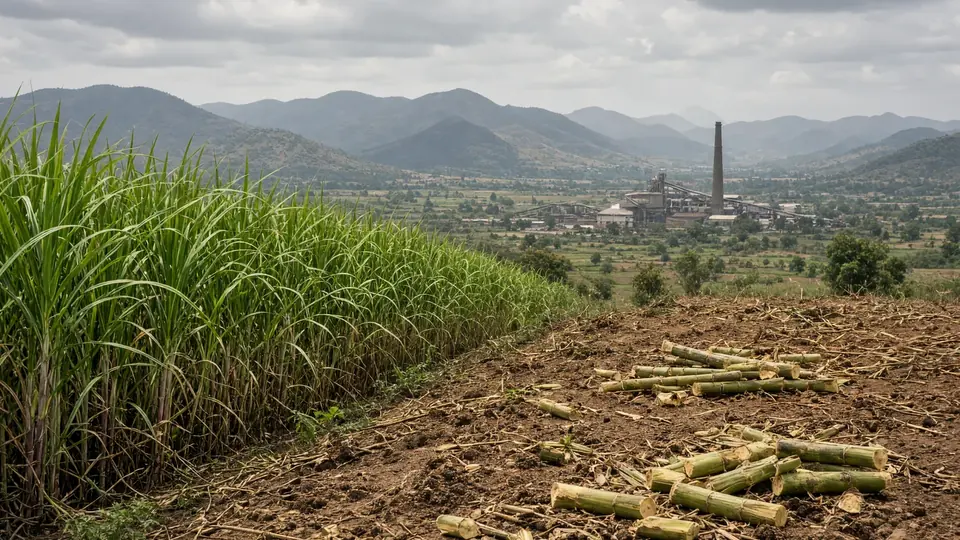
The Maharashtra government has formally approved 15 October 2026 as the commencement date for the state's sugarcane crushing season, leaving neighbouring Karnataka in suspense while its 30 mills prepare to navigate twin challenges of delayed decisions and cross-border competition.
Maharashtra Government Announces Season Start After Cabinet Committee Review
Chief Minister Devendra Fadnavis chaired a ministerial committee meeting at Sahyadri Guest House in Mumbai that granted approval to begin the 2026-27 crushing season on the specified date. The meeting brought together Deputy Chief Minister Sunetra Ajit Pawar, Cooperation Minister Babasaheb Patil, Agriculture Minister Dattatraya Bharne, Water Resources Minister Radhakrishna Vikhe-Patil, and senior officials to deliberate on multiple aspects of the upcoming season.
The committee examined several critical factors before reaching its decision, including sugarcane availability, projected sugar production levels, cane prices for farmers, Fair and Remunerative Price (FRP) payment status, and the financial health of sugar mills across the state. Officials also reviewed the performance of the previous 2025-26 crushing season, assessed the current area under sugarcane cultivation, evaluated production conditions, examined available sugar stocks across the country, and discussed pending FRP and Reserve and Rectification Cases (RRC) matters involving farmer payments.
The government has placed particular emphasis on ensuring farmers receive timely payment for their sugarcane during the coming season. This focus comes amid ongoing concerns about delayed payments that have affected growers in previous years and contributed to financial stress in farming communities dependent on sugarcane as a primary cash crop.
Karnataka Mills Confront Dual Threats From Early Maharashtra Start
While Maharashtra has resolved the question of when its season begins, Karnataka has yet to announce a crushing start date, creating operational uncertainty for the 30 mills in Belagavi district alone. This delay comes at a particularly challenging moment, as insufficient rainfall has prevented sugarcane from achieving expected growth in many areas this year.
If Karnataka follows Maharashtra's lead and begins crushing on 15 October, mills will process less mature cane than optimal, leading to reduced sugar recovery rates from the very start of the season. This outcome would directly affect both the calculation of FRP payments to farmers and the total sugar production volume achieved by mills. The problem is compounded by timing: if crushing begins in October and concludes by late January, the season will miss the natural period when sugarcane recovery rates improve through maturation.
The geographical position of Karnataka's sugar belt creates additional vulnerability. Mills in Belagavi district will face intense competition for sugarcane from border areas now that Maharashtra mills are starting operations first. During the previous crushing season, Belagavi district's 28 sugar mills operated for approximately 100 days and processed around 1.75 crore tonnes of cane. This year, 30 mills will participate in the season, and several have expanded their crushing capacity, increasing their collective demand for raw material at precisely the moment supply faces constraints.
Mills therefore confront what industry observers characterize as a double blow: anxiety about already diminished cane production on one side, and the risk that border-area sugarcane will move to Maharashtra on the other. Last year, Belagavi district anticipated daily crushing volumes exceeding 2 lakh tonnes, but actual processing figures revealed available cane quantities fell short of expectations. Karnataka mills benefited then because Maharashtra mills remained closed at the season's start, eliminating cross-border competition during the critical early weeks.
Competition for Cane Emerges as Central Challenge
Industry analysts consider cane availability the single biggest challenge this season. With Maharashtra beginning operations earlier, Karnataka mills will need to mount more intensive efforts to secure sugarcane from border regions. Reduced rainfall has affected cane growth, making actual cane availability an existential question for many facilities.
The combination of three factors, processing of less mature cane, reduced sugar recovery rates, and intensifying competition for available sugarcane, appears likely to affect Karnataka's sugar mills significantly. This situation represents a reversal from the previous season, when timing worked in Karnataka's favour and helped mills secure adequate raw material supplies despite initial concerns about shortfalls.
Border-area farmers typically make supply decisions based on price offers, payment reliability, transportation convenience, and the operational status of nearby mills. With Maharashtra facilities opening their gates on 15 October, Karnataka mills operating on a delayed or uncertain timeline risk losing cane to competitors offering immediate crushing and payment schedules.
Financial Relief Measures and Industry Support Discussed
The Maharashtra ministerial committee meeting addressed several relief measures designed to improve mill finances and accelerate pending farmer payments. Officials considered implementing an interest subsidy scheme on soft loans specifically targeted at settling outstanding FRP dues owed to growers. This mechanism aims to provide mills with affordable working capital to clear accumulated payment backlogs that have strained relationships with the farming community.
The committee also discussed issues affecting sugar mills' co-generation projects, particularly cases where power purchase agreements have expired. A proposal to provide relief at the rate of Rs 1.50 per unit based on the 2023-24 season benchmark received consideration during the meeting. Additionally, officials debated granting exemptions from the mandatory requirement to use jute bags for sugar packaging, a measure that could reduce operational costs for mills facing margin pressures.
The government's stated objective is to reduce costs and address practical problems confronting the sugar industry. By easing financial burdens and operational requirements, authorities hope to strengthen mill balance sheets and improve their capacity to meet payment obligations to farmers promptly.
Push Towards Alternative Revenue Streams for Sugar Sector
Maharashtra is emphasizing the development of new income sources connected to the sugar industry, particularly ethanol and compressed biogas (CBG) projects. The state government is preparing to take steps toward providing financial and technical incentives for these initiatives. Officials believe that promoting value addition within sugar mills will help develop new revenue streams for these facilities.
Strengthening the economic condition of the sugar industry through diversification is seen as a pathway to protecting farmers' interests as well. Mills with multiple revenue lines from ethanol, CBG, and power generation alongside traditional sugar production would have greater financial resilience to weather market fluctuations and maintain consistent payments to cane suppliers.
The meeting included a presentation on a special sugarcane development scheme designed to increase cane production and productivity. The scheme prioritizes promotion of high-quality sugarcane varieties, nursery development, seed processing, and encouragement of drip irrigation. Additional focus areas include balanced fertilizer use, modern farming techniques, and agricultural mechanization.
The government's goal through this development scheme is to boost sugarcane productivity while simultaneously reducing cultivation costs and increasing farmers' income. By improving yields per hectare and reducing input expenses, the initiative aims to enhance farm economics independent of price adjustments, providing growers with better margins through efficiency gains.
Central Government Issues and Policy Demands
The ministerial committee meeting also addressed matters pending with the central government related to the sugar industry. Maharashtra will recommend that the Centre increase the Minimum Selling Price (MSP) for sugar, raise ethanol prices, and expedite release of pending interest subsidies for ethanol projects. These demands reflect state-level concerns that current pricing and support mechanisms inadequately address the financial realities facing both mills and farmers.
The 15 October start date for the new crushing season is being regarded as significant for both sugarcane farmers and the sugar industry in Maharashtra. Government efforts are concentrated on increasing sugarcane production, ensuring farmers receive timely payments, and promoting alternative income sources such as ethanol and CBG alongside the sugar industry.
These policy priorities reflect recognition that the sugar sector's sustainability depends on addressing multiple interconnected challenges: farmer payment discipline, mill profitability, production efficiency, and revenue diversification. The emphasis on alternative fuels and biogas aligns with both national energy security objectives and climate commitments while providing mills with higher-margin products than commodity sugar.
Price Increase Signals Emerge From Bihar Mills
In a separate development signaling potential price relief for growers, Hasanpur Sugar Mill in Samastipur district of Bihar has indicated that cane purchase prices may increase before the crushing season begins. General Manager Ashok Mittal told sugarcane farmers that prices are likely to rise by the time the crushing season commences.
GM Mittal's assurance has raised hopes among cane farmers in the region. Farmers stated that if cane prices do increase, it would be welcome news providing them with economic relief amid rising costs. Mittal offered positive signals keeping farmers' interests in mind, saying that prices are likely to increase by the time the season arrives. This announcement has generated enthusiasm among sugarcane farmers in the area.
Farmers emphasized that obtaining fair prices for sugarcane is essential given the rising costs of fertilizer, seeds, irrigation, labour, and overall cultivation expenses. In this context, farmers view the mill management's price increase assurance as news bringing relief and hope. The statement from Hasanpur's leadership suggests that at least some mills recognize the need to adjust procurement prices upward to reflect input cost inflation and maintain grower participation.
Industry Faces Complex Season Amid Production and Market Pressures
The upcoming crushing season presents a complex landscape for India's sugar industry, with different states navigating distinct challenges shaped by weather patterns, competitive dynamics, and policy decisions. Maharashtra's definitive 15 October start date provides clarity for its extensive mill network and farmer base, enabling both to plan logistics, labour, and cash flows accordingly.
Karnataka's continued uncertainty over start dates, however, leaves its expanded mill capacity facing operational ambiguity precisely when competition for limited cane supplies will intensify. The state's 30 mills in Belagavi district, equipped with enhanced crushing capacity, require substantial and consistent cane supplies to operate efficiently. Delays in confirming the season start risk leaving these facilities at a disadvantage in securing border-region supplies, potentially resulting in underutilized capacity and shortened operating periods.
The rainfall deficit affecting cane maturity across multiple regions introduces additional complexity, as early crushing of less mature cane delivers lower recovery rates, affecting both mill economics and the FRP calculations that determine farmer payments. Mills face pressure to begin operations promptly to compete for available cane, yet early crushing of immature cane undermines profitability and farmer returns, a tension without easy resolution.
Financial stress in the sector, reflected in pending FRP payments and the need for interest subsidy schemes, underscores the structural challenges facing Indian sugar mills. Global sugar price volatility, domestic price controls, ethanol program economics, and input cost inflation create a difficult operating environment. Government initiatives to diversify mill revenue through ethanol and CBG production offer a pathway toward improved financial health, but require capital investment and long-term contracts that may challenge smaller or financially weaker operations.
The Bihar price increase signals from Hasanpur Mill, while limited to one facility, suggest that at least some mills are prepared to offer higher procurement prices to secure adequate supplies. Whether this pattern spreads more broadly will depend on market conditions, mill financial capacity, and competitive dynamics within each state's sugar belt.
For farmers, the season ahead presents both opportunities and anxieties. Timely payment assurances from state governments and potential price increases offer hope for improved cash flows and better compensation for rising input costs. However, concerns about lower yields from rainfall-affected crops, potential payment delays if mills face financial stress, and uncertainty about final prices create ongoing vulnerability for households dependent on cane income.
The 2026-27 crushing season will test the resilience of India's sugar sector as it navigates weather-related production challenges, cross-border competitive pressures, financial constraints, and evolving policy frameworks simultaneously. The outcomes in Maharashtra, Karnataka, Bihar, and other producing states will shape not only the immediate economics of mills and farmers but also influence longer-term decisions about cane cultivation, mill investments, and the sector's transition toward diversified biofuel and biogas production models.
Frequently asked questions
When will Maharashtra's sugar crushing season start in 2026?
Maharashtra has set October 15, 2026 as the official start date for the sugar crushing season, following approval by Chief Minister Devendra Fadnavis and a ministerial committee.
What factors did Maharashtra's government consider before deciding on the crushing season date?
The government reviewed sugarcane availability, projected sugar production, cane prices for farmers, FRP payment status, mill financial health, previous season performance, current cultivation area, production conditions, national sugar stocks, and pending farmer payment cases.
Why is Karnataka uncertain about its crushing season start date?
Karnataka has not yet announced a crushing start date, creating operational uncertainty for its 30 mills. Insufficient rainfall has also prevented sugarcane from achieving expected growth, complicating the timing decision.
What is the risk for Karnataka mills if they start crushing on the same date as Maharashtra?
If Karnataka begins crushing on October 15, mills will process less mature sugarcane than optimal, leading to reduced sugar recovery rates from the start of the season due to insufficient rainfall affecting cane growth.
Why is timely farmer payment a focus for Maharashtra's coming season?
The government has emphasized ensuring farmers receive prompt payment for their sugarcane to address ongoing concerns about delayed payments that have affected growers in previous years and caused financial stress in farming communities.
You may also like



Most read
- 1
Tesla audits Chinese suppliers to scale up Optimus robot production
- 2
Former minister Lakhan Singh Rajput to inaugurate temple bhandara at Shri Chakreshwar Mahadev
- 3
Firozabad BSA finds four government schools locked during inspection
- 4
Tamil Nadu dengue cases fall for third consecutive year to 17,049
- 5
Social workers stage silent protest at Fufund railway station for train halts
Comments
No comments yet. Be the first to comment.