
Madurai's Sungudi Saris and Jigarthanda: A Visitor's Guide
Explore Madurai's handloom heritage, historic sites, and street-food culture before the Kumbabhishekam. Discover sungudi saris and local favorites.
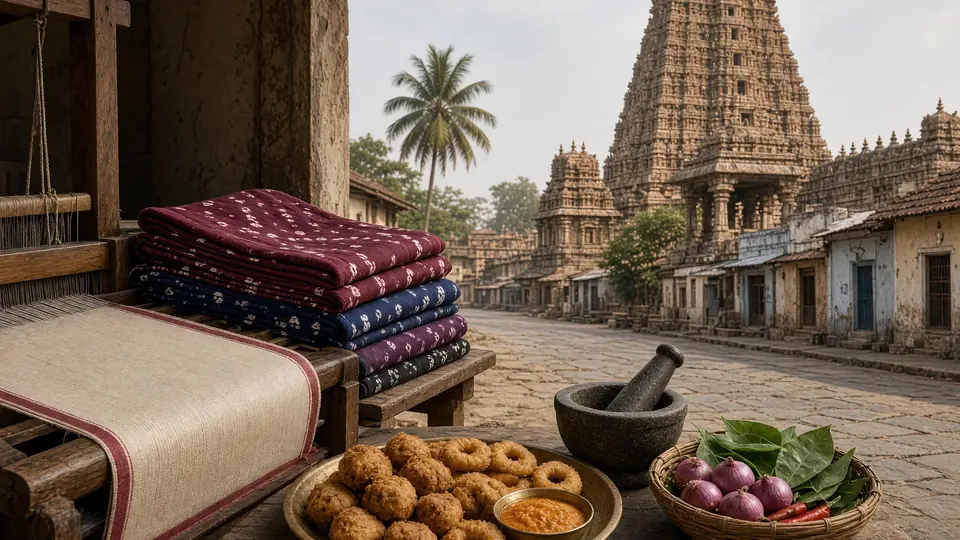
Madurai before the Kumbabhishekam: A local's guide
The ancient city opens itself to visitors through its handloom heritage, historic sites dating back millennia, and a street-food culture that thrives on pavements and in crowded parlours.
The tie-and-dye legacy of Saurashtrian weavers
The Saurashtrian community migrated from Gujarat to Madurai in the late 16th and early 17th Century, and thrived under Nayak rule. During this time, they brought to the city a tie-and-dye tradition, using stones, thread, and naturally occurring pigments on saris, to make patterns in more permutations and combinations than imaginable. Legend has it that this craft, known as sungudi, became a defining feature of the community's identity in their new home.
Today, only a handful of the members living around the Mahal area where their ancestors lived, continue this handloom tradition. Much of the labour-intensive work has been replaced by machine prints. However, some warriors continue to fiercely protect tradition.
To watch the sari making process up-close, contact Cholan Tours Madurai at 8220005542. If you want to take one home, drop by Tharagai Sungudi, a shop in BB Kulam, which works with 20 women from in and around Madurai, training them in making sungudi. Their store selling authentic saris (ranging from ₹2,000-₹15,000), as well as material, is open from Monday to Friday. Contact 8124361714 for details.
Jigarthanda: the answer to Madurai's heat
The best way to counter Madurai's heat is a tall, chilled glass of jigarthanda. There are several shops across the city that sell the caramel-coloured dessert. Famous Jigarthanda, though, is where it all began.
Head to their Kamarajar Street outlet: be warned, it is always crowded. Jostle your way through the packed counter in the front to order a glass of the drink that consists of jelly-like bits of badam pisin, ice cream, basundhi, and nannari syrup. The shop has 20 branches across the city and the one on Kamarajar Street has a spacious parlour nearby with wooden benches for customers to sit and enjoy their drink.
Sheik Meeran, the founder, operated from a push-cart in the same spot in the 1970s. The shop's expansion across Madurai speaks to the enduring appeal of this dessert that has become synonymous with the city itself.
Teppakulam: where the city gathers
Teppakulam is the best place to experience Madurai in its truest form. Here, there is good food: taste the sweet polis, freshly-fried bajjis, puttus, and enjoy great views. The central mandapam nestled amidst trees, surrounded by water (on rare occasions) is a sight that no visitor to the city should miss.
This historic temple tank is a microcosm of the city. It comes alive every evening with food stalls and more recently, activities such as balloon shooting, and amusement rides. But one need not do anything at all at Teppakulam. Simply buy yourself a packet of peanuts, stand by the low stone wall, and watch the world go by.
The fragrance economy: Madurai's jasmine markets
Walk down any by-lane in Madurai and you will find coils of jasmine. To douse yourself in the fragrance of the delicate, green-stemmed flower, visit the flower markets at Mattuthavani and Villapuram.
On a jasmine trail at these markets, one can see hillocks of jasmine, mullai, sampangi, rose, lotus, and marigold, not to mention garlands that artisans weave with mechanical precision. While there, pause to observe women string jasmine: their fingers deftly work to create strands that adorn not just temple deities, but the hair of every other Madurai woman.
Madurai malli is GI-tagged for its distinctive fragrance and round shape. According to Tamil Nadu Agritech Portal, it is exported to places such as Singapore, Malaysia, Sri Lanka, West Asia and the United States. The flower is not merely a cultural symbol but a significant economic crop that connects the city to international markets.
Keeladi and the Vaigai valley civilisation
It is in Madurai that the world first learnt of a civilisation from the Vaigai valley. Amid coconut groves in Keeladi, about 12 kilometres from Madurai, experts have unearthed artefacts to be 2,000 to 2,500 years old, with the oldest dating back to around 580BC.
The location is an absolute must for history lovers, and is open from 10am to 6pm on weekdays and till 7pm on weekends with an entry fee of ₹15 for adults. The site offers a glimpse into a sophisticated urban settlement that predates much of what has been traditionally understood about Tamil civilisation.
Hidden monuments in everyday spaces
Do not be surprised if you come upon a historical monument dating back to the Nayaks during a shopping spree. For, the city has some interesting structures that are part of everyday life. One such is the Pathu Thoon Street, a bustling marketplace that is home to stately stone pillars. According to historians, the pillars belong to an extended palace from the Nayak period.
The unfinished Raya Gopuram at the entrance of Yezhukadal Veedhi near the Meenakshi temple is another sight to behold. Also constructed by the Nayaks, it would have made a magnificent gateway had it been completed. But it stands unfinished, its stone sculptures looking out of place in a crowded street.
Gandhi's turn to simplicity
It was after a visit to Madurai that Mahatma Gandhi decided to adopt the simple attire he is known for. Gandhi Memorial Museum has several rare artefacts relating to the freedom fighter, the highlight of which is the blood-stained cloth that was wrapped around him when he was assassinated on January 30, 1948. The museum preserves not just objects but the moment that transformed Gandhi's public image and political symbolism.
Samanar Malai: a Jain heritage on a hillock
A drive on the Madurai-Theni highway will lead you to the picture-perfect Keelakuyilkudi village 15 kilometres from Madurai. This is where you will spot a hillock of deep historical significance dating back to 2,000 years.
Welcome to Samanar Malai where a stunning bas relief of Mahavira and two attendants; inscriptions that date to the 9th and 10th Century; and rock-cut sculptures of Gomateshwara, Mahavira, Yakshi and Yaksha, can be spotted. Take the long climb with over a hundred steps to look at all the bas relief structures. A pond here will make the physical effort worth it. There is a Brahmi inscription further up the hill too. One can visit the hill between 6am and 6pm. Entry is free.
Vadas: Madurai's uncontested specialty
Madurai has Tamil Nadu's best vadas. Drama aside, do head to Shankar Coffee Bar near Anna Bus Stand. Their chutney is orange and near-perfect.
Pause at every pushcart vendor who emerges around 7pm across the city to try the mullu murungai keerai vada, a small green puffed-up poori that the Saurashtrian community brought to Madurai. The push-carts can be found around the temple, Tirumalai Nayak Mahal, and most streets, selling three vadas for merely ₹10.
Do not miss the carts selling coconut stems too. The heart of the tree is served as thin slices. End with paruthipaal, a sweet and spiced drink made from cottonseed, hearty, thick and delicious, from Santhanam's 90-year-old shop called Sri Sastha Paruthipaal on Netaji Road. The shop has been serving this distinctive beverage for nine decades, a testament to the city's ability to preserve culinary traditions across generations.
The city reveals itself not in curated tourist circuits but in the everyday rhythms of its markets, the unfinished gopuram standing amid traffic, the jasmine coils in every lane, and the pushcarts that appear as the sun sets. Madurai's identity is woven through handloom saris, chilled desserts, ancient inscriptions, and street-corner vadas, each element a thread in a larger narrative of continuity and adaptation.
Source: The Hindu
Frequently asked questions
What is sungudi and where can I learn about it in Madurai?
Sungudi is a tie-and-dye textile tradition brought to Madurai by Saurashtrian weavers from Gujarat in the late 16th and early 17th century. The craft uses stones, thread, and naturally occurring pigments to create intricate patterns on saris. To watch the sari-making process, contact Cholan Tours Madurai at 8220005542.
Where can I buy authentic Sungudi saris in Madurai?
Tharagai Sungudi, located in BB Kulam, sells authentic handmade sungudi saris ranging from ₹2,000-₹15,000, along with materials. The shop works with 20 women from Madurai and is open Monday to Friday. Contact 8124361714 for details.
What is jigarthanda and where is the best place to try it?
Jigarthanda is a chilled dessert drink made with jelly-like badam pisin bits, ice cream, basundhi, and nannari syrup. Famous Jigarthanda on Kamarajar Street is where the dessert originated, founded by Sheik Meeran from a push-cart in the 1970s. The shop now has 20 branches across the city.
What should I do at Teppakulam?
Teppakulam is a historic temple tank where you can enjoy local street food like sweet polis, bajjis, and puttus, and take in views of the central mandapam surrounded by water. You can also browse food stalls, enjoy amusement activities, or simply relax by the stone wall watching the city life unfold.
You may also like
 Religious
Madurai's Meenakshi Temple prepares for historic kumbabishekam consecration ceremony
 Religious
Sri Meenakshi Sundareswarar Temple's grand kumbhabhishekam ceremony begins in Madurai
 National
After 66 years as Hong Kong's hidden supplier, Kau Kee finally opens to the public
 Politics
Bangkok launches app to map and formalise street food vendors
Most read
- 1
Tesla audits Chinese suppliers to scale up Optimus robot production
- 2
Former minister Lakhan Singh Rajput to inaugurate temple bhandara at Shri Chakreshwar Mahadev
- 3
Firozabad BSA finds four government schools locked during inspection
- 4
Tamil Nadu dengue cases fall for third consecutive year to 17,049
- 5
Social workers stage silent protest at Fufund railway station for train halts
Comments
No comments yet. Be the first to comment.