
Justice Pushpendra Singh Bhati sworn in as Chief Justice of J&K High Court
Justice Pushpendra Singh Bhati takes oath as Chief Justice of Jammu and Kashmir and Ladakh High Court in Srinagar ceremony.

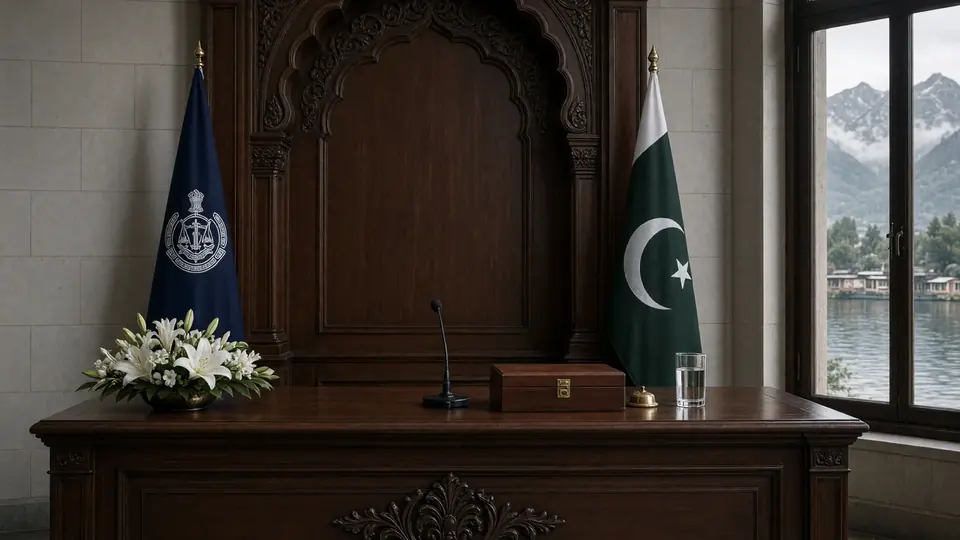
Justice Pushpendra Singh Bhati took oath as the Chief Justice of the Jammu and Kashmir and Ladakh High Court, with Ladakh Lieutenant Governor V.K. Saksena administering the oath of office and secrecy at a ceremony held in Srinagar. The swearing-in marked a historic departure from tradition, as this was the first time since Ladakh became a Union Territory in August 2019 that the Ladakh Lieutenant Governor administered the oath to the Chief Justice of the shared high court.
The oath ceremony took place at the Shalimar Auditorium of Sher-e-Kashmir University of Agricultural Sciences and Technology (SKUAST). Saksena is currently holding additional charge as Jammu and Kashmir Lieutenant Governor, as the incumbent Lieutenant Governor Manoj Sinha is on leave.
Presidential appointment and notification
President Droupadi Murmu appointed Justice Bhati, a sitting judge of the Rajasthan High Court, as Chief Justice of the Jammu and Kashmir and Ladakh High Court on 5 September. The central government issued the notification for Justice Bhati's appointment as Chief Justice on 5 September, with his appointment effective from the date he assumed charge.
The formal judicial proceedings were initiated when Registrar General of the High Court Shahzad Azeem read out the notification issued by the Ministry of Law and Justice and the appointment warrant issued by President Droupadi Murmu on 5 September 2026.
Supreme Court Collegium recommendation
The Supreme Court Collegium had recommended Justice Bhati's name for the post on 31 August. His appointment to the position of Chief Justice came as a promotion, following the Collegium's official recommendation on 31 August 2026.
Justice Bhati replaced Justice Sanjeev Kumar, who had been serving as acting Chief Justice since 2 June. His appointment filled the vacancy at the helm of the high court that serves both Union Territories.
Historic first for Ladakh
The decision to have the Ladakh Lieutenant Governor administer the oath represented a significant break from established practice. Typically, the Jammu and Kashmir Lieutenant Governor administers the oath to the Chief Justice of the high court. This deviation from tradition underscored the evolving constitutional arrangements following the reorganisation of the erstwhile state of Jammu and Kashmir.
August 2019 marked a watershed moment when Ladakh was carved out as a separate Union Territory. Since that reorganisation, both Jammu and Kashmir and Ladakh continue to share a common high court, but the oath-taking by the Ladakh Lt Governor was unprecedented in this new constitutional framework.
Distinguished attendees at ceremony
Chief Minister Omar Abdullah attended the oath-taking ceremony, alongside judges of the high court and subordinate courts. The important judicial event also saw participation from current and former judges of the high court, judicial officers from lower courts, Advocate General D.C. Raina, and senior administrative and police officials.
The ceremony, scheduled at the Convention Centre in Srinagar at 11 a.m., brought together the judicial, executive and legal fraternity of the Union Territory.
Justice Bhati's judicial career and expertise
Justice Bhati has built a distinguished judicial reputation as a senior judge of the Rajasthan High Court. He was appointed as a judge of the Rajasthan High Court on 16 November 2016 and has considerable experience in judicial work.
During his career, he developed particular expertise in writ jurisdiction covering both service and miscellaneous matters, public interest litigation (PIL), revenue laws, electoral disputes, mining, and matters related to educational infrastructure. His specialised knowledge spans diverse areas of law that regularly come before high courts in India.
Justice Bhati also served multiple times as Additional Advocate General for the state of Rajasthan. This experience on the state's legal team provided him with insights into governmental legal matters and public policy issues that frequently arise in constitutional litigation.
Administrative context
The appointment and oath-taking occurred during Manoj Sinha's official leave, necessitating V.K. Saksena to handle the additional charge of Jammu and Kashmir's administration. This administrative arrangement meant Saksena was overseeing both Union Territories at the time of the swearing-in ceremony, making him the appropriate constitutional authority to administer the oath.
The Jammu and Kashmir and Ladakh High Court will soon have its new Chief Justice, according to officials. The phrase reflected the anticipation surrounding the appointment before the oath ceremony took place.
Implications for the high court
Justice Bhati's assumption of office brings stability to the high court after Justice Sanjeev Kumar's tenure as acting Chief Justice. The appointment of a permanent Chief Justice is expected to provide continuity in judicial administration and decision-making at the apex judicial body serving the two Union Territories.
The high court, which functions as the constitutional court for both Jammu and Kashmir and Ladakh, handles a wide range of matters including constitutional challenges, service matters, criminal and civil appeals, and public interest litigation. Justice Bhati's expertise across multiple domains of law positions him to guide the court through the complex legal landscape of the region.
The shared high court arrangement between the two Union Territories means the Chief Justice oversees judicial administration across diverse geographical and cultural contexts, from the Kashmir valley to the high-altitude desert of Ladakh. His leadership will be tested in maintaining judicial standards and access to justice across this expansive jurisdiction.
Historical precedent and constitutional practice
The choice of venue in Srinagar for the oath ceremony maintains the tradition of holding such important judicial events in the summer capital of the erstwhile state. Even after the reorganisation into Union Territories, the high court continues to function from both Srinagar and Jammu on a rotational basis, following the Durbar Move tradition.
Justice Bhati's appointment comes through the well-established constitutional mechanism where the Supreme Court Collegium recommends candidates for high court Chief Justice positions to the central government. The President then makes the formal appointment, which is followed by the oath-taking ceremony administered by the Lieutenant Governor.
The process from Collegium recommendation on 31 August to presidential notification on 5 September and oath-taking demonstrates the swift implementation once consensus is reached on judicial appointments. This efficiency in filling the Chief Justice's post reflects the importance attached to maintaining leadership continuity in constitutional courts.
With his extensive experience in the Rajasthan High Court since 2016 and his specialised knowledge across multiple legal domains, Justice Pushpendra Singh Bhati brings valuable expertise to his new role as head of the Jammu and Kashmir and Ladakh High Court. His tenure will be watched closely as the high court continues to navigate the legal and constitutional questions that arise in the post-reorganisation era of these Union Territories.
Frequently asked questions
Who is Justice Pushpendra Singh Bhati?
Justice Pushpendra Singh Bhati is a sitting judge of the Rajasthan High Court who was appointed as Chief Justice of the Jammu and Kashmir and Ladakh High Court by President Droupadi Murmu on 5 September.
What was historic about this swearing-in ceremony?
This was the first time since Ladakh became a Union Territory in August 2019 that the Ladakh Lieutenant Governor administered the oath to the Chief Justice of the shared high court, marking a departure from the traditional practice of the Jammu and Kashmir Lieutenant Governor administering the oath.
Who administered the oath of office?
Ladakh Lieutenant Governor V.K. Saksena administered the oath of office and secrecy at the ceremony held at Shalimar Auditorium of SKUAST in Srinagar. Saksena is currently holding additional charge as Jammu and Kashmir Lieutenant Governor.
Who did Justice Bhati replace as Chief Justice?
Justice Bhati replaced Justice Sanjeev Kumar, who had been serving as acting Chief Justice since 2 June.
How was Justice Bhati recommended for this position?
The Supreme Court Collegium recommended Justice Bhati's name for the post of Chief Justice on 31 August, following which the central government issued the notification for his appointment.
You may also like




Most read
- 1
Tesla audits Chinese suppliers to scale up Optimus robot production
- 2
Former minister Lakhan Singh Rajput to inaugurate temple bhandara at Shri Chakreshwar Mahadev
- 3
Firozabad BSA finds four government schools locked during inspection
- 4
Tamil Nadu dengue cases fall for third consecutive year to 17,049
- 5
Social workers stage silent protest at Fufund railway station for train halts
Comments
No comments yet. Be the first to comment.