
IISc Develops Light-Controlled Technique To Study, Rescue Cell Division
IISc researchers developed LISA, a blue-light method to activate Aurora A kinase and study spindle assembly in living cells.

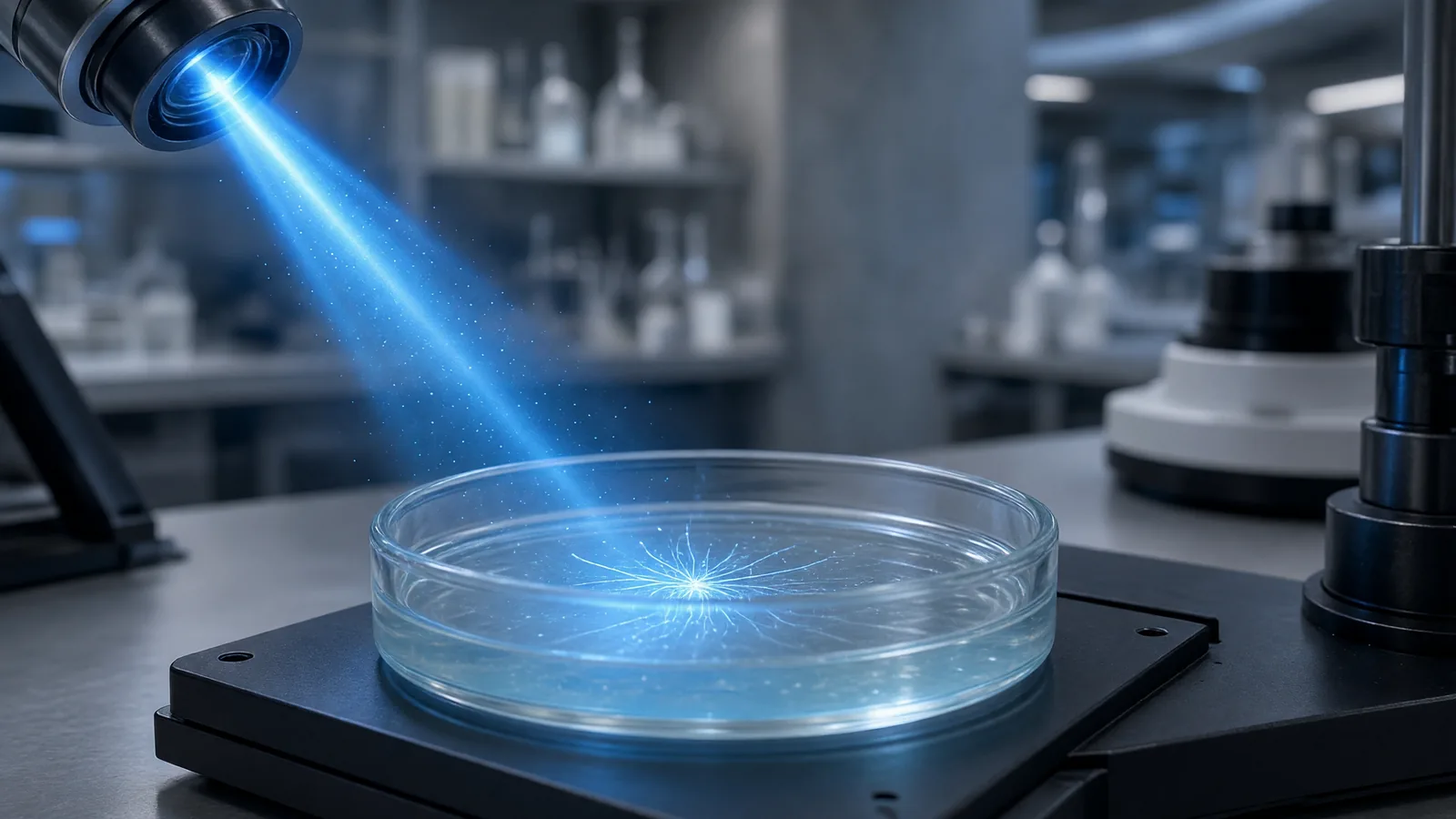
IISc researchers use light to fix cell division
Researchers at the Indian Institute of Science have developed Light-Induced Spindle Activation, or LISA, a technique that can reversibly activate Aurora A kinase, a centrosomal enzyme critical for spindle assembly.
The institute said the method allows scientists to study centrosomes and spindle assembly in much greater detail, while also opening the possibility of rescuing cell division by artificially manipulating these components and processes when they fail.
A light-controlled route to activate Aurora A
Scientists believed that Aurora A is activated through clustering, a process promoted in cells by Cep192, its evolutionarily conserved scaffold.
According to IISc, previous work has shown that Aurora A-coated beads can trigger microtubule nucleation in frog egg extracts.
However, Cep192 is required for Aurora A activation in this setting, the institute said.
“With LISA, researchers can now reversibly induce and study Aurora A clustering using blue light, independently of Cep192, across a range of cell types,” IISc said.
The institute said LISA can also be applied directly in living cells, whereas the bead-based method is largely restricted to cell extracts.
That distinction is central to the technique because it moves the study of Aurora A clustering beyond a method that is largely restricted to cell extracts and into living cells, according to IISc.
How the team adapted LARIAT
To develop LISA, Sachin Kotak, associate professor at the Department of Microbiology and Cell Biology, and his team identified a novel application for an existing technique called LARIAT.
LARIAT is typically used to inhibit proteins by inducing their clustering with light.
Prof. Kotak’s team realised that the same light-induced clustering could instead be harnessed to activate Aurora A kinase.
LARIAT uses the plant proteins CRY2 and CIB1, which can be induced to cluster in response to blue light.
The researchers first engineered human cells to express a fusion protein in which Aurora A kinase was linked to CRY2.
When blue light was shone on the fusion protein, CRY2 underwent a conformational change that promoted its interaction with CIB1.
This interaction drove the clustering of multiple Aurora A assemblies, said Vignesh Olakkal, a PhD student and first author of the study.
“This provides a novel way to trigger and activate an artificial Aurora A kinase complex: Aurora A fused to light-sensitive plant proteins, which is sufficient to induce microtubule nucleation,” he added.
Testing whether LISA could rescue spindle defects
Cells without centrosomes often have defects in spindle assembly, leading to errors in cell division.
Prof. Kotak’s team wanted to test whether LISA could overcome this defect.
The researchers first chemically eliminated the centrosomes from human cells and then introduced the engineered Aurora A clustering system.
When blue light was applied during mitosis, it induced Aurora A clustering and efficiently stimulated microtubule nucleation.
IISc said this light-induced activation of Aurora A was sufficient to restore spindle assembly and rescue defects in cell division caused by centrosome loss.
The finding matters because the institute has linked the technique not only to closer study of centrosomes and spindle assembly, but also to the possibility of rescuing cell division when these components and processes fail.
Potential therapeutic direction
IISc said LISA also has potential therapeutic applications.
“In many solid tumours, Aurora A kinase is overexpressed, and that’s why there are drugs targeting it,” Prof. Kotak said.
“But Aurora A kinase has multiple targets,” he said.
Prof. Kotak said the strategy could help identify Aurora A kinase-specific targets independent of the centrosome, as far as microtubule nucleation is concerned.
“Now, with our strategy, we can find out what the Aurora A kinase-specific targets are, independent of the centrosome, as far as microtubule nucleation is concerned,” Prof. Kotak said.
“Then we will hopefully be able to find other targets of Aurora A kinase and design the drugs,” he added.
The therapeutic relevance described by IISc is tied to the overexpression of Aurora A kinase in many solid tumours and to the existence of drugs targeting the kinase.
The technique therefore gives researchers a way to separate Aurora A kinase activity connected to microtubule nucleation from centrosome-dependent processes, according to Prof. Kotak’s explanation.
By using blue light to induce clustering, LISA provides a reversible way to study Aurora A activation across a range of cell types, independently of Cep192, IISc said.
The institute described the method as a way to activate an artificial Aurora A kinase complex and to stimulate microtubule nucleation through light-sensitive plant proteins fused to Aurora A.
The work was published on September 29, 2026, at 08:31 pm IST.
Source: The Hindu
Frequently asked questions
What technique did IISc researchers develop to study cell division?
IISc researchers developed Light-Induced Spindle Activation, or LISA, a light-controlled technique that can reversibly activate Aurora A kinase, an enzyme important for spindle assembly.
How does LISA activate Aurora A kinase?
LISA uses blue light to induce clustering of Aurora A fused to light-sensitive plant proteins, enabling activation of an artificial Aurora A kinase complex.
Why is LISA significant compared with earlier bead-based methods?
Unlike bead-based methods that are largely restricted to cell extracts, LISA can be applied directly in living cells and can induce Aurora A clustering independently of Cep192.
What role did the LARIAT technique play in developing LISA?
The IISc team adapted LARIAT, which normally uses light-induced clustering to inhibit proteins, to instead activate Aurora A kinase through clustering.
What cell division problem did the researchers test LISA against?
The researchers tested whether LISA could help overcome spindle assembly defects in human cells whose centrosomes had been chemically eliminated.
You may also like
 Technology
IISc's FSID sets sights on 1,000 industry projects by 2030
 Uttar Pradesh
Ajay Rajvar named federation’s UP chief general secretary
 National
Tirupati NCC Cadet K. Thirumal Wins Gold at Telangana Equestrian Championship
 National
ABVP Hathras to Organise District-Level Agnishikha Conference on October 27
Most read
- 1
Air China Adds Extra Flight for Passengers Stranded in Fuel-Starved Cuba
- 2
Western disturbance to bring rain, hail and strong winds across north India
- 3
Yogi Adityanath Directs No Occupied Houses Be Demolished for Achhalda Bridge
- 4
Gwalior Temple Truck Crash Kills 12, Injures 28-29 Devotees During Navratri
- 5
Heavy Rain Waterlogs Bengaluru, Snarls Traffic; Ride-Hailing Fares Surge
Comments
No comments yet. Be the first to comment.