
China opens first river-to-sea canal since 1949 to boost inland trade
China's first river-to-sea canal since 1949 opens, linking Guangxi to the Beibu Gulf. The 134km waterway aims to cut shipping costs and reshape inland trad

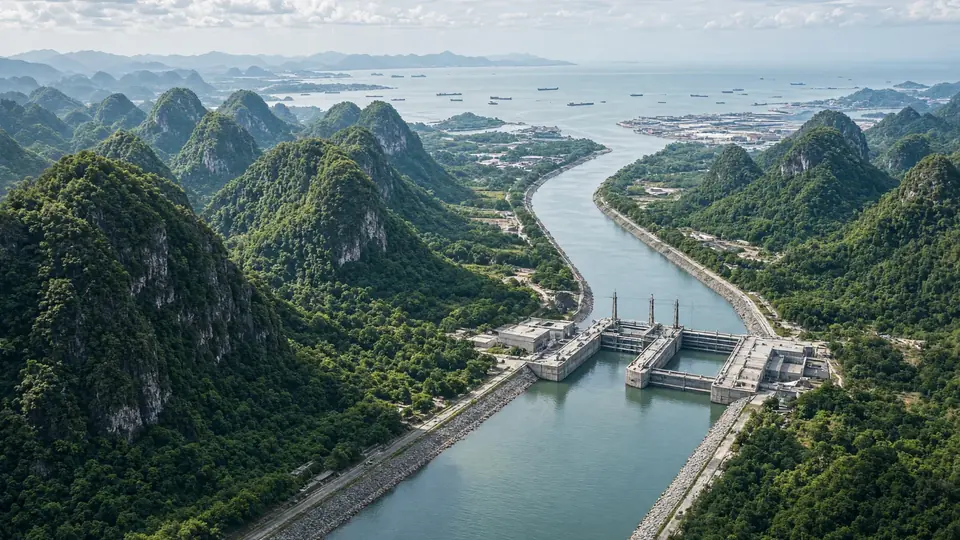
China's first river-to-sea canal built since the founding of the People's Republic in 1949 has opened, with its operator predicting the waterway could drive inland economic growth comparable to the transformation the Yangtze River brought to Shanghai.
The Pinglu Canal began operations on Wednesday, creating a 134.2-kilometre link between a major tributary of the Pearl River in southern Guangxi Zhuang autonomous region and the Beibu Gulf, the Chinese name for the Gulf of Tonkin. The waterway measures 83.4 miles in length.
Shorter Routes for Landlocked Provinces
The canal is designed to serve as a short cut for cargo moving between western China and the Association of Southeast Asian Nations. It promises shorter routes to the sea and lower transport costs, potentially reshaping the fortunes of landlocked regions in the country's southwestern interior.
The operator stated that the project was prioritised to ease severe congestion at traditional logistics hubs. Additional projects are already under way to maximise the waterway's economic potential, according to the operator.
The new canal is expected to boost trade links with Southeast Asia, opening a more direct maritime connection for China's inland western provinces that have historically depended on longer, more congested routes to reach international markets.
Source: South China Morning Post
Frequently asked questions
What is the Pinglu Canal and when did it open?
The Pinglu Canal is China's first river-to-sea canal built since 1949. It began operations on Wednesday, creating a 134.2-kilometre link between a major tributary of the Pearl River in southern Guangxi Zhuang autonomous region and the Beibu Gulf.
How does the Pinglu Canal benefit inland provinces?
The canal provides shorter routes to the sea and lower transport costs for cargo moving between western China and Southeast Asia. It benefits landlocked regions in China's southwestern interior by offering more direct maritime connections to international markets.
What problem does the Pinglu Canal solve?
The canal was prioritised to ease severe congestion at traditional logistics hubs. It serves as a shortcut for cargo between western China and ASEAN, reducing reliance on longer, more congested routes.
What is the economic potential of the Pinglu Canal?
The canal's operator predicts it could drive inland economic growth comparable to the transformation the Yangtze River brought to Shanghai. Additional projects are underway to maximise the waterway's economic potential and boost trade links with Southeast Asia.
You may also like
 International
China Launches Trials for $10 Billion Canal to Boost Trade Links
 National
Hong Kong positions itself as Belt and Road connectivity hub across infrastructure, standards, and people ties
 International
Chinese space firm GalaxySpace delivers first turnkey satellite system to Thailand
 Business
Pacific island nations play superpowers, securing Western defence deals and Chinese investment
Most read
- 1
Tesla audits Chinese suppliers to scale up Optimus robot production
- 2
Former minister Lakhan Singh Rajput to inaugurate temple bhandara at Shri Chakreshwar Mahadev
- 3
Firozabad BSA finds four government schools locked during inspection
- 4
Tamil Nadu dengue cases fall for third consecutive year to 17,049
- 5
Social workers stage silent protest at Fufund railway station for train halts
Comments
No comments yet. Be the first to comment.