
Chandigarh's first pour-only cocktail bar reimagines precision over showmanship
The Back Room reimagines the neighborhood bar with India's first pour-only cocktail bar, lab-crafted drinks, and a design focused on conversation and comfo
Why Chandigarh is ready for a new kind of cocktail bar
When The Back Room returned to The Toy Hotel in Chandigarh's Sector 34A, it brought with it a fundamentally different proposition: India's first pour-only cocktail bar, where drinks are crafted in a laboratory and precision replaces performance.
The venue, which originally opened in 2015 before shutting in 2024, has been reimagined by Saanya and Akshay Verma of VTC Group not as a simple reopening but as a complete rethink of what a neighbourhood bar can be. French interior architect Jean-Louis Deniot has shaped the physical space, while Beverage director Tanka Gurung has redesigned the entire approach to what happens in the glass.
A space designed for conversation
The most immediate impression The Back Room makes is one of spatial generosity. In a city where a night out can sometimes mean squeezing yourself into a table while someone's phone is doing far too much, the venue offers something that feels luxurious: the ability to sit comfortably, hear the person across from you, and actually have a conversation.
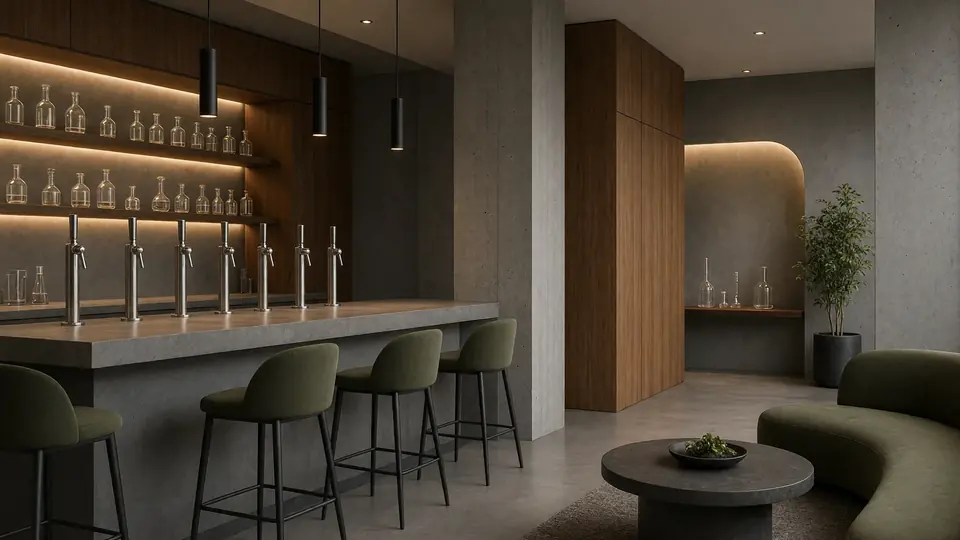
The design aesthetic is retro-futuristic, built from dark stone, brass, globe lights and slightly sci-fi details that create the feeling of wandering into a very well-designed version of the future. The room features thumbbacks, intimate corners, a long central bar, and enough space around the tables to make it work equally well for a date night or even a long lunch.
"We wanted to give people a reason to come out and enjoy an evening out. You have time to catch up with a friend in Chandigarh; the city's slow pace allows that, which I think is refreshing given how we all operate in the metros," says Akshay, who wanted to elevate the neighbourhood bar because he believes Chandigarh is ready for more complex and layered cocktails.
The laboratory approach to cocktails
The most obvious departure from conventional bar practice is that, technically, very little happens behind the bar itself. The Back Room operates as India's first pour-only cocktail bar, with its drinks made in a dedicated lab inside the Toy Hotel, in Room 404.
This space is Tanka and the other bartenders' playground, and access is, unsurprisingly, denied: although Saanya says that if they like you, they may bring guests in to sample cocktails they are working on. Recipes are developed, tested and measured in grams, then built, batched, rested and sealed in large-format bottles. When you order, the bartender pours the drink over ice.
The whole point of the pour-only format is precision and consistency, and the actual work has already happened in the lab. This approach has consciously taken the performance element out of the equation.
A numbering system inspired by the city
Even the menu has been given a Chandigarh treatment. Instead of cocktail names, drinks are identified by three-digit codes. Each number corresponds to the base spirit, method and flavour profile, a neat reference to the city's numbered sectors and its famously ordered grid.
It takes a minute to get your head around the system, and then it becomes oddly intuitive. The first digit tells you the base: 4 is whisky, Scotch or bourbon; 5 is tequila; 6 is vodka. The second tells you the method: 2 is integration, 3 is blend plus cryo/filtration, and 5 is maceration. The third is the profile: 4 is toasted, 3 is bitter/tart and 1 is acid.
Testing the coded cocktails
Three drinks on the menu demonstrate the range of this approach: 424, 533, and 651. The 424, whisky, brown rice, green tea and aromatic bitters, was probably the pick of the three. There is something quite nice about the way the brown rice and green tea pull whisky away from its more obvious, familiar territory without disguising it. The toasted note comes through without turning the drink into a dessert, and the bitters give it enough edge to keep going back to it.
The 533 was more immediate. Tequila, guava, kokum, green peppercorn, and pink salt sound almost like a list of things that should not necessarily be in the same glass, but the drink comes together surprisingly neatly. The guava gives it fruit without making it sweet, the kokum brings a clean sourness, and the peppercorn and salt give it a savoury little kick.
The 651, with vodka, cucumber, basil and malic acid, was the freshest of the three. The cucumber and basil do most of the talking, while the malic acid gives it that persistent, mouth-watering sourness. It is also the least challenging of the three, which isn't necessarily a bad thing.
What was missing, though, was the bartender. Something is engaging about sitting at a bar and telling the person behind it what you like, or don't like, and watching them figure out what to make you. The option of asking a bartender to make something would have been welcome.
Food designed to work with the drink
The food takes a less literal route. Chef Megha Kohli and Noah Barnes of Logic Hospitality have put together a small-plates menu that doesn't behave as the usual bar menu bolted onto a drinks programme. There is pani puri reworked as Mexican agua chile, jhol momos with sambal or tom kha, chili-coconut corn ribs, prawns off the plancha and burrata with charred peppers.
The menu moves through Fresh, Street, Fire and Slow and Smoky, with a shorter At the Bar section, and most of it is designed to be passed around the table. The idea is that the food should work with the drink, not compete with it.
A city with a serious drinking habit
What makes The Back Room interesting isn't just what is happening inside it. It is where the bar sits within a city that has always had a fairly serious drinking habit. Chandigarh does not need to be introduced to alcohol. The numbers alone make that clear.
The Chandigarh Administration's 2025, 26 liquor quota works out to roughly 38,000 750-ml bottles a day, with whisky leading the way. Imported foreign liquor is still a much smaller part of the market, but its quota has more than doubled from 3.5 lakh proof litres in 2021, 22 to 8 lakh in 2025, 26. This is not a city that suddenly discovered drinking because cocktails became fashionable.
What is changing is what people want around the drink. "Chandigarh bar culture is very much a work in progress," says Vikram Achanta, founder and CEO of Tulleeho and co-founder of 30BestBarsIndia and India Bartender Show.
There have been "a fair bit of stops and starts along the way," he says, which perhaps explains why the return of a place like The Back Room feels significant. Its opening, he adds, "gives some hope for some stirrings" when it comes to the further evolution of bar and cocktail culture in the city.
The evolution of going out
There have, after all, been several versions of a Chandigarh night. Chandigarh-based journalist Aarti Kapur Singh describes an earlier whisky-and-club era, when drinking was as likely to happen at home or behind the doors of a private club as at a destination bar. Then came the microbreweries and cafés, particularly around Sectors 7 and 26, which changed the social geography of going out.
Now there is a younger, considerably more travelled crowd that has seen what bars look like in Delhi, Mumbai, Singapore and everywhere in between, and has started bringing some of those ideas home. Aarti calls it a "fascinating transition phase".
Chandigarh still has an enduring appreciation for premium whisky and the old-school pleasures of drinking, but it is also absorbing global cocktail culture at a fairly rapid pace. The difference, she says, is that the city is sometimes more interested in the experience around a drink before it has fully developed an appetite for the complexity of the drink itself.
Vibe over pour
That is where the city's new bar culture gets interesting. Aarti puts it rather neatly: "The vibe over the pour". Going out has become social currency, and the bar itself is increasingly part of the occasion.
Nikhil Sood, Chandigarh-based Jameson brand ambassador at Pernod Ricard India, sees another advantage. The people interested in this kind of drinking are already fairly well travelled and, importantly, they know their drinks. In many cities, cocktail culture begins with sweet, easy drinks that barely taste alcoholic. Chandigarh, he says, seems to be experimenting differently, with bartenders putting together menus that are already "off the charts" in terms of flavour.
Whisky and tequila lead the way
Whisky, unsurprisingly, isn't going anywhere. "Whisky is always going to be the spirit of choice in the North because people inherently love it," Nikhil says. But tequila is increasingly entering the conversation.
Chandigarh's travellers see what is happening elsewhere, return home and want to try it here. He thinks whisky and tequila will be the city's big spirits, both because they have character and because drinkers are becoming less interested in spirits that disappear into a sugary cocktail.
The house party endures
And yet, for all this talk of cocktail culture, the house party remains stubbornly alive. "Chandigarh still loves entertaining at home, only the home bar has become considerably more ambitious. Caterers are brought in, mixologists are hired, and the evening can sometimes resemble a restaurant opening without anyone having to leave the house. The old instinct for hospitality hasn't disappeared," says Aarti.
That may be why The Back Room's decision to open from noon feels less like a gimmick than it first appears. It isn't insisting that a bar has to wait until evening to become relevant. For a city that has always had a relationship with drinking, the interesting change is that the drink itself is no longer enough. There is the room, the food, the design, the crowd, the conversation and, increasingly, the expectation that a night out should feel like something.
Source: The Hindu
Frequently asked questions
What is a pour-only cocktail bar?
A pour-only cocktail bar is where drinks are crafted in a laboratory with precision measurements rather than made at the bar counter. Recipes are developed, tested, batched, and sealed in bottles in advance, then the bartender simply pours the drink over ice when ordered. This approach prioritizes consistency and precision over performance.
Where is The Back Room located in Chandigarh?
The Back Room is located at The Toy Hotel in Chandigarh's Sector 34A. The cocktail lab where drinks are created is in Room 404 of the hotel.
Who designed The Back Room's physical space?
French interior architect Jean-Louis Deniot shaped the physical space. The design aesthetic is retro-futuristic, featuring dark stone, brass, globe lights, and sci-fi details, with intimate corners and a long central bar designed for comfortable conversation.
How are cocktails identified on the menu?
Cocktails are identified by three-digit codes instead of traditional names. Each number corresponds to the base spirit, method, and flavour profile, with the numbering system inspired by Chandigarh's numbered sectors.
Who leads the beverage program at The Back Room?
Tanka Gurung is the Beverage director who has redesigned the entire approach to cocktail crafting. Tanka and other bartenders work in the laboratory space where recipes are developed, tested, and prepared.
You may also like



Most read
- 1
Tesla audits Chinese suppliers to scale up Optimus robot production
- 2
Former minister Lakhan Singh Rajput to inaugurate temple bhandara at Shri Chakreshwar Mahadev
- 3
Firozabad BSA finds four government schools locked during inspection
- 4
Tamil Nadu dengue cases fall for third consecutive year to 17,049
- 5
Social workers stage silent protest at Fufund railway station for train halts
Comments
No comments yet. Be the first to comment.