
CCPA cracks down on misleading "100%" food labels, fines manufacturers for false purity claims
Central Consumer Protection Authority fines food manufacturers for misleading '100%' labeling. Bread with 87% wheat and reconstituted juice face penalties.

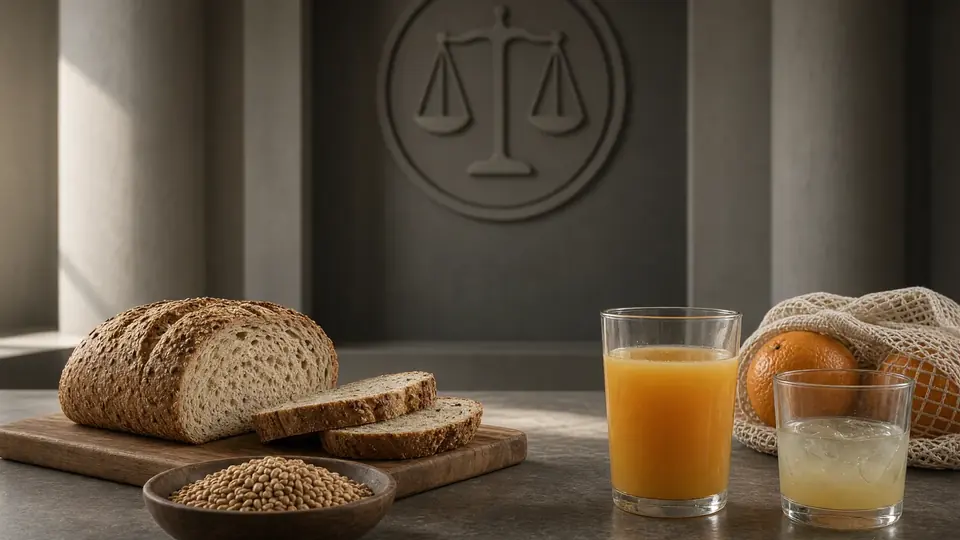
The Central Consumer Protection Authority has begun penalising food manufacturers whose packaging carries "100%" claims that do not reflect actual ingredient proportions, arguing that such labelling misleads shoppers into believing they are buying products of absolute purity or completeness.
'100%' must mean exactly that
The crackdown stems from cases in which headline claims diverged sharply from ingredient declarations. In June 2026 the CCPA fined Mrs. Bectors Food Specialities and Storia Foods and Beverages ₹1 lakh each and ordered them to remove the disputed claims from all packaging, websites and digital platforms. Mrs. Bectors had marketed bread as "100% Atta Bread" and "100% Whole Wheat Bread" even though the loaf contained 87 per cent whole wheat flour. The company argued that "100% Atta" simply meant wheat flour was the only grain used, but the Authority rejected the defence, stating that "100%" is an exact numerical expression and should not be used loosely or approximately. Pairing the claim with "Zero Maida" reinforced the impression that consumers were buying bread made entirely from whole wheat.
Reconstituted juice faces identical scrutiny
Storia's coconut water carried a "100% Tender Coconut Water" label yet listed water and 9.6 per cent coconut water concentrate among its ingredients, with a footnote reading "Equivalent to 100% Coconut Water" and "Reconstituted". The CCPA ruled that ordinary consumers would read the prominent front claim as a promise of pure tender coconut water. The same reasoning applied to Storia's "100% Juice" range: the pomegranate variant contained water, 4 per cent pomegranate juice concentrate and 10 per cent apple juice concentrate, while the mango version held water, 16 per cent mango pulp and 12.5 per cent apple concentrate.
Fine print cannot rescue a misleading front panel
The Authority has made clear that burying correct information in an ingredient list does not cure a misleading headline claim, because shoppers typically see the front of a packet before turning it over. In the case of McVitie's Wholewheat Marie biscuits, which contained 19.5 per cent whole wheat flour and 52 per cent refined wheat flour, the CCPA found that the prominent "Wholewheat" descriptor and wheat imagery led consumers to expect a product predominantly made from whole grain. Pladis India's argument that "Wholewheat" formed part of a registered trademark made no difference, and a disclaimer on the pack did not override the overall impression.
Two regulators, overlapping mandates
The Food Safety and Standards Authority of India advised food businesses in May 2025 to stop using "100%" altogether, noting that the term lacks a definition under existing regulations and risks creating a false impression of absolute purity or superiority. A year earlier, in June 2024, FSSAI had specifically directed companies to drop "100% Fruit Juice" claims from reconstituted products. While FSSAI enforces labelling standards under food-safety law, the CCPA addresses consumer protection: under Section 21 of the Consumer Protection Act it can order the discontinuation or modification of false or misleading advertisements and impose penalties of up to ₹10 lakh, rising to ₹50 lakh for repeat violations.
The twin interventions signal that product names, imagery and front-panel wording will all be weighed when authorities assess the risk of consumer deception. For shoppers, the ingredient list remains the surest guide to what a packet actually contains.
Source: The Hindu
Frequently asked questions
Why is the CCPA cracking down on '100%' food labels?
The CCPA argues that '100%' claims mislead consumers when they don't reflect actual ingredient proportions. The Authority treats '100%' as an exact numerical expression and has ruled that such claims must mean the product is entirely made of that ingredient, not loosely or approximately.
What happened to Mrs. Bectors and Storia Foods for their labeling?
In June 2026, the CCPA fined both companies ₹1 lakh each and ordered them to remove disputed claims from all packaging and digital platforms. Mrs. Bectors had marketed bread as '100% Atta Bread' despite it containing only 87% whole wheat flour. Storia labeled coconut water as '100% Tender Coconut Water' when it was actually reconstituted with only 9.6% coconut water concentrate.
Can fine print disclaimers on packaging justify misleading front-label claims?
No. The CCPA has ruled that burying correct information in an ingredient list does not cure a misleading headline claim, because shoppers typically see the front of a packet first. A prominent claim that contradicts the actual contents remains misleading regardless of disclaimers or fine print.
What guidance has FSSAI provided to food manufacturers?
In May 2025, FSSAI advised food businesses to stop using '100%' altogether, noting that the term lacks a definition under existing regulations and risks creating a false impression of absolute purity or superiority. FSSAI had also specifically directed companies to drop '100% Fruit Juice' claims from reconstituted products in June 2024.
You may also like
 National
Zomato bans analogue cheese dishes, threatens to remove non-compliant restaurants
 Religious
Food safety team destroys 35kg contaminated sweets in Jahangirabad raid
 Uttar Pradesh
FDA intensifies food safety crackdown in Bahraich ahead of Raksha Bandhan
 Uttar Pradesh
Food Safety Department seizes adulterated sweets, paneer ahead of Rakshabandhan
Most read
- 1
Tesla audits Chinese suppliers to scale up Optimus robot production
- 2
Former minister Lakhan Singh Rajput to inaugurate temple bhandara at Shri Chakreshwar Mahadev
- 3
Firozabad BSA finds four government schools locked during inspection
- 4
Tamil Nadu dengue cases fall for third consecutive year to 17,049
- 5
Social workers stage silent protest at Fufund railway station for train halts
Comments
No comments yet. Be the first to comment.