
Bengaluru AI Traffic System Mistook Guitar for Passenger, Triggering Wrong Challan
Bengaluru's AI traffic system mistook a guitar for a pillion rider, highlighting errors in automated challans and the need for human verification.

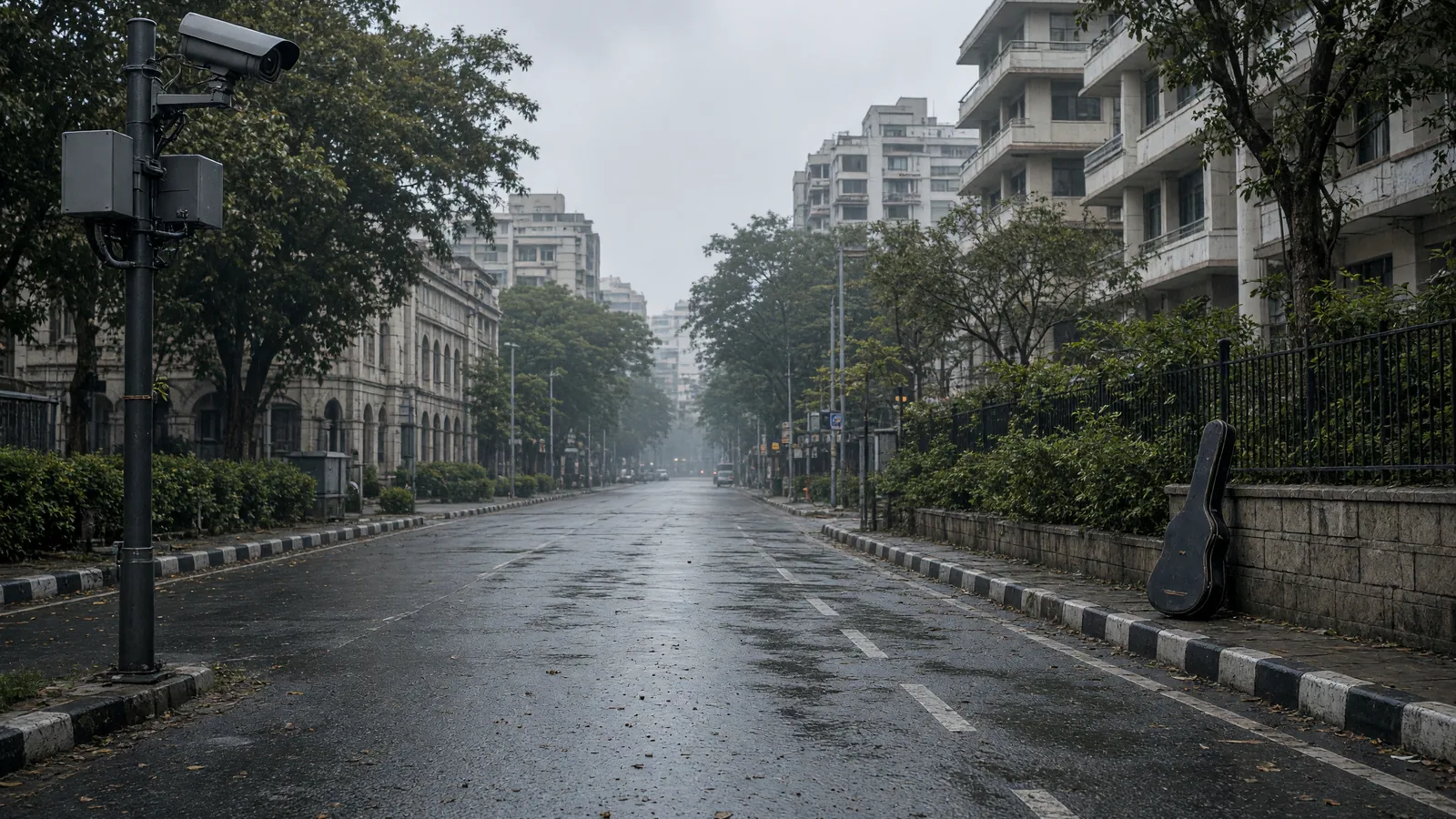
How accurate is Bengaluru’s AI traffic enforcement? | Explained
Bengaluru Traffic Police says its artificial intelligence-based traffic enforcement system has improved over the past two years, but officers still need to verify at least some violations before a challan is issued.
That position follows an incident in which the system identified a guitar strapped to a motorist’s back as a human passenger and generated a challan for pillion riding without a helmet.
The episode exposed the central tension in Bengaluru’s technology-led traffic enforcement: artificial intelligence can process large volumes of violations, but it can also misread objects, road markings, clothing and traffic movements.
How the guitar became a traffic violation
In mid-September, a Bengaluru motorist received an online traffic violation challan.
When he checked the Bengaluru Traffic Police’s e-challan website, he found that the alleged violation was pillion riding without a helmet.
The motorist, however, had no pillion on his scooter.
He later realised that the guitar strapped to his back had been wrongly flagged by the BTP’s Artificial Intelligence-based violation flagging system, which mistook it for a human.
A senior traffic police officer told The Hindu that the incident was a judgement error by an AI camera that forms part of the BTP’s Intelligent Traffic Management System, or ITMS.
The violation was subsequently sent for manual review, but a challan was issued because of human oversight as well.
That distinction is important because the error did not arise only from the camera’s initial interpretation.
The system wrongly identified the object, and the subsequent review did not prevent the challan from being issued.
The incident raised questions online about the accuracy of AI systems and about the limitations of using AI in smart policing and the enforcement of rules.
It also brought attention to the way contactless challans are generated, reviewed and challenged in Bengaluru.
Three systems issue contactless challans
The BTP uses three systems to raise contactless challans: the Intelligent Traffic Management System, Field Traffic Violation and Regulation Analytics, and Public Eye.
The ITMS was adopted in Bengaluru in December 2022 with the objective of minimising human intervention in issuing challans and deploying more officers for traffic regulation.
It uses artificial intelligence and machine learning to detect traffic violations automatically.
The resulting feed is sent to the Traffic Management Centre, which is the BTP’s head office.
The FTVR system works differently because traffic police officers capture pictures of violators or vehicles involved in violations and raise challans online.
Public Eye allows citizens to take pictures and upload them anonymously through the BTP application.
Together, these systems have shifted a large share of traffic enforcement away from physical interception and towards technology-based detection.
The ITMS is therefore not the only route through which a contactless challan can be issued.
That matters when comparing the performance of different enforcement methods, since a challan raised after an officer takes a picture is not the same as one initially identified by an AI camera.
The BTP’s 99% accuracy claim
Karthik Reddy, Joint Commissioner of Police (Traffic), has claimed that the ITMS has nearly 99% accuracy with minimal human intervention.
He also said that wrong flagging is negligible.
The available challenge figures, however, do not by themselves establish that the system is 99% accurate.
The Hindu reviewed Actionable Intelligence for Sustainable Traffic Management data, an initiative of the BTP that uses AI for traffic management.
The data showed that the BTP issues an average of nearly 26,500 challans through contactless means every day.
Of these, over 19,000 challans are generated after violations are identified through AI cameras.
An average of 25 cases, or 0.13% of cases, are challenged every day out of those 19,000 challans.
But the 0.13% challenge rate cannot be treated as a measure of AI accuracy.
Once the ITMS detects a violation, a team at the Traffic Management Centre reviews the violation flagged by the system before a challan is generated, Reddy explained.
That means the number of challenges reflects what happens after the system’s output has already been reviewed.
It does not show how many potential errors were identified and corrected during that review.
Another senior officer said that after cases rectified by the team during manual review are included in the assessment, AI accuracy could fall to about 90%.
The two figures, therefore, describe different stages of the process.
The nearly 99% figure is the claim made for the ITMS with minimal human intervention, while the estimate of about 90% takes into account cases corrected through manual filtering.
Accuracy has varied by violation
By the end of 2023, the BTP had identified that the system’s accuracy had dropped to 80%.
The problem was particularly visible in violations such as pillion riding without a helmet, seatbelt violations and signal jumping.
The BTP says that the accuracy level has since been scaled up over the past two years.
A senior officer said, “Despite machine learning and constant feeding of data having improved the system, we need human intervention, at least to verify some aspects.”
He added, “We cannot completely rely on AI.”
The comments indicate that the system’s performance is not uniform across every kind of violation.
A camera may perform differently when identifying a missing helmet, a seatbelt, a signal violation or a defective number plate.
The BTP has also acknowledged limitations in collecting enormous amounts of data for specific aspects of enforcement.
One example is the difficulty of correctly identifying a seatbelt when its colour is close to the colour of the motorist’s shirt.
The BTP has said that achieving 100% accuracy in such areas is a very long process.
What the ITMS mainly flags
The ITMS can flag over 10 violations, but it predominantly identifies eight.
These are riding without a helmet, pillion riding without a helmet, driving without a safety belt, jumping a traffic signal, a defective number plate, using a phone while driving, no entry and triple riding.
ASTraM data for contactless challans issued in 2026 showed that 29% of cases involved riding without a helmet.
Wrong parking accounted for 21% of the cases.
Pillion riding without a helmet and jumping a traffic signal accounted for 14% each.
Another 6% involved driving without a seat belt, while the remaining cases related to other violations.
The pattern was different for contact challans.
Among those challans, 38% of cases involved no entry, or one-way violations.
Wrong parking accounted for 12%, while riding without a helmet and pillion riding without a helmet accounted for 7% each.
Traffic police sources and previous requisitions assessed by The Hindu indicated that most erroneous ITMS flaggings were related to wearing helmets and jumping traffic signals.
These categories also illustrate why a violation can be difficult for an automated system to interpret when the surrounding circumstances are not fully captured.
How ordinary road situations create errors
A motorist who removes a helmet for a prolonged period while waiting for a signal to turn green is likely to be flagged by the system as committing a violation.
The system may not distinguish between a person who has removed a helmet temporarily while waiting and a person who is riding without one.
There have also been cases at junctions where right turns are paused after a brief period while vehicles travelling straight are allowed to proceed.
In such situations, commuters have challenged ITMS challans for identifying them as having jumped a signal even though they were driving straight.
The issue is not necessarily the absence of a traffic signal.
It is the system’s interpretation of the movement permitted at a particular junction.
Number plates have also been flagged as faulty because of variations in fonts.
Individuals wearing black shirts have been flagged for driving without a safety belt because the colour frequency of the shirt was closer to that of a seat belt.
The flagging occurred even when the individuals had fastened their seat belts.
The BTP is attempting to improve the system’s accuracy, but sources said that collecting enough data for specific situations, including the colour relationship between a seat belt and a shirt, remains a limitation.
The guitar incident fits into this wider pattern of an automated system interpreting an object or visual detail incorrectly.
Why human review remains necessary
The BTP says that the best results come from balancing AI systems with human intervention.
It also acknowledges that certain anomalies will occur.
The senior officer’s example of faded zebra-crossing lines shows why enforcement cannot always be separated from the condition of the road.
At several junctions where ITMS cameras are installed, the zebra-crossing line has faded.
Motorists may not notice the line, but even a minor inconsistency of this kind can be flagged by the ITMS.
The officer said these violations are not actively booked in many cases because civic bodies may be at fault for not painting the zebra-crossing lines.
He explained that human intervention is necessary in such instances.
This places a limit on what an automated system can decide from an image alone.
The image may show a technical inconsistency, but an officer may still need to assess whether issuing a challan is appropriate.
Reddy, however, said FTVR flaggings are challenged more often than ITMS flaggings.
He said officers often take pictures of violations at places where there are no traffic signs.
Those cases have to be dismissed if they are challenged.
The comparison suggests that human involvement does not automatically eliminate disputes.
It can prevent some automated errors, but an officer’s photograph and decision can also be questioned when the road does not have the sign required to support the violation.
How motorists can challenge a wrong challan
The BTP’s ASTraM application provides several services, including planning a commute route, e-FIRs and paying traffic fines.
Citizens can use the application to check challans issued against their vehicles.
The application also displays images connected with the violation.
These images may have been taken by the police, uploaded by citizens or captured by ITMS cameras.
For every violation flagged, the system allows citizens to raise a dispute and provide a detailed description explaining why the challan is erroneous.
The BTP also permits citizens to raise objections through its website.
A challan can additionally be disputed by email or by visiting a Traffic Management Centre in person.
These channels are significant because a wrong flagging may not be obvious from the challan description alone.
The image attached to the challan can show whether the alleged passenger was actually an object, whether a helmet was removed only while waiting, or whether a vehicle was travelling in a permitted direction.
The source does not state how many such disputes are accepted through each channel.
It does establish that citizens have multiple ways to object and provide an explanation before the violation is treated as valid.
Contactless enforcement is still dominant
Around 7.9 lakh contactless challans are issued every month, accounting for 87% of the BTP’s total challans.
By comparison, around 1.05 lakh challans are issued through physical interception each month.
The monthly total is 9, 9.1 lakh challans.
The figures show the scale at which the BTP now relies on contactless enforcement.
They also show why even a small error rate can affect a substantial number of motorists when the system processes large volumes of cases.
The introduction of ITMS in 2022 was intended partly to curb manual checking, which had often led to complaints of harassment.
Several accidents were also reported that year while commuters tried to avoid being caught by traffic police.
M.A. Saleem, the current head of the police force and DG&IGP of the State, was the Special Commissioner of Traffic for Bengaluru city in 2022.
He had said there would be minimal on-ground interception of commuters and that only visible violations would be intercepted.
In 2022, 97% of the total cases booked were through contactless systems, relying on technology and other interventions.
That percentage dropped to 93% in 2024 and further to 88% in 2025.
In the current year, the percentage is around 87%.
Why the BTP is increasing physical checking
Traffic police sources said citizens had stopped paying traffic fines despite challans being issued, while several violations also went unchecked.
Serious violations such as drunk driving fell to 6,000 in 2023, compared with an average of around 35,000 earlier.
Traffic police sources said this raised safety concerns.
A senior officer said, “There was no fear of fines at all, which is a major tool for traffic rules enforcement.”
He said the BTP therefore had to balance technology-based enforcement with the deterrent effect of on-ground checking.
The officer said, “So, we are required to strike a balance between using technology for smooth enforcement while also keeping the fear of fines. Thus, we increased on-ground checking as well.”
The department has been ordered not to intercept anyone during peak hours unless there is a visible violation.
As a result, vehicle checking has increased substantially in the city during non-peak hours over the past year.
This marks a shift from the original emphasis on limiting manual checking, even though contactless challans continue to account for the larger share of enforcement.
What the accuracy question really means
The Bengaluru experience does not support treating AI accuracy as a single fixed number.
The BTP’s nearly 99% claim, the estimate of about 90% after manual corrections and the 80% accuracy identified by the end of 2023 refer to different points in the system’s development and review process.
The challenge rate of 0.13% cannot settle the question because violations are reviewed before challans are generated.
At the same time, the examples of the guitar, faded zebra-crossing lines, helmet removal, signal movements, number-plate fonts and shirt colours show why automated detection can produce incorrect results.
The BTP is continuing to improve the system through machine learning and the constant feeding of data.
It has also acknowledged that collecting sufficient data for every visual and traffic circumstance is difficult.
For now, the system’s value lies in its ability to process the volume of violations that a largely manual system could not handle.
Its limitation is that the final decision may still require a person to assess context, road conditions and the details visible in an image.
The BTP’s own approach is therefore neither complete reliance on AI nor a return to purely manual enforcement.
It is a system in which technology identifies and processes violations at scale, while human review remains necessary to correct anomalies and decide whether a challan should stand.
Source: The Hindu
Frequently asked questions
Why did Bengaluru’s AI traffic system issue a challan to the motorist?
It mistook a guitar strapped to the motorist’s back for a human passenger and identified the incident as pillion riding without a helmet.
Was the challan issued solely because of the AI camera’s error?
No. The violation was sent for manual review, but human oversight also failed to prevent the challan from being issued.
What does Bengaluru’s Intelligent Traffic Management System do?
It uses artificial intelligence and machine learning to automatically detect traffic violations and send the resulting feed to the Traffic Management Centre.
What other systems does Bengaluru Traffic Police use for contactless challans?
It also uses Field Traffic Violation and Regulation Analytics and Public Eye, which allow officers or citizens to submit images of traffic violations.
You may also like
 National
Bahraich traffic police issue 610 challans, collect Rs 8.39 lakh in safety drive
 Uttar Pradesh
Bahraich traffic police issue 435 challans in road safety drive
 Karnataka
Bengaluru to Host Himachali Sangam for 3,000-Strong Community Gathering
 Uttar Pradesh
Hathras drivers allege arbitrary challans, bribe demands during overloading crackdown
Most read
- 1
Air China Adds Extra Flight for Passengers Stranded in Fuel-Starved Cuba
- 2
Western disturbance to bring rain, hail and strong winds across north India
- 3
Yogi Adityanath Directs No Occupied Houses Be Demolished for Achhalda Bridge
- 4
Gwalior Temple Truck Crash Kills 12, Injures 28-29 Devotees During Navratri
- 5
Heavy Rain Waterlogs Bengaluru, Snarls Traffic; Ride-Hailing Fares Surge
Comments
No comments yet. Be the first to comment.