
Women farmers in Telangana turn to drones, ditching pesticide sprayers for health
Women farmers in Telangana are adopting drone technology for pesticide spraying, reducing health risks and creating new agricultural business opportunities

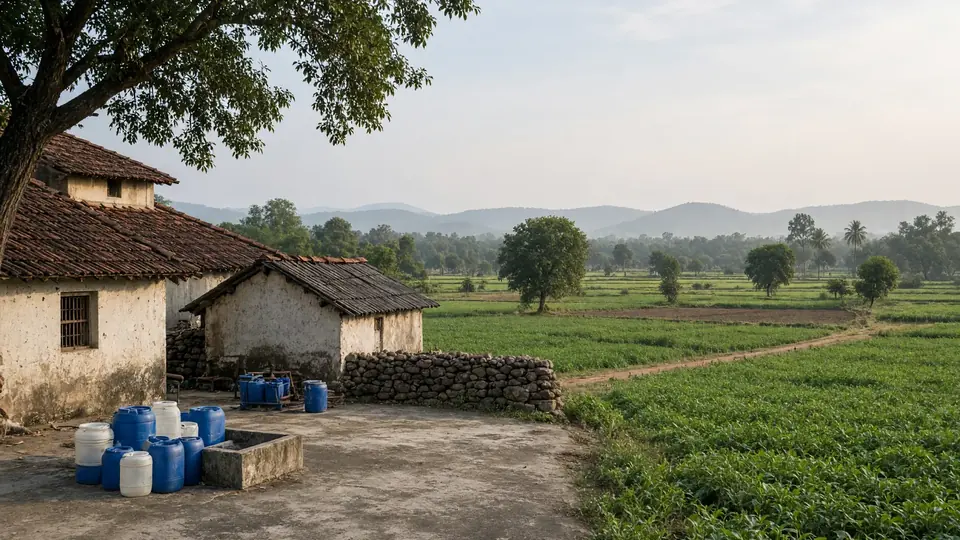
Women take the controls as farms embrace new tech in Telangana
Usirika Sandhya manoeuvres a drone over her paddy field in Motakondur village, completing in minutes what would demand hours of gruelling manual labour with a hand sprayer. The 33-year-old farmer is steering pesticide coverage across her crop with precision, but her motivation extends far beyond efficiency.
Sandhya's decision to invest in drone technology stems from watching her husband Mahesh suffer health consequences after prolonged exposure to pesticide spraying every crop season. That personal concern has now evolved into a professional venture, positioning her at the forefront of a broader transformation unfolding across rural Telangana where women from self-help groups are claiming new roles as drone pilots and technology-driven agricultural entrepreneurs.
Health concerns drive technology adoption
"Every crop season, my husband spends hours spraying pesticides with a hand sprayer, and the work takes a toll on his health. So, I wanted to find a solution and invested in a drone, seeing its growing use in villages," Sandhya explains. She and Mahesh, who holds an Industrial Training Institute qualification while she has studied till Class 10, cultivate cotton and paddy across approximately 15 acres in Motakondur village, though only two acres are their own land.
The drone's arrival in Motakondur village, located in Yadadri-Bhuvanagiri district, drew crowds of curious villagers as it hummed overhead. For Sandhya, the technology represents both a solution to an immediate family health crisis and the opening of an entirely new livelihood path.
Government partnership enables women's entry into drone piloting
Sandhya learned that the Society for Elimination of Rural Poverty (SERP) was actively encouraging women to train as drone pilots and reached out to Zilla Samakhya, the district federation, along with District Rural Development Agency officials for both financial support and training. She completed a 10-day training programme that equipped her with the skills to operate the drone.
The drone unit she received comprises a battery-operated vehicle designed to safely transport the drone, and was formally handed over to her during Independence Day celebrations at Bhuvanagiri, the district headquarters, on August 15 this year. The complete unit carried a price tag of ₹7.90 lakh.
Sandhya is one among 35 women from self-help groups spread across 13 mandals who have received training from the DRDA to pursue modern, technology-based livelihood opportunities. The DRDA has forged partnerships with pharmaceutical major Hetero and MIRAI, a company that supplies agricultural products and connects local farmers with global trade channels, to deliver this training. In neighbouring Nalgonda district, around 50 people have also been trained, according to MIRAI.
District administration supports technology-driven self-employment
Yadadri District Collector Anuraag Jayanti characterises the initiative as aimed at "helping the trained women create self-employment opportunities" while simultaneously providing farmers access to modern, technology-driven agricultural services.
For Sandhya, the drone represents a significant financial investment that she expects will eventually generate returns sufficient to justify its cost. She is currently awaiting her Remote Pilot Certificate from the Directorate General of Civil Aviation (DGCA) and plans to offer drone-based agricultural services to other farmers once certified.
Even while completing her training and certification process, Sandhya has begun constructing a professional identity for her venture, developing branding and marketing material and already receiving initial enquiries from potential customers. "I am optimistic that within a few years, I can clear the bank loan for the drone," she states.
More women embrace agricultural technology
Sandhya's journey reflects a pattern emerging across the district. P. Jhansi, 29, from Aregudem village in Yadadri Bhuvanagiri district, is among those trained under the same programme and is awaiting clearance for her application under the Prime Minister's Employment Generation Programme (PMEGP), a credit-linked subsidy scheme operated by the Ministry of Micro, Small and Medium Enterprises.
"I had never imagined flying a drone for agricultural operations since we were involved in age-old traditional methods of farming. But thanks to the government's initiatives, we are now using the latest technologies," Jhansi says.
Financial support mechanisms for drone entrepreneurs
The financial viability of this model remains a crucial consideration as more women undergo training. District Rural Development Officer T. Nagi Reddy explains that efforts are underway to help trainees access PMEGP. "Eligible applicants can get government subsidy of up to 35% of the unit cost," he adds.
For the women entering this field, mastering drone flight represents only the initial step. MIRAI director N. Vijaya Suseel emphasises that the programme also concentrates on helping them build a complete business around the technology. "The trainees are supported in mobilising farmers, conducting field demonstrations, acquiring customers, scheduling drone operations, managing the business and providing service support," he explains.
Self-help groups expand into technology sectors
This shift is propelling self-help groups beyond their traditional roles in thrift, microcredit and small enterprises, with women increasingly entering technology-intensive and emerging sectors. SERP Chief Executive Officer Divya Devarajan says the organisation plans to train additional women as drone pilots, particularly those from agricultural families.
"SHG members have already demonstrated their ability to run small and medium businesses, and have recently entered the solar sector under the Indira Mahila Shakti scheme," she adds.
The initiative has attracted national attention. Prime Minister Narendra Modi has praised 53 SHG members from Sangareddy district who learned drone operation through the DRDA in May last year. They are, however, reportedly yet to receive drones because of policy-related issues.
Artificial intelligence and digital tools reach farmland
The State's efforts to integrate technology into agriculture extend well beyond drones. Farmers are increasingly deploying artificial intelligence, mobile applications and other digital tools to inform decisions on weather, crop management, irrigation and markets.
Namireddy Srinivas Reddy, a farmer from Molkapatnam village in Nalgonda district and a practising advocate, uses large language model tools such as ChatGPT for information on pest and fertiliser management. He also employs artificial intelligence-based apps to check weather forecasts before spraying pesticides in his sweet lime orchard and to track daily lime prices. Some farmers are also experimenting with remotely operated smart drip-irrigation systems, he says.
Young entrepreneurs promote digital farming practices
For 26-year-old Byram Madhu of Munjampalli village in Endapalli mandal of Jagtial district, digital technology is helping promote more efficient farming practices. He works for a Hyderabad-based climate-tech company developing carbon-credit and regenerative-agriculture projects and encourages farmers to reduce water use in paddy through the company's mobile app, which uses digital field data and satellite-based monitoring.
Tipparti Ajay, also from Munjampalli, owns a harvester and tractor and undertakes tilling work for farmers. He says weather apps and digital tools for measuring land are increasingly proving useful in his work.
These individual uses of technology form part of Telangana's broader effort to build a digital agriculture ecosystem. The State's Information and Communications Technology (IT&C) Policy, launched in 2016, identified technologies such as drones, artificial intelligence (AI), blockchain, machine learning and cloud computing as areas for development.
State builds institutional framework for digital agriculture
An Emerging Technologies Wing was established within the IT&C Department in 2018, followed by a specialised Digital Agriculture Wing as the nodal agency for technology adoption in agriculture. The State has been working with the Agriculture Department to promote data-driven policymaking and technology-based solutions, including the use of drones, AI and the Internet of Things (IoT) for crop-health monitoring, pest prediction, soil-nutrient testing, quality assessment and market linkages.
Partnerships with research and technology organisations are also being used to provide farmers with evidence-based advisories and improve crop planning.
"At our Centre for Digital Agriculture and Technology at Rajendranagar, the Professor Jayashankar Telangana Agricultural University is using AI, IoT, remote sensing, Geographic Information Systems (GIS), drones and robotics for climate-smart and precision agriculture," says university Vice-Chancellor Aldas Janaiah.
Agricultural university develops specialised technology infrastructure
The centre houses specialised units such as the Agro Climate Research Unit, the All India Coordinated Research Project on Farm Implements and Machinery Unit, the Remote Sensing and GIS Lab, the PJTAU Drone Academy and the SBI ARISA Lab. Their work spans farm mechanisation, digital advisories, weather-based agrometeorological services, crop monitoring, drone pilot training and smart farming technologies.
PJTAU has also contributed to the development of crop-specific Standard Operating Procedures (SOPs) for spraying pesticides on crops using drones. It has developed a drone-based package of practices for wet direct-seeded rice covering the application of herbicides, nutrients and pesticides.
The university has also strengthened its drone-training capabilities. Four faculty members completed DGCA-certified Master Trainers Training in 2024. The DGCA has approved the PJTAU Drone Academy to offer dual certification for small- and medium-category drone pilot training, making it the first institution among Remote Pilot Training Organisations (RPTOs) and State Agricultural Universities in the Telugu States to receive such recognition. The academy has trained as many as 780 remote pilots.
Technology push creates agri-tech entrepreneurship opportunities
The technology push is also creating space for agri-tech entrepreneurship. Agri & Food Innovation Hub (AgHub), a hub-and-spoke incubator with its Innovation Hub at the PJTAU campus in Hyderabad, supports agri-tech and food-tech start-ups and student entrepreneurs from across the country.
Meanwhile, the Association for Innovation Development of Entrepreneurship in Agriculture (a-IDEA), the technology business incubator of the ICAR-National Academy of Agricultural Research Management (ICAR-NAARM), Hyderabad, has supported more than 350 agri-start-ups through incubation, acceleration and mentoring programmes. More than 92 startups have been accelerated through its AGRI UDAAN Food and Agribusiness Accelerator Programme.
It has facilitated nearly ₹25 crore in grants and seed funding, while startups supported by it have collectively raised about ₹160 crore from private investors. The startups work across different areas including AgTech, FoodTech, biotechnology, AI, robotics, farm mechanisation, supply chains and sustainability.
"The success of our startups and the impact created at the grassroots level, benefiting more than 1.5 lakh farmers, reflect the transformative potential of technology and entrepreneurship in agriculture," says Raman Meenakshi Sundaram, director of ICAR-NAARM and president of a-IDEA.
Structural constraints limit digital agriculture adoption
The spread of digital agriculture is, however, not without hurdles. While AI and other technologies can improve productivity, resource efficiency and farm-level decision-making, their adoption is constrained by the structure of Indian agriculture itself.
More than 85% of operational holdings are in the small and marginal category, according to the latest Agriculture Census, limiting the economies of scale needed to deploy some advanced technologies. Low farm incomes and indebtedness can further restrict farmers' ability to invest in digital tools, while gaps in digital literacy and internet use remain in rural areas, as indicated in studies conducted by the National Bank for Agriculture and Rural Development (NABARD), National Statistical Office and other institutions.
Last-mile connectivity and other infrastructure gaps also continue to pose challenges in several villages.
For Telangana's farmers and rural entrepreneurs, therefore, the question is no longer whether technology can enter the field. It is whether the ecosystem around it, training, finance, connectivity, services and market access, can keep pace with the technology itself.
Source: The Hindu
Frequently asked questions
Why are women farmers in Telangana switching to drones for pesticide spraying?
Women farmers are adopting drone technology primarily due to health concerns from prolonged pesticide exposure. Farmer Usirika Sandhya invested in a drone after witnessing her husband suffer health consequences from seasonal hand sprayer use. Drones complete pesticide coverage in minutes compared to hours of manual labor, while reducing direct chemical exposure.
How are women farmers trained to operate agricultural drones?
Women from self-help groups receive training through government partnerships. The Society for Elimination of Rural Poverty (SERP), District Rural Development Agency (DRDA), and organizations like pharmaceutical company Hetero and MIRAI provide 10-day training programs. Sandhya completed this training to operate her drone unit.
What support do women farmers receive to adopt drone technology?
Women farmers receive financial support and training from government agencies including Zilla Samakhya (district federation) and the District Rural Development Agency. The complete drone unit, which includes a battery-operated transport vehicle, costs ₹7.90 lakh and is formally handed over to trained farmers.
How many women farmers have been trained as drone pilots in Telangana?
In Yadadri-Bhuvanagiri district, 35 women from self-help groups across 13 mandals have received training from the DRDA. Additionally, around 50 people have been trained in neighboring Nalgonda district through the same initiative.
You may also like
 National
Ex-servicemen, widows in Telangana to get higher welfare grants
 National
Telangana's 2.6 million MSMEs urged to adopt cleaner industrial technologies
 Agriculture
Irrigation Minister blames El Nino and previous govt for farmer crisis
 Weather
IMD warns of thunderstorms and lightning across 25 Telangana districts
Most read
- 1
Tesla audits Chinese suppliers to scale up Optimus robot production
- 2
Former minister Lakhan Singh Rajput to inaugurate temple bhandara at Shri Chakreshwar Mahadev
- 3
Firozabad BSA finds four government schools locked during inspection
- 4
Tamil Nadu dengue cases fall for third consecutive year to 17,049
- 5
Social workers stage silent protest at Fufund railway station for train halts
Comments
No comments yet. Be the first to comment.