
Supreme Court to consolidate Satya Niketan collapse cases for unified oversight
Supreme Court transfers Delhi High Court cases on Satya Niketan building collapse for unified oversight, focusing on unauthorized commercial use in residen

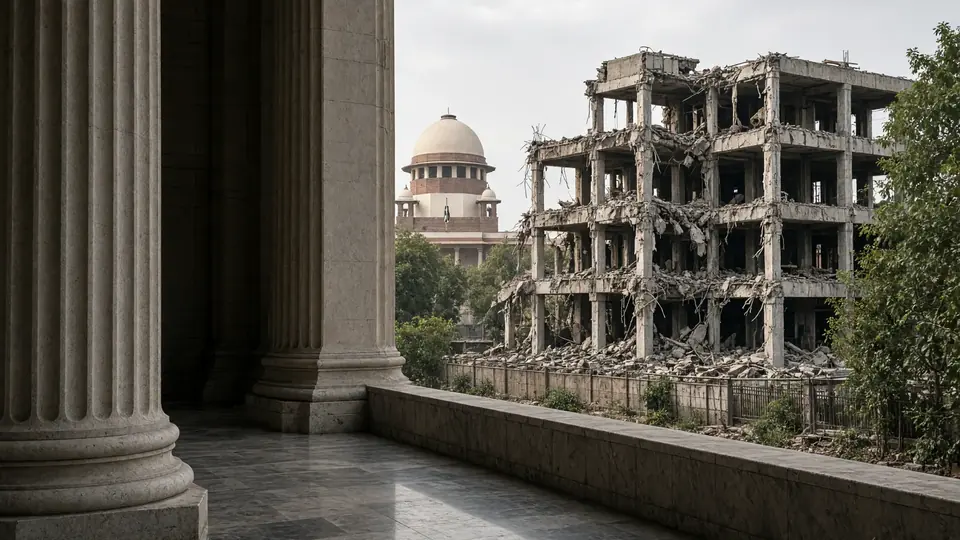
Supreme Court Signals Transfer of Delhi High Court Cases Related to Satya Niketan Tragedy
The Supreme Court has indicated it will transfer all pending cases related to the Satya Niketan building collapse from the Delhi High Court to itself, taking cognizance of an amicus curiae report during a significant hearing. The decision aims to enable unified monitoring of the entire matter, with the apex court focusing its attention on non-conforming use, the violation of rules in residential areas.
Focus on Unauthorized Commercial Activities in Residential Zones
The court observed that in areas declared as residential, commercial activities are being run in violation of norms, and stated it would personally monitor the entire matter. According to the apex court, violation of land use, meaning the breach of designated use of land, is a major problem that endangers the safety of common people and students.
The amicus curiae report presented in the case recommended periodic safety inspections of PG accommodations, private hostels and student residences built around all colleges and universities in Delhi. According to the report, these buildings should be inspected within defined limits for their plans, construction work, basement use, structural strength, fire safety and entry-exit routes.
"We Are on the Same Side": Court's Collaborative Approach
The Supreme Court stated, "We are not taking this matter in an adversarial or opposing manner". Addressing the Solicitor General, the court said, "Without your assistance we will not succeed, we are all on the same side".
In a separate development during proceedings, a bench comprising Justice Ahsanuddin Amanullah and Justice R. Mahadevan commenced the hearing by stating that it proposes to issue directions to stop the use of land in violation of norms in Delhi. The bench observed, "The condition of residential areas in Delhi is deplorable... children cannot play, the elderly cannot walk".
Dire Conditions in Residential Areas: Court's Observations
Expressing concern over the building collapse in Satya Niketan, Justice Amanullah remarked, "They stuff hundreds of them into one room, like sardines are packed in a tin. Is that structure capable of bearing such weight? There is neither proper arrangement for entry-exit, nor anything else".
Justice Amanullah made this observation when senior advocate Ajit Kumar Sinha mentioned gyms, coaching centers and BPOs, stating that large-scale violations of norms could be happening at these places as well. He told the bench that during the inspection conducted pursuant to the apex court's previous order, buildings were found in Saidulajab area of south Delhi where approximately 500 people were working.
The five-storey building with paying guest (PG) facility for boys in Satya Niketan near South Campus of Delhi University collapsed on Sunday, killing seven students and injuring 12 people.
Satya Niketan Cases to Continue in High Court
The Supreme Court clarified that it is not transferring the proceedings ongoing in the Delhi High Court regarding the Satya Niketan building collapse to itself because "action has commenced in the matter". The apex court stated that it does not want to make any changes to the existing situation and the High Court will continue to monitor compliance with its directions at short intervals.
The bench of Justice Ahsanuddin Amanullah and Justice R. Mahadevan passed this order while considering a suggestion by senior advocate Ajit Kumar Sinha, who is playing the role of amicus curiae in the matter.
Senior advocate Sinha told the bench that he had learned from his sources and media reports that civic bodies have initiated action against illegal construction and PG accommodations, and buildings taller than four storeys are being demolished. He said, "In my opinion, if the matter is transferred from the High Court, everything will stop".
However, he emphasized that the Supreme Court's earlier directions for action against illegal construction and land use change (where residential buildings are used for commercial purposes) should be complied with.
Court Rejects Adversarial Framework
The Supreme Court stated that it has never viewed this matter as a confrontational case. The bench told the Solicitor General not to view this matter as a confrontational case. The bench said, "After two months you will understand why we are saying this. Trust us. We have never viewed this matter as a confrontational case... We need your help. We will take care of your concerns".
Solicitor General Tushar Mehta, appearing for the Delhi government and municipal corporation, also urged the apex court not to transfer the Satya Niketan matter from the High Court to the Supreme Court as competent authorities are functioning properly.
Accepting the suggestion of the amicus curiae and the Solicitor General, the Supreme Court stated that the hearing in the matter pending in the High Court will continue. It also said that its earlier directions against illegal construction will be complied with.
Earlier Indication of Possible Transfer
The Supreme Court had stated on September 8 that if necessary, it could transfer the Satya Niketan building collapse case from the Delhi High Court to itself. During the hearing of the matter, the bench had said that the court's initial intention was to focus on misuse of land, especially in residential areas, and illegal construction.
The bench subsequently ordered the municipal corporation and other bodies and concerned departments to file affidavits regarding action taken on violations of building by-laws and land use norms and compliance with the court's previous orders.
Nationwide Directives on Land Use Violations
On March 25, the Supreme Court had issued directions to municipal corporations and municipalities in the capitals of all states and union territories to conduct a comprehensive survey to identify those residential areas that are being used for non-residential purposes.
In an order dated August 5, the apex court noted that the necessary physical survey in specific areas falling under the New Delhi Municipal Council and municipal corporation had not been completed, and directed both bodies to provide competent draftsmen to carry out this work. The court had also directed a similar survey to be conducted in the Aliganj area of Lucknow and sought a report.
Expanded Inspection and Safety Audit Recommendations
Senior advocate Ajit Sinha urged the Supreme Court to issue necessary directions regarding permission to conduct inspections in areas beyond those previously identified by the court, such as Lajpat Nagar, Malviya Nagar and Saket in the capital. He said that concerned authorities can be directed to conduct inspection and safety audit of PG accommodations, private hostels and other such places of student residence located around colleges and universities across Delhi within a fixed time limit.
Senior advocate Ajit Kumar Sinha, playing the role of amicus curiae, stated in his report presented to the Supreme Court that safety audit of buildings should include checking entry-exit routes and the presence of any dangerous or dilapidated condition.
The Supreme Court directed the Delhi government and municipal corporation to file affidavits regarding action taken on violations of building construction norms and land use regulations, as well as compliance with the court's previous orders, while making these observations.
Coaching Centers and Overcrowding Concerns
Justice Amanullah pointed out that these coaching institutions cram hundreds of students into a single room where there are not adequate entry-exit routes. This observation came during a discussion about widespread violations occurring at various establishments including gyms, coaching centers and business process outsourcing facilities across the city.
The court's concern extends beyond just the immediate tragedy to the systemic issue of how residential areas in Delhi have been degraded through unauthorized commercial use. The bench's observation that "children cannot play, the elderly cannot walk" in Delhi's residential areas underscores the broader quality-of-life implications of unchecked land use violations.
Structural and Safety Parameters Under Scrutiny
The amicus curiae report's recommendations are comprehensive, covering multiple dimensions of building safety that require systematic examination. The report calls for inspection of building plans, construction work quality, how basements are being utilized, structural strength of buildings, fire safety measures, and whether entry-exit routes meet prescribed standards.
These parameters directly address the vulnerabilities that led to the Satya Niketan tragedy, where a five-storey building housing paying guests collapsed, resulting in seven student deaths and 12 injuries. The building was located near the South Campus of Delhi University, an area that typically sees high concentration of student accommodations due to proximity to educational institutions.
Monitoring Mechanism and Compliance Timeline
The Supreme Court's approach involves maintaining a balance between allowing ongoing enforcement action to continue at the High Court level while ensuring that its broader directives on land use violations across Delhi are implemented. The court has made it clear that the High Court will monitor compliance with its directions at regular, short intervals.
The apex court's March 25 directions to municipal corporations and municipalities in state and union territory capitals to conduct comprehensive surveys represent a nationwide approach to addressing the problem of residential land being misused for non-residential purposes. The subsequent August 5 order highlighting incomplete physical surveys in areas under the New Delhi Municipal Council and municipal corporation, with directions to provide competent draftsmen, shows the court's persistence in ensuring implementation.
The specific mention of the Aliganj area in Lucknow for similar survey and reporting requirements indicates that the court views this as a pan-India urban governance issue, not limited to the national capital.
Collaborative Rather Than Confrontational Approach
The court's repeated emphasis that it is not viewing the matter adversarially, and its assurance to the Solicitor General that "we need your help" and "we will take care of your concerns," reflects a problem-solving approach rather than a punitive one. The bench's statement that "after two months you will understand why we are saying this" suggests a longer-term strategy that requires cooperation between the judiciary and the executive.
The Solicitor General's argument that competent authorities are functioning properly and his request not to transfer the Satya Niketan case from the High Court was accepted by the apex court, further demonstrating this collaborative framework.
Scope of Violations Beyond Student Accommodations
Senior advocate Sinha's reference to gyms, coaching centers and BPOs as potential sites of large-scale norm violations, and his report about buildings in Saidulajab in south Delhi where approximately 500 people were found working, illustrates the scale and diversity of land use violations. The inspection findings in Saidulajab were made pursuant to the Supreme Court's previous orders, showing that systematic violations exist across different types of commercial establishments operating in residential zones.
The court's directive for safety inspections and audits to cover all PG accommodations, private hostels and student residences around colleges and universities in Delhi addresses the immediate concern about student safety following the Satya Niketan collapse. However, the broader focus on non-conforming use in residential areas indicates that the court recognizes student accommodations as one manifestation of a larger urban planning and enforcement failure.
Safety Audit Components and Implementation
The safety audit framework recommended by the amicus curiae is detailed and technical, requiring examination of architectural plans, actual construction quality, basement usage patterns, structural integrity, fire safety installations and systems, and adequacy of ingress-egress facilities. The inclusion of checks for any dangerous or dilapidated conditions in the safety audit protocol directly responds to the structural failure that caused the Satya Niketan deaths.
The court's direction for these audits to be conducted within a fixed time limit for establishments around colleges and universities across Delhi suggests urgency in identifying and addressing similar risks before another tragedy occurs. The scope extending beyond just the areas previously identified by the court, with specific mention of localities like Lajpat Nagar, Malviya Nagar and Saket, indicates a city-wide rather than localized response.
The matter represents a significant judicial intervention in urban governance, with the Supreme Court using the Satya Niketan tragedy as a catalyst to address systemic violations of building and land use regulations that compromise public safety. The court's decision to maintain the current enforcement momentum rather than transferring all cases to itself, while ensuring compliance with its broader directions, reflects a calibrated approach to judicial monitoring of executive action.
Frequently asked questions
What is the Supreme Court doing with the Satya Niketan collapse cases?
The Supreme Court has indicated it will transfer all pending cases related to the Satya Niketan building collapse from the Delhi High Court to itself to enable unified monitoring of the entire matter.
What is the main issue the Supreme Court is focusing on?
The court is focusing on unauthorized commercial activities and non-conforming use in residential areas, which violates land use norms and endangers public safety.
What does the amicus curiae report recommend?
The report recommends periodic safety inspections of PG accommodations, private hostels, and student residences around colleges and universities in Delhi, checking plans, construction work, basement use, structural strength, fire safety, and entry-exit routes.
What conditions did the court observe in Delhi's residential areas?
Justice Amanullah remarked that residential areas are in deplorable condition with overcrowding (hundreds packed into single rooms without proper entry-exit arrangements), making structures unsafe for children to play or elderly to walk.
You may also like

Most read
- 1
Tesla audits Chinese suppliers to scale up Optimus robot production
- 2
Former minister Lakhan Singh Rajput to inaugurate temple bhandara at Shri Chakreshwar Mahadev
- 3
Firozabad BSA finds four government schools locked during inspection
- 4
Tamil Nadu dengue cases fall for third consecutive year to 17,049
- 5
Social workers stage silent protest at Fufund railway station for train halts
Comments
No comments yet. Be the first to comment.