
Sharadiya Navratri Series Begins At Datia's Maa Pitambara Peeth
The first stop in the Sharadiya Navratri special series, “Nine Days, Nine Shakti Peethas,” is the Maa Pitambara Peeth in Datia, Madhya Pradesh.

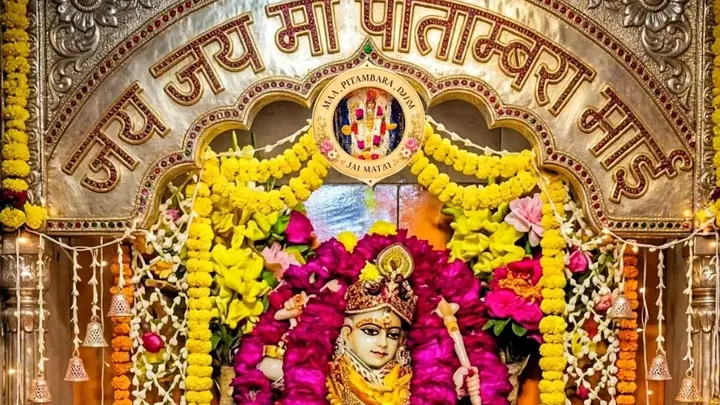
The first stop in the Sharadiya Navratri special series, “Nine Days, Nine Shakti Peethas,” is the Maa Pitambara Peeth in Datia, Madhya Pradesh. Located in the Bundelkhand region, this famous Siddhapeeth is known for the worship of Maa Baglamukhi, also called Maa Pitambara. The shrine is associated with faith, spiritual practice and the belief in protection of the nation.
During Sharadiya Navratri, when Goddess Durga is worshipped in temples across the country, the atmosphere at Shri Pitambara Peeth in Datia also becomes especially devoted to faith, meditation and the worship of Shakti. Devotees from different parts of the country come here to bow before Maa Baglamukhi. Politicians, spiritual practitioners, devotees and ordinary people visit the shrine with their wishes and prayers.
Some come hoping for relief from difficulties, while others pray for courage, success and peace in life. Every visitor has a personal faith and a particular wish, but the central attraction remains the belief in the power of Maa Pitambara.
The importance of Pitambara Peeth is not limited to the temple of Maa Baglamukhi. The same complex also has a temple dedicated to Maa Dhumavati and the ancient Vankhandeshwar Mahadev Temple. The presence of these three important places of worship together gives the shrine a distinctive religious and spiritual identity.
The modern establishment of Pitambara Peeth is credited to Pujya Swamiji Maharaj. According to accounts associated with the Peeth, Swamiji Maharaj reached Datia around the year 1929. He spent several years here in meditation and penance. Later, in the year 1935, the shrine received an organised form with the consecration of Maa Baglamukhi.
The temple of Maa Dhumavati was established later. In this way, the spiritual centre gradually developed into a larger place of worship and religious practice.
The life of Swamiji Maharaj remained connected with simplicity, spiritual discipline and the study and teaching of Sanskrit. Through his efforts, Pitambara Peeth became more than a place for पूजा-अर्चना. It also developed as a centre for religious study and the tradition of spiritual practice. The complex is also associated with the tradition of Sanskrit learning and the preservation of religious texts.
Several accounts connected with the history of the Peeth continue to be narrated among devotees. Swamiji Maharaj’s penance and his deep devotion to the Goddess are regarded by followers as important foundations of the reputation of this shrine.
In the Hindu Shakta tradition, Maa Baglamukhi is regarded as the eighth Mahavidya among the ten Mahavidyas. She is also known as Pitambara Devi. The colour yellow has a special connection with her worship and symbolic identity. Because of this, devotees traditionally offer yellow clothes, yellow flowers and other yellow items to the Goddess.
According to religious beliefs, Maa Baglamukhi has the power to neutralise the negative force of enemies. Her worship is also associated with control over speech, courage and the strength to face difficult circumstances. Devotees connect her worship with the desire to overcome obstacles, disputes and crises.
The form of Maa Baglamukhi is different from several other forms of the Goddess. In traditional depictions, she is shown controlling the tongue of an enemy. The spiritual meaning of this image is not understood only as victory over an enemy. It is also linked with control over harsh speech, falsehood and uncontrolled tendencies.
At Pitambara Peeth in Datia, devotees travel from faraway places for darshan of Maa Baglamukhi. Many arrive with the wish to perform special prayers and rituals. However, the traditions related to tantric practices and specific rituals at the Peeth are matters of prevailing religious belief and should be understood in that context.
Another distinctive feature of Pitambara Peeth is the temple of Maa Dhumavati. Maa Dhumavati is also counted among the ten Mahavidyas. Her form is regarded as serious and strongly associated with detachment, unlike several other forms of the Goddess.
In religious tradition, Maa Dhumavati represents the ability to recognise truth amid deprivation, sorrow, hardship and instability in life. Her worship is associated with detachment, self-reflection and the strength to remain patient during adverse circumstances.
Maa Baglamukhi is worshipped with the wish to stop the power of an enemy and overcome crises. Maa Dhumavati, on the other hand, is associated with accepting difficult experiences in life and drawing spiritual inspiration to rise above them. The two forms therefore represent different aspects of spiritual understanding and devotion.
The presence of temples dedicated to two Mahavidyas within the same complex is a distinctive religious feature of Pitambara Peeth. For devotees, the complex offers an opportunity to understand and worship different forms of Shakti in one place.
The Vankhandeshwar Mahadev Temple, located within the Pitambara Peeth complex, is another major centre of faith. An ancient Shivling of Lord Shiva is worshipped here. According to local religious tradition, the temple is connected with the period of the Mahabharata.
Devotees who visit Vankhandeshwar Mahadev also worship Lord Shiva along with Maa Pitambara and Maa Dhumavati. The temple complex therefore reflects a meeting point of the worship of Shakti and Shiva.
The belief linking Vankhandeshwar Mahadev with the period of the Mahabharata gives the temple special religious importance. At the same time, the difference between a belief preserved through local tradition and a confirmed historical date of antiquity is important to understand. From the point of view of faith, the temple remains an important part of the identity of Pitambara Peeth.
One of the most widely discussed beliefs associated with Pitambara Peeth relates to special religious rituals performed for the security of the country. Accounts among devotees and descriptions connected with the Peeth mention special yagyas and spiritual practices conducted with prayers for national security and peace during the 1962 India-China war and the 1965 and 1971 India-Pakistan wars.
These accounts have led to Pitambara Peeth also being associated with the faith surrounding national protection. In Indian society, the tradition of offering prayers, conducting yagyas and holding collective religious rituals during a national crisis has existed for a long time. In the context of Pitambara Peeth, devotees remember these episodes as symbols of the Goddess’s power and dedication to the nation.
However, the specific details of these rituals and any direct connection between them and military results should not be presented as historically proven facts. Their importance is primarily connected with religious faith and the wish for the welfare and security of the country.
The worship of Maa Baglamukhi is traditionally linked with victory, inner strength and the ability to face adverse circumstances. This is one reason why Pitambara Peeth has also been discussed in connection with people from political and public life.
Devotees come here from different parts of the country. Some visit the Peeth for special rituals, while a large number come for ordinary darshan and prayer. There is no single kind of visitor at the shrine. From ordinary devotees to people known in public life, everyone comes to express faith before Maa Baglamukhi.
The popularity of the Peeth is also connected with its spiritual atmosphere and its long tradition of religious practice. Its identity is not limited to any one section of society. People arrive with different circumstances and different wishes, but the shrine provides a common space for worship and devotion.
Sharadiya Navratri is a major festival dedicated to the worship of the Goddess. During these nine days, different forms of Maa Durga are worshipped. At Pitambara Peeth too, the devotion of visitors becomes especially visible during Navratri.
Devotees who come for darshan of Maa Baglamukhi pray for relief from difficulties, success in their work, mental strength and the happiness and prosperity of their families. Devotees also worship at the temple of Maa Dhumavati according to their religious traditions. A visit to Vankhandeshwar Mahadev adds the worship of Lord Shiva to the pilgrimage.
The message of Navratri is not limited to the fulfilment of wishes. The festival is also regarded as a symbol of self-control, courage, positivity and victory over evil. The worship of Maa Pitambara can be understood in this wider sense as well. It inspires devotees to seek control over fear, anger and negativity within themselves.
The temple in Datia has become an important part of the city’s identity. It is also a significant religious destination for devotees travelling from the Gwalior and Jhansi regions. Pitambara Peeth is said to be approximately two kilometres from Datia railway station. Gwalior airport is the major nearby air-connectivity centre.
The attraction of Pitambara Peeth lies less in grandeur and more in its tradition of spiritual practice, religious beliefs and historical memories. The worship of Maa Baglamukhi, the distinctive form of Maa Dhumavati and the ancient tradition associated with Vankhandeshwar Mahadev can all be seen within the same complex.
During Sharadiya Navratri, the darbar of Maa Pitambara conveys the belief that power does not mean victory alone. It also means restraint, wisdom, courage and the ability to remain firm in difficult circumstances. This is the faith that gives the Datia shrine a special place in the hearts of devotees.
As the first stop in the “Nine Days, Nine Shakti Peethas” series, Datia’s Maa Pitambara Peeth stands out as a centre where Shakti worship, spiritual practice and the wish for national welfare come together.
Frequently asked questions
Where is Maa Pitambara Peeth located?
Maa Pitambara Peeth is located in Datia, Madhya Pradesh, in the Bundelkhand region.
Which deity is worshipped at Maa Pitambara Peeth?
The shrine is known for the worship of Maa Baglamukhi, also called Maa Pitambara.
What other temples are located in the Pitambara Peeth complex?
The complex also includes a temple dedicated to Maa Dhumavati and the ancient Vankhandeshwar Mahadev Temple.
When did Maa Baglamukhi shrine receive an organised form?
The shrine received an organised form in 1935 with the consecration of Maa Baglamukhi.
What offerings are traditionally made to Maa Baglamukhi?
Devotees traditionally offer yellow clothes, yellow flowers and other yellow items.
You may also like
 Politics
Congress Leader Claims Jitu Patwari Will Fly MP’s New ₹250-Crore Jet
 Viral
MP reports fever patients; concerns over antibiotic self-medication
 Madhya Pradesh
 TET Gets Just 34,200 Applications From 1.5 Lakh Eligible Teachers
 Madhya Pradesh
 Government's New Bombardier Challenger 3500 Jet Reaches Bhopal
Most read
- 1
Air China Adds Extra Flight for Passengers Stranded in Fuel-Starved Cuba
- 2
Western disturbance to bring rain, hail and strong winds across north India
- 3
Yogi Adityanath Directs No Occupied Houses Be Demolished for Achhalda Bridge
- 4
Gwalior Temple Truck Crash Kills 12, Injures 28-29 Devotees During Navratri
- 5
Schools Shut in Five Tamil Nadu Districts, Including Chennai, Amid Heavy Rain
Comments
No comments yet. Be the first to comment.