
Russell's Viper and Rattlesnake: A Comparative Study of Two Deadly Snakes
Explore the differences between Russell's viper and rattlesnake, two of the world's most feared snakes. Learn about their habitats, sizes, and more.

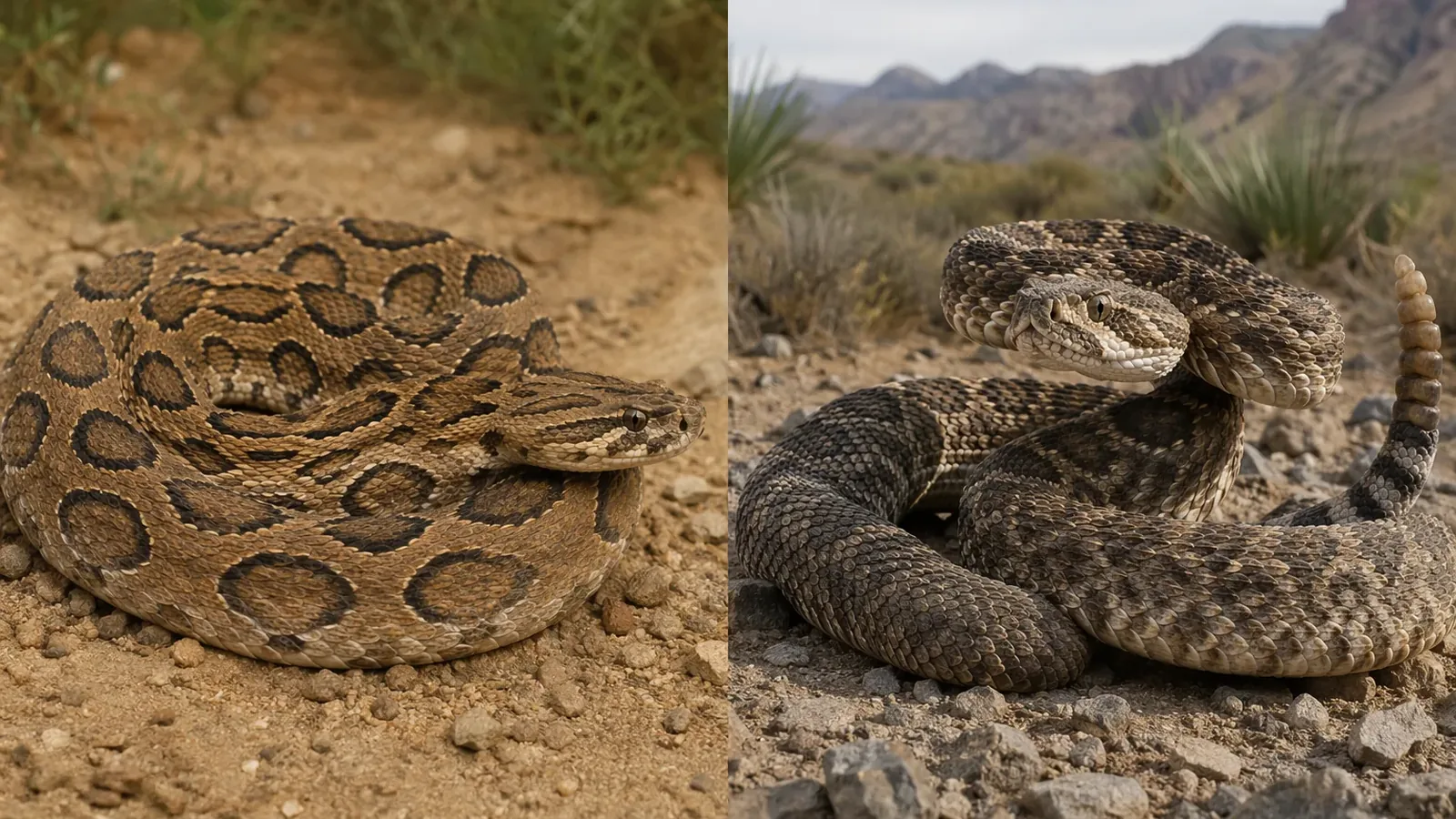
Venomous snakes are both fascinating and fearsome, and the Russell's viper and rattlesnake exemplify this duality. Despite belonging to the same viper family and relying on venom to hunt, these snakes evolved on different continents and adapted to vastly distinct environments. The Russell's viper is widespread across South Asia, often found near agricultural landscapes and rural settlements, while the rattlesnake is native to the Americas and is globally recognised for its iconic tail rattle.
Size and Physical Build
Both snakes are known for their thick, muscular bodies, though they achieve this in different ways. Russell's vipers appear particularly stout for their length, with broad heads and robust builds that convey power. In contrast, rattlesnakes vary significantly in size across their many species, with some remaining small while others grow beyond two metres. Regardless of size, most rattlesnakes share a muscular build designed for quick, effective strikes.
Habitat and Distribution
Russell's vipers are highly adaptable, inhabiting open countryside, agricultural land, scrub vegetation, and areas near villages. This proximity to human settlements makes them one of Asia's most recognised venomous snakes. Rattlesnakes, on the other hand, occupy a vast range spanning southern Canada to parts of South America. Depending on the species, they thrive in diverse habitats, including deserts, forests, grasslands, rocky slopes, and semi-arid landscapes, making them one of the most geographically diverse venomous snake groups.
Appearance and Identification
Russell's vipers are easily identified by their striking chain-like patterns of dark oval markings, which help them blend into dry vegetation and soil. Rattlesnakes, while more varied in colour and pattern, are universally recognised for their rattles. These tail structures, made of interlocking keratin segments, produce a buzzing sound when shaken, serving as one of nature's most distinctive warning signals.
Hunting Strategy
Both snakes rely on ambush tactics rather than active pursuit. Russell's vipers often remain motionless, camouflaged in their surroundings, before striking at unsuspecting prey like rodents. Similarly, rattlesnakes position themselves near trails or feeding areas frequented by rodents, launching lightning-fast strikes when prey comes within range. In both cases, patience and precision are key to their hunting success.
Venom and Bite
The venom of a Russell's viper is among the most medically significant in Asia, primarily affecting the blood and circulatory system, though its impact can extend beyond the initial bite. Rattlesnake venom varies across species, with most causing tissue damage and affecting blood clotting, while some possess neurotoxic elements. Despite their potency, the venom in both snakes is primarily adapted for hunting and digestion rather than defence.
Sensory Abilities
One major difference between these snakes lies in how they detect prey. Rattlesnakes, as pit vipers, have specialised heat-sensing organs between their eyes and nostrils, allowing them to detect warm-blooded animals even in darkness. Russell's vipers lack these heat-detecting pits and instead rely on scent, vibration, and visual cues to navigate their surroundings and locate prey.
Defensive Behaviour
When threatened, Russell's vipers emit a loud, forceful hiss as a warning before deciding whether to strike. Rattlesnakes use their tail rattle as an advanced warning system, alerting potential threats to avoid confrontation. Both strategies aim to prevent dangerous encounters for the snake and the perceived threat.
Relationship with Humans
Human encounters with these snakes are common but occur under different circumstances. Russell's vipers are often found in farming regions, drawn by the abundance of rodents, increasing the chances of accidental encounters. Rattlesnakes are typically found in wilderness areas, though expanding human development has brought them closer to populated regions. Most bites from both snakes occur when they are accidentally stepped on, disturbed, or deliberately approached.
Conservation Status
Russell's vipers are widespread and not globally threatened, though local pressures like habitat changes and persecution can impact populations. The conservation status of rattlesnakes is more complex, with some species remaining common while others face threats from habitat loss, road mortality, and human persecution. Their conservation outlook varies by species and location.
A Hypothetical Match-Up
A confrontation between a Russell's viper and a rattlesnake is purely hypothetical, as these snakes evolved on separate continents and would never naturally encounter each other. The outcome would depend on factors like the rattlesnake species involved, as sizes vary greatly within the group. While Russell's vipers boast powerful venom and rapid defensive strikes, rattlesnakes bring advantages like heat-sensing organs and, in some cases, larger size. Ultimately, neither snake is designed for direct combat; their strengths lie in ambush hunting and survival. This comparison underscores how both species evolved different adaptations to thrive as predators in their respective ecosystems.
Frequently asked questions
Where are Russell's vipers and rattlesnakes found?
Russell's vipers are widespread across South Asia, commonly found near agricultural landscapes and rural settlements. Rattlesnakes are native to the Americas, with a range spanning southern Canada to parts of South America, thriving in diverse habitats including deserts, forests, grasslands, and semi-arid landscapes.
How can you identify a Russell's viper versus a rattlesnake?
Russell's vipers are identified by their striking chain-like patterns of dark oval markings that help them blend into dry vegetation. Rattlesnakes are universally recognised for their distinctive tail rattles, made of interlocking keratin segments that produce a buzzing sound when shaken.
What is the hunting strategy of these snakes?
Both Russell's vipers and rattlesnakes rely on ambush tactics rather than active pursuit. They remain motionless and camouflaged in their surroundings, positioning themselves near areas frequented by prey like rodents, before launching lightning-fast strikes when prey comes within range.
How does the venom of these snakes differ?
Russell's viper venom is among the most medically significant in Asia, primarily affecting the blood and circulatory system. Rattlesnake venom varies across species, with most causing tissue damage and affecting blood clotting, while some possess neurotoxic elements.
You may also like
 National
Kuppam Granite Quarries Evolve into Thriving Peacock Sanctuary
 National
Lions vs Jaguars: Comparing Strength and Adaptations of Apex Predators
 Tamil Nadu
Conservationists warn Munnar viewpoint project could disrupt elephant habitat
 National
Leopard spotted prowling near house in Bahraich village, caught on CCTV
Most read
- 1
Air China Adds Extra Flight for Passengers Stranded in Fuel-Starved Cuba
- 2
Western disturbance to bring rain, hail and strong winds across north India
- 3
Yogi Adityanath Directs No Occupied Houses Be Demolished for Achhalda Bridge
- 4
Gwalior Temple Truck Crash Kills 12, Injures 28-29 Devotees During Navratri
- 5
Schools Shut in Five Tamil Nadu Districts, Including Chennai, Amid Heavy Rain
Comments
No comments yet. Be the first to comment.