
Rajasthan farmer grows crops and solar power on same land, earning eight times more
Agrophotovoltaic installation in Rajasthan generates 600 kW while allowing maize cultivation, balancing energy and food security despite high capital costs

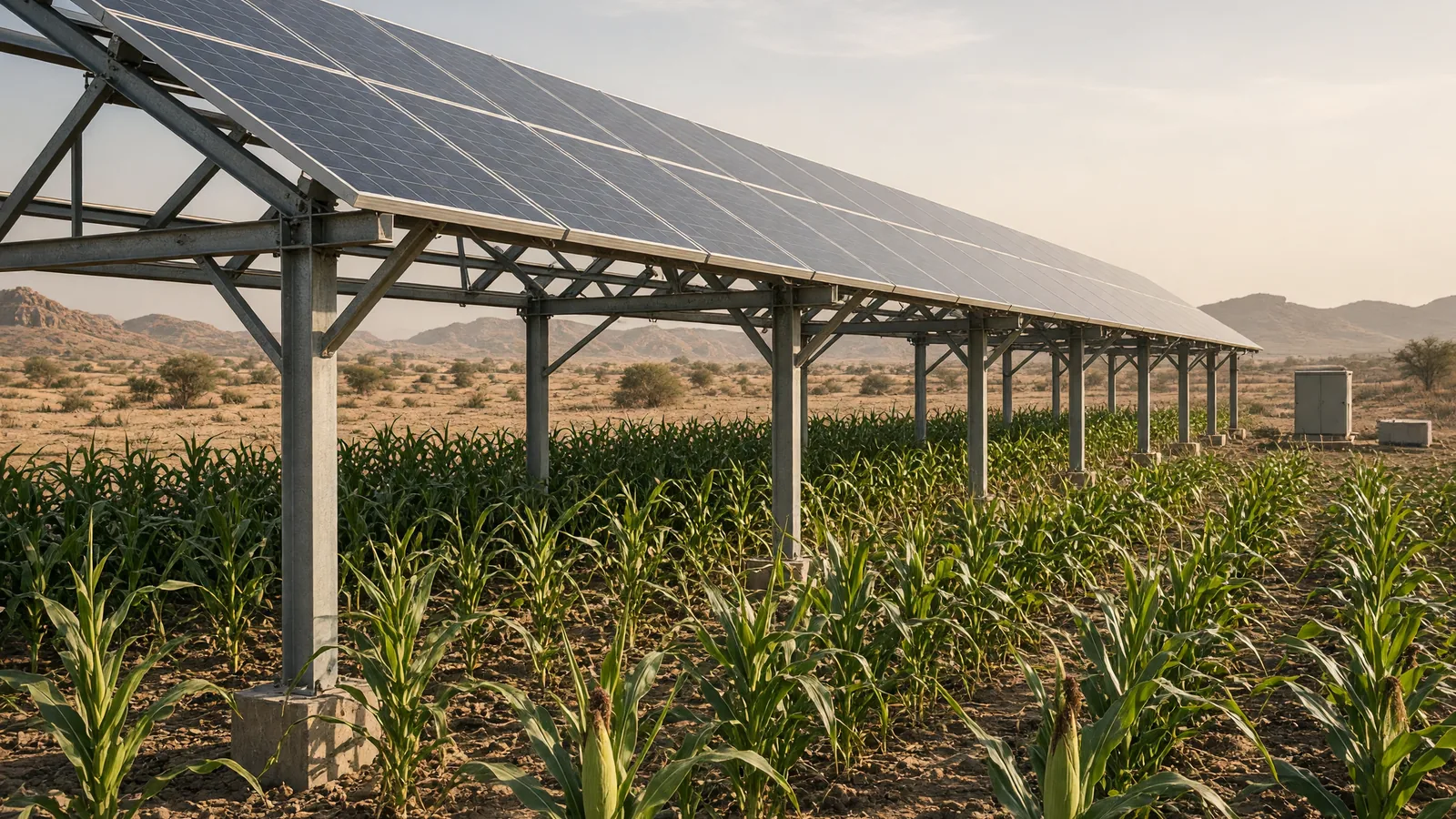
Sowing the seeds of a solar power intervention
Rajasthan's first farmer-owned agrophotovoltaic installation is generating 600 kW of electricity while allowing cultivation to continue, a model that could redefine how India balances its energy transition with food security, but steep capital costs and policy gaps are blocking wider adoption.
On Kojadmal Jat's nearly 3-acre pilot farm in Kundanpura village, tender maize grows beneath elevated solar panels where conventional installations leave land barren. The 60-year-old farmer had converted his fields to solar power in 2023, drawn by predictable monthly income, but struggled with the trade-off. "My farm was generating solar power, but at the end of the day, I am a farmer. I could not come to terms with the fact that I was no longer able to cultivate my land because of the solar panels," he says.
Why it matters in a food-insecure nation
India ranks 102nd out of 123 countries on the 2025 Global Hunger Index, making the conversion of productive farmland to solar plants a threat to food security. Agrophotovoltaics, the practice of using the same land for both agriculture and solar generation, offers a way out by working on the principle that partial shading from panels reduces heat stress and evaporation while stabilising microclimates, particularly valuable in dry regions.
Jat's farm now feeds enough electricity into the local grid to provide daytime irrigation for around 250 farms. His annual income has jumped nearly eightfold, from close to ₹40,000 through farming alone to about ₹3 lakh. By diversifying income, the model strengthens resilience to climatic and market risks.
The ₹35-lakh barrier
Researchers from the Indian Council for Research on International Economic Relations worked with Jat to retrofit his existing solar plant one inverter at a time, minimising energy loss during construction. While agrophotovoltaics can increase farmers' annual returns to ₹3 lakh to ₹4 lakh per acre, elevated mounting structures add nearly ₹35 lakh over conventional installations, a sum out of reach for most smallholders.
For this pilot, 70% of costs came from a commercial bank loan at 10.25% interest, while the additional ₹35.3 lakh retrofitting cost was covered by Kotak Mahindra's CSR programme. With viability gap funding, Jat's payback period drops from nearly 12 years to just over six, while annual profits rise to ₹4.48 lakh per acre and expected return on investment climbs from 12% to 18%.
What's blocking scale
GIZ India found that 54% of 1,700 farmers engaged through workshops expressed interest in agriPV systems, yet one farmer watching Jat's project admitted, "Kojadmal could take the risk. I'd like to as well... But I don't have the appetite to take such a big loan".
High lending rates around 10.5%, reluctant state distribution companies, bureaucratic delays and shifting policy guidelines have slowed implementation, says Ashok Gulati, agricultural economist at ICRIER. Anand Jain, an IIT Roorkee MTech graduate and farmer who studied European agrivoltaic projects, took over nine months to secure a power-purchase agreement, while four meters cost ₹20 lakh before his plant could begin generating returns.
India has no formal agriPV standards, unlike Germany, France and Japan, which have clear technical benchmarks and eligibility criteria. Agrivoltaics must compete with conventional ground-mounted solar in tenders designed around lower-cost systems, despite higher capital costs and agricultural benefits.
Subrahmanyam Pulipaka, CEO of the National Solar Energy Federation of India, says India must first establish a clear definition of what constitutes an agriPV project, then scale demonstrations across all agro-climatic regions to generate reliable data on productivity and economics. Shirish Garud, consultant with The Energy and Resources Institute, argues India needs a dedicated Renewable Purchase Obligation for agrivoltaics, as the current mandate makes no distinction between conventional solar and agriPV.
Source: The Hindu
Frequently asked questions
What is agrophotovoltaics and how does it work?
Agrophotovoltaics is the practice of using the same land for both agriculture and solar power generation. Elevated solar panels are installed above crops, allowing cultivation to continue underneath. The partial shading from panels reduces heat stress and evaporation while stabilizing microclimates, which is particularly valuable in dry regions like Rajasthan.
How much has the pilot farmer's income increased?
Kojadmal Jat's annual income has increased nearly eightfold, from close to ₹40,000 through farming alone to about ₹3 lakh per year. With viability gap funding factored in, annual profits can rise to ₹4.48 lakh per acre.
What is the main cost barrier preventing wider adoption?
The elevated mounting structures required for agrophotovoltaics add nearly ₹35 lakh over conventional solar installations, a sum out of reach for most smallholder farmers. High lending rates around 10.5% and reluctant state distribution companies further complicate financing.
Why is agrophotovoltaics important for India?
India ranks 102nd out of 123 countries on the 2025 Global Hunger Index. Converting productive farmland solely to solar plants threatens food security. Agrophotovoltaics allows India to advance its energy transition while maintaining agricultural productivity and food security simultaneously.
What impact does the pilot farm have on the local community?
Jat's 3-acre farm generates 600 kW of electricity, enough to provide daytime irrigation for approximately 250 farms in the region, directly supporting the agricultural community's water needs.
You may also like
 Agriculture
Rajasthan Becomes North India's First State To Issue 90.19 Lakh Farmer IDs
 Education
Prof Narsi Ram Bishnoi assumes charge as MGSU Vice-Chancellor
 Weather
Southwest monsoon to withdraw from Rajasthan in three to four days
 Politics
989 nominations filed for mayors, chairpersons across Rajasthan's 305 urban bodies
Most read
- 1
Air China Adds Extra Flight for Passengers Stranded in Fuel-Starved Cuba
- 2
Western disturbance to bring rain, hail and strong winds across north India
- 3
Yogi Adityanath Directs No Occupied Houses Be Demolished for Achhalda Bridge
- 4
Gwalior Temple Truck Crash Kills 12, Injures 28-29 Devotees During Navratri
- 5
Schools Shut in Five Tamil Nadu Districts, Including Chennai, Amid Heavy Rain
Comments
No comments yet. Be the first to comment.