
Karnataka coffee cultivation area stagnant for 15-20 years, says KPA chief
Karnataka's coffee cultivation has stayed at 2.46 lakh hectares for 15-20 years amid policy, finance and climate-related challenges.

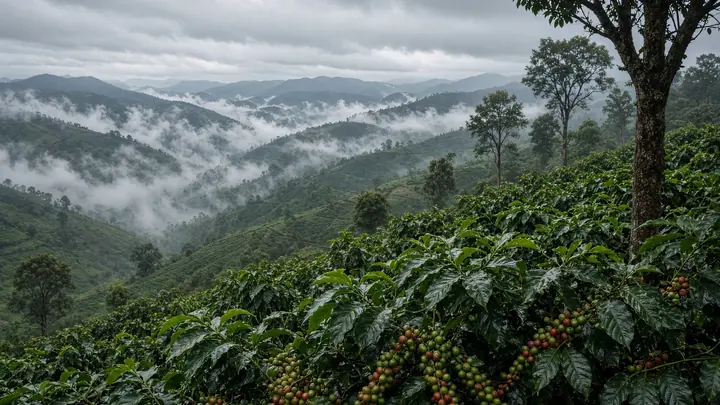
Karnataka’s coffee cultivation has failed to expand for 15 to 20 years even as the State continues to account for more than 70% of India’s coffee production, according to M. Salman Baseer, Chairman of the Karnataka Planters Association (KPA).
The State produces between 2.5 lakh and 2.8 lakh metric tonnes of coffee a year from about 2.46 lakh hectares of land.
Mr. Baseer attributed the stagnation to several constraints, including rigid land conversion laws, a lack of State-sponsored credit, underfunded subsidies, high interest rates and the unavailability of climate-resilient and high-yielding varieties.
Expansion blocked by policy and finance
Coffee planters are struggling to undertake expansion activities because the financial and institutional support available to them is inadequate, Mr. Baseer said.
He said the pressure on Karnataka’s coffee sector was becoming more significant as global competitors continued to expand their cultivation areas.
“While global competitors like Vietnam and Brazil rapidly expand, India's cultivation area remains choked by rigid land conversion laws, underfunded replantation subsidies, and high-cost institutional capital, among others,” Mr. Baseer told The Hindu.
He said India needed to protect its global competitiveness through higher yields rather than relying on the expansion of cultivated land.
“To protect our global competitiveness, we should have a policy with a focus on yield intensification through climate-resilient, high-density planting and aggressive branding of our shade-grown gourmet coffees,” he said.
The KPA’s proposed approach is centred on improving productivity, supporting replantation and strengthening the market position of Indian coffee.
Mr. Baseer said Karnataka’s ecological setting also placed limits on the way the industry could grow.
“Karnataka farms coffee under the canopy of the Western Ghats, protecting a precious ecological hotspot,” he said.
“That is our pride, but it also means our path to growth cannot be through reckless horizontal land expansion like some of our esteemed global peers,” Mr. Baseer added.
Call for insurance and long-term capital
According to Mr. Baseer, Karnataka would need better financial protection and policy support to match the scale and yield efficiencies of global competitors.
He called for coffee to be integrated into robust weather-based insurance schemes and for legislative modernisation to be accelerated.
He also sought long-term capital to support cyclical replanting, which is necessary for maintaining plantations over time.
“The Ministry and the Coffee Board have been receptive, but we need to move with greater agility,” Mr. Baseer said.
He also said India lacked dedicated, centralised export hubs with state-of-the-art warehousing and value-added processing clusters.
According to him, such facilities could help lower logistics costs for the coffee industry.
Push for premium and value-added coffee
Mr. Baseer said Indian coffee needed stronger branding instead of competing primarily through bulk volumes.
“We must aggressively market our shade-grown, hand-picked Arabicas and Robustas as premium, sustainably produced gourmet commodities to command higher realisations, rather than competing purely on bulk volume,” he said.
He said the sector’s export strategy should move beyond the shipment of baseline green coffee.
The proposed shift includes greater emphasis on high-margin, value-added soluble products and on India’s identity as a sustainable, shade-grown origin.
Mr. Baseer also called for modern policy support for growers as part of this shift.
“If the industry wants to protect and elevate its export competitiveness, the roadmap is clear,” he said.
“We must pivot aggressively from exporting baseline green coffee toward high-margin, value-added soluble products, leverage our unique identity as a sustainable, shade-grown origin, and back our growers with modern, future-ready policy support,” he added.
Demand to bring coffee under PMFBY
The KPA has repeatedly asked the Union government to bring coffee, tea and rubber under the Pradhan Mantri Fasal Bima Yojana (PMFBY).
The demand comes against the backdrop of severe drought and incessant, unseasonal rain affecting plantation crops.
Mr. Baseer said recurring weather anomalies were damaging yields and pushing smallholders into deep debt.
He said over 2,000 coffee growers across Karnataka were facing immense financial distress, with outstanding loans of ₹400 crore to ₹500 crore.
Many of them, he said, were also facing coercive action from banks under the Securitisation and Reconstruction of Financial Assets and Enforcement of Security Interest (SARFAESI) Act.
Mr. Baseer argued that the exclusion of plantation crops from PMFBY was linked to their administrative placement under the Ministry of Commerce rather than the Ministry of Agriculture.
“The government's hesitation stems primarily from bureaucratic silos,” he said.
“Plantation crops fall under the Ministry of Commerce rather than Agriculture, creating an unfair policy exclusion,” Mr. Baseer added.
Loan relief and protection from asset seizures
The KPA is pressing the banking sector and the Union government for measures to ease the financial burden on growers.
“We are pressing the banking sector and the Union government for a comprehensive loan repayment moratorium, a complete halt to coercive asset seizures on biological farm assets, and flexible One-Time Settlement (OTS) packages,” Mr. Baseer said.
The association is also seeking clarification on the protection available to coffee plantation lands under the SARFAESI Act.
“The KPA will continue to urge the government to address ambiguities under Section 31(i) of the SARFAESI Act, to explicitly shield coffee plantation lands from distress auctions, mirroring protections afforded to traditional agricultural holdings,” he said.
For Karnataka’s coffee sector, the issues raised by the KPA cover stagnant cultivation area, low access to capital, exposure to weather shocks, limited processing infrastructure and pressure from loan recovery proceedings.
Source: The Hindu
Frequently asked questions
How long has Karnataka’s coffee cultivation area remained stagnant?
It has remained stagnant for 15 to 20 years.
What share of India’s coffee production comes from Karnataka?
Karnataka accounts for more than 70% of India’s coffee production.
How much coffee does Karnataka produce annually?
The State produces between 2.5 lakh and 2.8 lakh metric tonnes of coffee a year.
What factors have limited the expansion of coffee cultivation in Karnataka?
Rigid land conversion laws, inadequate credit, underfunded subsidies, high interest rates and the lack of climate-resilient, high-yielding varieties have limited expansion.
What measures has the Karnataka Planters Association proposed?
It has proposed improving yields through climate-resilient, high-density planting, supporting replantation, strengthening coffee’s market position, expanding weather-based insurance and providing long-term capital.
You may also like
 Crime
Farmer Arrested After Over 500 Cannabis Plants Found In Karnataka’s Vijayapura
 Entertainment
Kambala Makes Mysuru Dasara Debut With 150 Buffalo Pairs Racing
 Technology
Canada Eyes Expanded Karnataka Partnerships in Quantum Computing, AI, Aerospace, Defence
 Karnataka
 Seeks Centre’s Intervention To Resume LPG Connections, 36,000 Applications Pending
Most read
- 1
Air China Adds Extra Flight for Passengers Stranded in Fuel-Starved Cuba
- 2
Western disturbance to bring rain, hail and strong winds across north India
- 3
Yogi Adityanath Directs No Occupied Houses Be Demolished for Achhalda Bridge
- 4
Gwalior Temple Truck Crash Kills 12, Injures 28-29 Devotees During Navratri
- 5
Heavy Rain Waterlogs Bengaluru, Snarls Traffic; Ride-Hailing Fares Surge
Comments
No comments yet. Be the first to comment.