
Jio IPO draws ₹3.2 lakh crore demand as Reliance shares rise; GMP, price and subscription status
Reliance Jio Platforms IPO attracted reported demand of about ₹3.2 lakh crore, including anchor and first-day public bids. Here is the reported subscription status, issue price, GMP context and key dates.

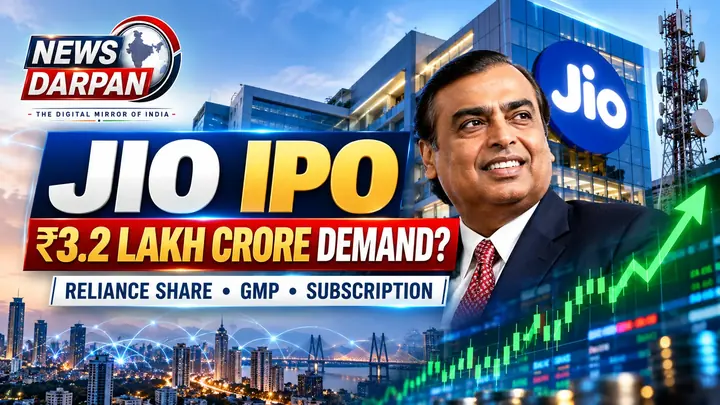
New Delhi: Reliance Industries’ digital unit Jio Platforms has become a major talking point in the Indian stock market after the Reliance Jio Platforms IPO reportedly attracted demand of about ₹3.2 lakh crore from anchor investors and public bids on the first day. According to figures reported on 21 October 2026, the issue drew attention because the reported demand was significantly higher than the reported issue size of about ₹30,213 crore to ₹30,230 crore. The exact issue size should be checked against the relevant official documents.
The strong response to the Jio IPO has also increased investor interest in Reliance Industries shares. Searches are now focused on the Jio IPO subscription status, Jio IPO price, Jio IPO date, Jio GMP, Jio Platforms IPO GMP, grey market premium and the possible listing outcome. These are related subjects, but they do not represent the same market signal. Heavy demand, an unofficial premium in the grey market and a possible rise in the listed share price must be assessed separately. None of them guarantees a profit at listing.
Jio IPO subscription status on the first day
According to a Moneycontrol report dated 21 October 2026, applications were received for shares worth about ₹69,713 crore under the public bidding portion of the Jio IPO. On that basis, the issue was subscribed about 3.1 times on the first day. The figure reflects the reporting period covered by the report and should not be treated as the final subscription level.
Anchor investors were reported to have placed demand of about ₹2.5 lakh crore. When the public bidding demand and anchor-book demand were considered together, total demand was reported to have reached about ₹3.2 lakh crore. The anchor demand and the public subscription figure are therefore being discussed together, although they belong to different parts of the issue process.
The category-wise figures available for the first-day reporting period were reported as follows:
| Investor category | Subscription |
|---|---|
| Qualified Institutional Buyers (QIB) | About 9.42 times |
| Non-Institutional Investors (NII) | About 1.68 times |
| Retail Individual Investors (RII) | About 0.73 times |
| Total public issue | About 3.16 times |
The category table gives the total public issue subscription as about 3.16 times, while the report described the issue as about 3.1 times subscribed during the first day. Both figures refer to the same reporting period and should not be confused with the final subscription status.
Investors looking for the latest Jio IPO subscription status should check the official updates issued by the National Stock Exchange, the Bombay Stock Exchange and the issue itself. The figures can change while the public bidding window remains open. The first-day numbers also do not establish how many shares an individual applicant will receive.
Reliance Jio Platforms IPO details: price, dates and listing
The key details of the Reliance Jio Platforms IPO are among the information investors are seeking most frequently. The reported issue size is about ₹30,213 crore, although some reports have cited ₹30,230 crore. That difference is one reason the final offer document should be treated as the primary reference.
- IPO name: Jio Platforms IPO
- Issue size: About ₹30,213 crore; some reports have cited ₹30,230 crore
- Price band: ₹1,065 to ₹1,119 per share
- Jio IPO date: 21 October to 23 October 2026
- Lot size: 12 shares
- Minimum application amount: ₹13,428 at the upper price band
- Possible allotment date: 26 October 2026
- Possible listing date: 28 October 2026
- Proposed listing: NSE and BSE
The issue size, lot size and dates should be verified from the official offer document and the latest issue updates. The dates described as possible are not a guarantee that the allotment or listing will occur in that form. An application may be valid without resulting in an allotment of shares.
The Jio IPO price is being discussed alongside the reported demand because investors use the price band to compare the amount sought by the company with the level of interest shown in the issue. The upper price band is also relevant to the stated minimum application amount of ₹13,428 for a lot of 12 shares. These details describe the application terms and do not indicate the price at which the shares will trade after listing.
Jio GMP and the meaning of the grey market premium
Jio GMP is an informal market reference. The term describes the unofficial premium at which the shares of an IPO are said to trade in the grey market before listing. Investors also search for Jio Platforms IPO GMP and grey market premium when they try to estimate a possible listing price. Such references are not official prices set by the stock exchanges.
For example, if an IPO has an issue price of ₹1,119 and a hypothetical GMP of ₹100, the implied estimate would be ₹1,219. This is only a calculation used to explain the concept. It is not the actual GMP of the Jio IPO and should not be read as a confirmed listing price.
A verified live GMP for the Jio IPO is not available here. Figures shown on unofficial websites should therefore not be treated as an official price or as a certain listing gain. Grey-market prices can change, and the unofficial figures may differ from the eventual listing price on the exchange.
GMP IPO, IPO GMP and related search terms
GMP IPO, IPO GMP, GMP of Jio IPO and grey market premium are commonly used search terms for the same broad subject. Investors may use them to understand an informal market view of an issue before listing. The terms do not change the official price band, the official subscription figures or the allotment rules.
A high GMP does not prove that a company’s share price will continue to rise after listing. It also does not remove the risks connected with the issue. Before making an investment decision, investors should examine the company’s valuation, financial performance, possible future growth, competition, debt position and the risks described in the official documents.
The reported premium should therefore be kept separate from the ₹1,065 to ₹1,119 price band and from the subscription figures. The price band is an issue term, the subscription figure measures reported demand and the GMP is an unofficial indication. Each describes a different part of the IPO discussion.
Reliance share price and the interest in RIL
Reliance share price and Reliance Industries share price have also become prominent search terms alongside the Jio IPO. One reason is that Jio Platforms is an important part of Reliance Industries’ telecom and digital businesses. A separate listing could give investors a new reference for assessing the value of that digital business and could provide another point of comparison for the wider Reliance group.
According to an INDmoney report dated 21 October, the Reliance Industries share rose about 2.7% during intraday trading and reached ₹1,234.30 amid developments related to the Jio IPO and the company’s business. This price should not be understood as the current live price.
The reported movement in the Reliance Industries share brought additional attention to the relationship between the parent company and Jio Platforms. However, a possible Jio listing would not by itself establish a direct or certain relationship with the market price of Reliance Industries shares.
RIL share performance is not dependent only on Jio. The movement in Reliance Industries’ share price can also be considered in relation to refining, petrochemicals, retail, telecom, energy, global crude oil prices and overall market sentiment, as described in the source material. These businesses and market factors mean that the possible valuation of Jio and the market price of Reliance Industries should not automatically be treated as identical measures.
For that reason, investors comparing the Jio IPO with Reliance share price should look at the relevant facts separately. A discussion about the digital business may affect how the group is viewed, but it does not provide a fixed formula for calculating the price of Reliance Industries shares.
Why the Jio Platforms IPO matters to investors
Jio Platforms’ business extends beyond telecom connectivity to digital services and enterprise solutions. The next phase described for the company includes efforts to increase average revenue per user, expand digital services and earn more from investments already made in its network.
The money to be raised through the IPO has been described as being intended in large part for repaying or prepaying the company’s borrowings. If used for that purpose, the funds could help reduce interest expenses and strengthen the company’s financial position. That possibility is part of the issue discussion, but it does not remove the need to assess the company’s earnings and financial risks.
Investors therefore need to consider the proposed valuation together with the company’s earnings, expected growth rate, competition and debt position. The reported demand shows interest in the issue, but demand alone does not establish whether the valuation is appropriate or whether the shares will perform in a particular way after listing.
The distinction is also important when the issue is compared with other market opportunities. Subscription data can show how different investor categories responded during the bidding period, while financial performance and valuation are used to examine the company itself. Both kinds of information are relevant, but they answer different questions.
What investors should check on Zerodha, Groww and INDmoney
As the Jio IPO has attracted attention, investors may search for information about the issue on platforms such as Zerodha, Groww and INDmoney. The services, application process and information available on each platform may differ. Investors should confirm application details with the relevant platform and use official exchange and issue updates for verification.
Zerodha: Investors may use the IPO application facility available through Zerodha and check the status of their application there. Nithin Kamath, the co-founder of Zerodha, is also frequently searched in discussions connected with the stock market and investing. However, separate evidence would be needed before linking the Jio IPO demand figures to any statement by him.
Groww: Investors may find IPO information, application services and related investment services on Groww. Groww share price is a separate search subject and has no direct connection with the Jio IPO’s GMP or subscription figures. The existence of interest in one subject should not be treated as evidence about the other.
INDmoney: INDmoney has discussed the rise in Reliance share price and the possible valuation of the Jio IPO. Investors may read market-related analysis there, but analysis should not be treated as a guarantee of an investment result.
Before applying, investors should confirm the official issue details, the application route and the information provided by the exchanges. Social media posts and unofficial GMP figures should not be used as the sole basis for an investment decision.
Why Paras Healthcare IPO, Vodafone Idea and Airtel searches are appearing
Investors often compare several IPOs and listed shares during the same period. That is why searches for Paras Healthcare IPO, Vodafone Idea share, Airtel share price and Bharti Airtel share price may appear alongside searches connected with the IPO and telecom sectors. The presence of these search terms does not mean that the companies have the same business position or the same investment risk.
Paras Healthcare IPO: The date, price band, subscription figures and GMP for this issue should be confirmed from its official issue details. The figures for Paras Healthcare IPO should not be combined with the reported figures for the Jio Platforms IPO.
Vodafone Idea share: Vodafone Idea’s financial position, debt, funding and telecom business may affect the price of its shares. The demand reported for the Jio IPO is not automatically a positive or negative signal for Vodafone Idea share.
Airtel share price and Bharti Airtel share price: Bharti Airtel’s earnings, subscriber base, average revenue per user and network investment are among the factors described as relevant to its share performance. A Jio listing could give investors a new basis for comparing telecom companies, but the valuation of each company would still depend on its own financial figures.
Investors should therefore analyse each company separately. A common connection with the telecom sector does not mean that all the shares will move in the same way. The business position, financial information and risks for each company need to be considered on their own.
How to check Jio IPO subscription status and allotment
Applicants who have applied for the Jio Platforms IPO can use several routes to check their application and allotment status. The first route is the official IPO or application-status service of the relevant stock exchange. The second is the official website of the IPO registrar, where allotment information may be made available.
- Check the official IPO or application-status service of the relevant stock exchange.
- Visit the official website of the IPO registrar and review the available allotment information.
- Check the application status on the broker or investment platform used to apply.
- After allotment is announced, confirm the status using the PAN or application number requested by the relevant service.
An accepted application does not mean that shares will necessarily be allotted. The allotment process is completed according to the relevant rules and the number of shares available. Applicants should rely on the official status service rather than an informal message or an unverified claim.
Five points to understand before investing in the Jio IPO
1. Valuation: Compare the company’s earnings and growth prospects with the issue price. A large demand figure does not by itself establish that the valuation is suitable.
2. Subscription: Examine the demand from QIB, NII and retail investors separately. The total subscription figure does not provide the complete picture of how each category responded.
3. GMP: Treat the grey market premium as an unofficial indication and not as a fixed or guaranteed return.
4. Listing risk: Even a popular IPO can list below its issue price. Strong subscription does not eliminate the possibility of a weaker listing.
5. Investment period: Decide whether the objective is a listing gain or a longer-term investment. The risks associated with the two approaches are different.
These points also help separate the reported first-day demand from the later market outcome. QIB, NII and retail subscription data describe applications during the issue period. GMP describes an unofficial pre-listing reference, while the listing price will be determined when the shares begin trading on the proposed exchanges.
What to watch next for the Jio IPO
The public bidding for the Jio Platforms IPO has been announced as remaining open until 23 October 2026. After that, investor attention is expected to focus on the allotment process and the proposed listing. The possible allotment date has been reported as 26 October 2026, while the possible listing date has been reported as 28 October 2026.
The most important updates for investors will include the final subscription status, the official allotment, the listing price and information about the company’s financial performance. These updates will provide more specific information than an early demand figure or an unofficial GMP.
Conclusion: The early demand reported for the Reliance Jio Platforms IPO has shown strong interest in the Indian IPO market. However, Jio GMP, Reliance share price, Groww share price, Vodafone Idea share and Bharti Airtel share price are separate subjects that must be assessed using their own facts. Investors should check official figures, study the company’s valuation and review the risks before making a decision.
Frequently asked questions
How much demand did the Jio IPO reportedly attract?
The Jio IPO reportedly attracted about ₹3.2 lakh crore in combined demand from anchor investors and public bids on the first day.
What was the reported first-day subscription status of the Jio IPO?
The public issue was reported as subscribed about 3.1 times on the first day, while the category table showed total subscription of about 3.16 times.
What were the reported category-wise subscription figures?
QIBs subscribed about 9.42 times, NIIs about 1.68 times and retail investors about 0.73 times during the reported first-day period.
Does strong Jio IPO demand guarantee a listing profit?
No. Heavy demand, an unofficial grey market premium and a possible rise in the listed share price must be assessed separately, and none guarantees a profit at listing.
You may also like
 International
real madrid vs rb leipzig: Vinicius Junior's return and Federico Valverde's full-back role
 Opinion
Big Indian AI SuperChip Dream: Bharatiya Chips Powering the Electronic Revolution
 Politics
BJP MP Gulam Ali Khatana alleges Pakistan orchestrated OIC’s anti-India resolutions
 National
Singareni revises pay scales for 1,800 officers, aligning them with Coal India
Most read
- 1
Air China Adds Extra Flight for Passengers Stranded in Fuel-Starved Cuba
- 2
Western disturbance to bring rain, hail and strong winds across north India
- 3
Yogi Adityanath Directs No Occupied Houses Be Demolished for Achhalda Bridge
- 4
Schools Shut in Five Tamil Nadu Districts, Including Chennai, Amid Heavy Rain
- 5
Gwalior Temple Truck Crash Kills 12, Injures 28-29 Devotees During Navratri
Comments
No comments yet. Be the first to comment.