
Google's Visakhapatnam data centre to use air-cooling despite industry impracticality concerns
Google's 1-GW data centre near Visakhapatnam will use air-cooling after local protests. Experts say the technology is impractical for this scale.

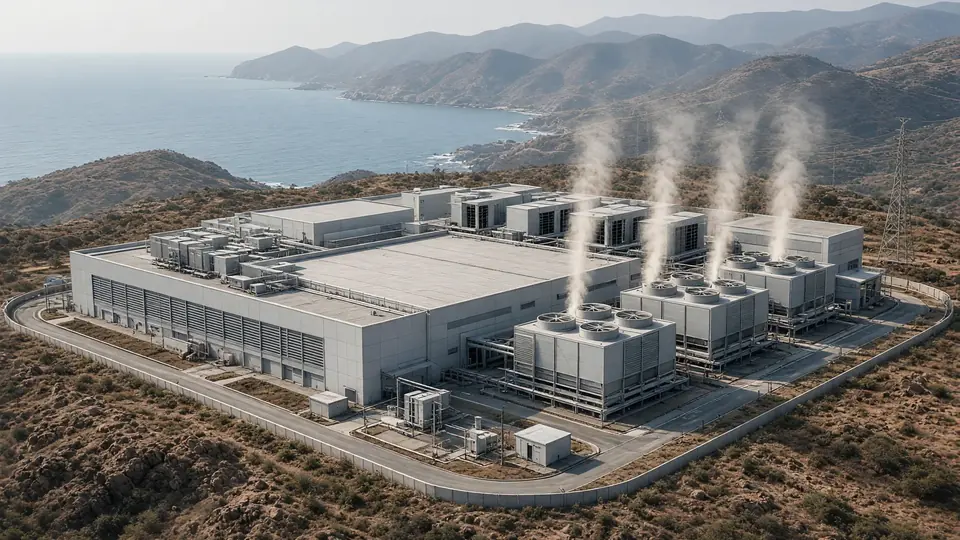
Google has confirmed its 1-GW data centre near Visakhapatnam will rely on air-cooling technology following local protests over water use, according to the city's MP M. Sribharat. The decision, however, places the facility at odds with current industry practice: as of 2026, air-cooling a 1-GW data centre is considered impractical both physically and economically.
The heat challenge
A 1-GW facility, the scale planned by both Google near Visakhapatnam and the newly announced Tata Consultancy Services HyperVault, must remove 1 GW of heat generated by trillions of transistors. Each transistor releases heat as it manipulates electrical current through resistance and charge cycles. That heat travels from the silicon die to a cooling plate, then onward depending on the technology used.
Why air-cooling struggles at this scale
Air-cooling faces a "thermal wall": it can remove at best around 40 kW per rack. Modern AI chips like the Nvidia Blackwell, however, generate 700, 1,000 W per GPU, pushing a single rack to 120, 150 kW. Cooling such racks with air alone would require installation inside a wind tunnel, with power consumption skyrocketing.
The technology also demands acoustic control; air-cooling chillers and air-handling units can produce up to 100 dB, and the resulting low-frequency hum can travel several kilometres under favourable atmospheric conditions, disturbing sleep.
While air-cooling incurs lower upfront infrastructure costs than liquid-cooling, which carries a 7, 10% premium due to complex piping, leak detection systems, and coolant distribution units, it levies a performance and efficiency tax that can raise total ownership costs within a few years of operation.
The industry standard
Many 1-GW data centres today use hybrid cooling: air for low-density servers, rear-door heat exchangers to handle up to 50 kW, and direct-to-chip liquid cooling for high-density AI clusters, including the Nvidia Blackwell. Liquid-cooling is more effective because water-based liquids typically have higher heat capacity than air for the same volume, meaning they absorb more heat before warming up.
TCS's HyperVault, also a 1-GW facility, is "building infrastructure for where AI is going: higher density, liquid cooling, larger power blocks, and faster deployment," CEO Deepesh Kiran Nanda told Mint. News agency ANI reported the HyperVault will feature direct-to-chip cooling and renewable energy.
Google's water pledge
Google has said it will replenish 120% of water consumed for non-cooling needs across its operations by 2030, quantified under the Volumetric Water Benefit Accounting standard. Alexander Smith, principal of Global Infrastructure and Energy, Asia Pacific, Google, told Hindustan Times the company is also planning integrated watershed-management measures, including rainwater catchment systems on data-centre buildings, groundwater recharge infrastructure, water pumps, and water ATMs.
Source: The Hindu
Frequently asked questions
Why is Google using air-cooling for its Visakhapatnam data centre despite industry concerns?
Google chose air-cooling following local protests over water use. However, this decision places the facility at odds with current industry practice, as air-cooling a 1-GW data centre is considered impractical both physically and economically as of 2026.
What is the thermal wall problem with air-cooling at data centre scale?
Air-cooling can remove at best around 40 kW per rack, but modern AI chips like Nvidia Blackwell generate 700, 1,000 W per GPU, pushing a single rack to 120, 150 kW. Cooling such racks with air alone would require installation inside a wind tunnel with skyrocketing power consumption.
What cooling technology do most 1-GW data centres use today?
Many 1-GW data centres use hybrid cooling: air for low-density servers, rear-door heat exchangers to handle up to 50 kW, and direct-to-chip liquid cooling for high-density AI clusters. Liquid-cooling is more effective because water-based liquids have higher heat capacity than air for the same volume.
What noise concerns are associated with air-cooling systems?
Air-cooling chillers and air-handling units can produce up to 100 dB, and the resulting low-frequency hum can travel several kilometres under favourable atmospheric conditions, disturbing sleep.
You may also like
 West Bengal
West Bengal allocates 10 acres for LTM data centre, inaugurates IT campus
 Technology
NHAI launches AI tool Margsarthi to streamline highway project management
 National
India's Infrastructure Boom Relies on Construction Efficiency for Success
 Technology
NHAI launches AI system to improve highway project quality and efficiency
Most read
- 1
Tesla audits Chinese suppliers to scale up Optimus robot production
- 2
Former minister Lakhan Singh Rajput to inaugurate temple bhandara at Shri Chakreshwar Mahadev
- 3
Firozabad BSA finds four government schools locked during inspection
- 4
Tamil Nadu dengue cases fall for third consecutive year to 17,049
- 5
Social workers stage silent protest at Fufund railway station for train halts
Comments
No comments yet. Be the first to comment.