
Deepak Dhar Receives Dirac Medal for Statistical Physics Innovations
Deepak Dhar awarded the Dirac Medal for his work on the Abelian sandpile model, a key concept in statistical physics. Discover his groundbreaking contribut
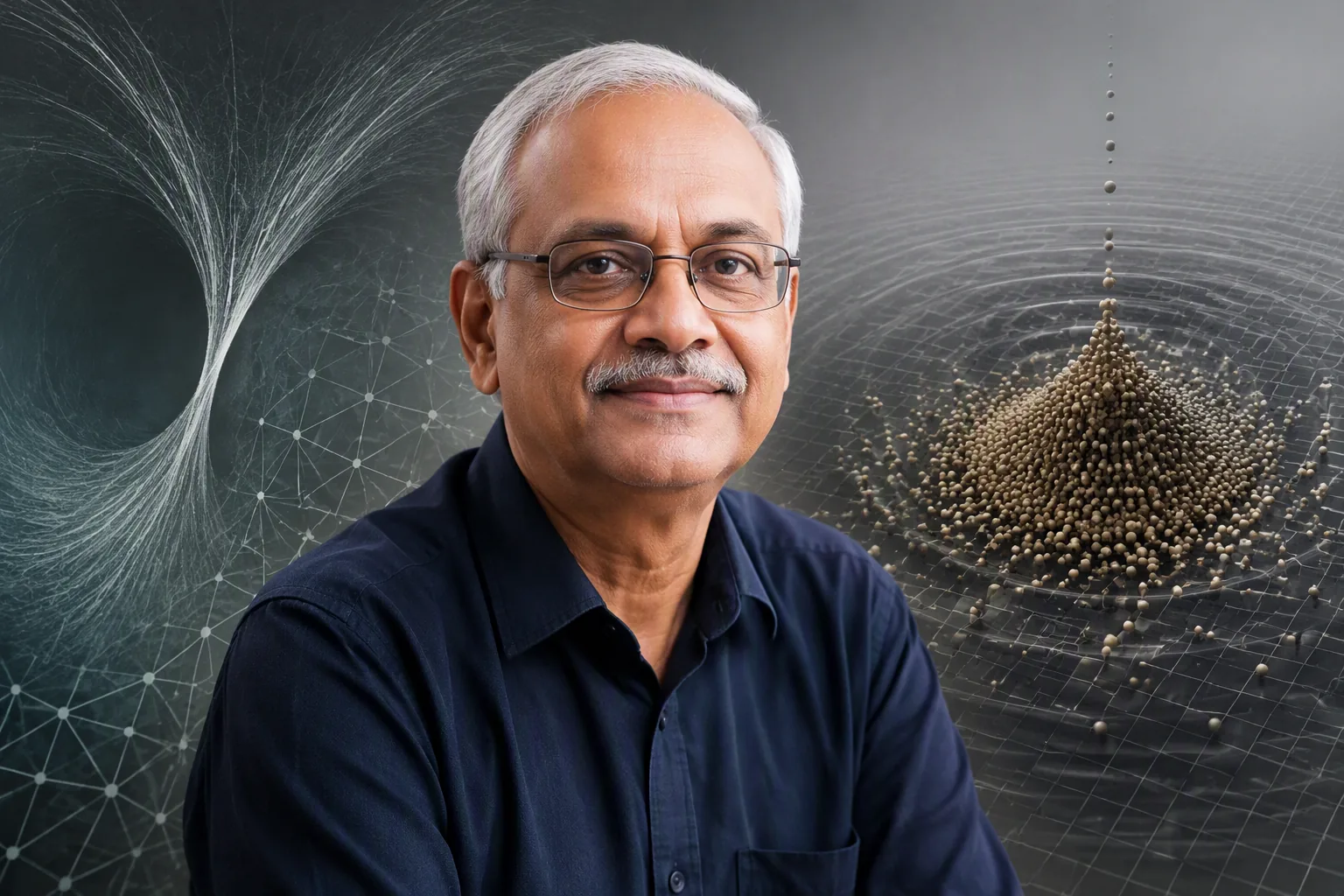
Theoretical physicist Deepak Dhar has been awarded the prestigious Dirac Medal for his contributions to statistical physics, sharing the honour with Bernard Derrida, Marc Mézard, and Haim Sompolinsky. The award, announced by the International Centre for Theoretical Physics (ICTP) in Trieste, Italy, commemorates British physicist Paul A.M. Dirac’s birthday and recognises significant contributions to theoretical physics. Dhar is only the second Indian scientist to win this medal, following string theorist Ashoke Sen in 2012.
---
What is the Abelian Sandpile Model?
Dhar’s most celebrated work revolves around the Abelian sandpile model, a mathematical framework inspired by the concept of self-organised criticality. This idea was first proposed in the late 1980s by physicists Per Bak, Chao Tang, and Kurt Wiesenfeld. It describes systems that naturally evolve into a critical state where minor disturbances can lead to effects ranging from negligible to catastrophic. Dhar’s contribution was to refine this concept into a model that allows exact predictions.
In the Abelian sandpile model, grains of sand are added to a pile until it becomes unstable. When instability occurs, grains topple and cascade, sometimes triggering avalanches. Dhar’s insight was that no matter the sequence of toppling events, the pile always settles into the same final shape — a property described as “Abelian.” This predictability makes the model a powerful tool for understanding complex systems.
---
Why It Matters
The Abelian sandpile model has broad applications across scientific disciplines. It has been used to simulate phenomena like earthquakes, forest fires, neural activity in the brain, and fluctuations in financial markets. These diverse applications highlight the model’s ability to capture the behaviour of systems that accumulate instability and release it unpredictably — a concept central to understanding many natural and artificial processes.
---
Dhar’s Career and Legacy
Born in 1951 in Pratapgarh, Uttar Pradesh, Dhar pursued his education at Allahabad University, IIT-Kanpur, and the California Institute of Technology (Caltech), where he completed his PhD in 1978 under the mentorship of Nobel laureate Richard Feynman. After his doctorate, Dhar chose to return to India, dedicating much of his career to the Tata Institute of Fundamental Research in Mumbai. Since 2016, he has been associated with the Indian Institute of Science Education and Research (IISER), Pune, and currently serves as the INSA Distinguished Professor at the International Centre for Theoretical Sciences, Bengaluru.
Over nearly five decades, Dhar has made significant contributions to statistical mechanics, a field that studies how large-scale patterns emerge from the collective behaviour of vast numbers of particles. His accolades include the Shanti Swarup Bhatnagar Prize (1991), the TWAS Prize (2002), the Boltzmann Medal (2022), and the Padma Bhushan (2023). The Boltzmann Medal, awarded every three years, is considered the most prestigious prize in statistical physics.
---
The Significance of the Dirac Medal
Established in 1985, the Dirac Medal honours physicists who have made outstanding contributions to theoretical physics but have not yet received top-tier honours like the Nobel Prize. Past recipients include luminaries such as Stephen Hawking and Edward Witten, many of whom later won Nobel Prizes. This year’s winners, including Dhar, were recognised for applying statistical mechanics to diverse fields such as neuroscience, artificial intelligence, and optimisation problems.
Dhar’s recognition underscores the growing contributions of Indian scientists to global physics research. His work not only advances theoretical understanding but also offers tools to tackle real-world challenges, making his Dirac Medal win a landmark moment for Indian science.
Source: The Hindu
Frequently asked questions
Who is Deepak Dhar?
Deepak Dhar is a theoretical physicist awarded the Dirac Medal for his contributions to statistical physics.
What is the Dirac Medal?
The Dirac Medal is a prestigious award given to recognize significant contributions to theoretical physics, commemorating British physicist Paul A.M. Dirac’s birthday.
What is the Abelian sandpile model?
The Abelian sandpile model is a mathematical framework that describes systems evolving into a critical state where minor disturbances can lead to varying effects, refined by Deepak Dhar.
What are the applications of the Abelian sandpile model?
The model has applications in simulating phenomena such as earthquakes, forest fires, neural activity in the brain, and fluctuations in financial markets.
Where did Deepak Dhar complete his PhD?
Deepak Dhar completed his PhD at the California Institute of Technology (Caltech) under Nobel laureate Richard Feynman.
You may also like
 National
Bahraich MLA Anupama Jaiswal Leads Independence Day Celebrations
 Kerala
Chokramudi Hills to Open for Tourists as Neelakurinji Blooms Begin
 National
FTII's Jagat Murari: Shaping India's Filmmaking Rebels Since the 1960s
 West Bengal
Suvendu Adhikari vows 'Vikshit Bharat' vision relies on 'Viksit Bengal' by 2047
Most read
- 1
Raja Mahendra Pratap Singh University launches 'Free Thinkers Club' for students
- 2
Andhra Pradesh Cabinet Ministers List 2026 with Contact Numbers and Portfolios
- 3
Teacher arrives drunk at Firozabad school, sparks chaos and protests
- 4
Hamirpur stenographer rescued after suicide attempt from bridge
- 5
Tamil Nadu Cabinet Ministers List 2026 with Portfolios
Comments
No comments yet. Be the first to comment.