
ChatGPT Replies Will Carry an Invisible Watermark in the EU: OpenAI's Big Move and How AI Text Will Be Identified
OpenAI will add an invisible textGrain watermark to eligible ChatGPT and Codex text output in the EU to meet the EU AI Act, while API customers worldwide can opt in. Here is how it works and its limits.

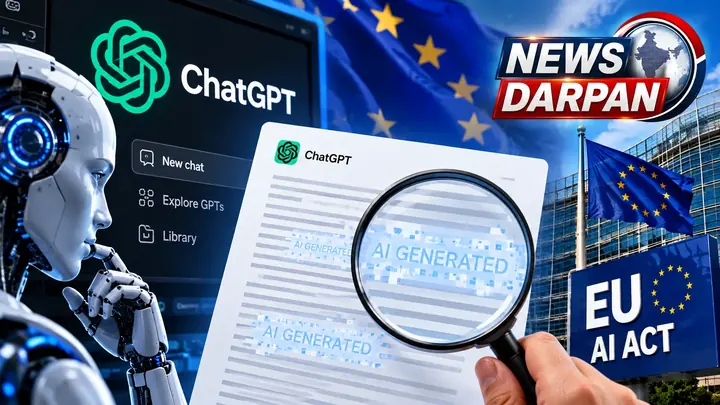
ChatGPT: OpenAI has taken a major step on identifying text produced by ChatGPT and Codex. The company will add an invisible text watermark to eligible ChatGPT and Codex output in the European Union. It will not be a visible logo, mark or separate tag. Instead, a statistical pattern is built into the way words are chosen, and a special detector can pick it up.
According to OpenAI, the step is meant to make AI-generated content machine-identifiable under the EU AI Act. The company calls the technology textGrain, and set out its approach on 5 October 2026.
How will the ChatGPT watermark work?
The key point is that users will not see any watermark when they read a ChatGPT reply.
According to OpenAI, textGrain makes a very slight change to how the model picks the next word or token. Across a longer passage, these word choices form a specific pattern that OpenAI's detector can look for. It does not add hidden characters, invisible spaces or unusual punctuation.
In other words, a normal user will see the ChatGPT reply exactly as before, but a signal that a machine can read may sit underneath it.
When will ChatGPT users in the EU get it?
OpenAI says it will introduce the invisible watermark on eligible ChatGPT and Codex text output in the EU over the coming weeks, across all plans. The rollout is limited to the EU, and OpenAI is not making it a global default for ChatGPT at launch.
The arrangement is different for developers and organisations using the OpenAI API. API customers around the world can opt in to text watermarking on select models, while the feature stays off by default in the API.
Will it prove that ChatGPT wrote a text?
This is an important point to understand.
A watermark does not prove authorship, ownership or legal responsibility for a text. According to OpenAI, finding a watermark can signal that an OpenAI model generated or processed the text, but it does not show how much a human contributed.
Likewise, if no watermark is found in a text, that does not mean a human definitely wrote it.
AI detection is still a big challenge
OpenAI itself admits that text watermarking and detection are early technologies with real limits.
For example, according to a Search Engine Journal report on OpenAI's tests, replacing about 25 per cent of the words in a 400-token English passage with synonyms cut the detection rate from about 92 per cent to 17 per cent. Replacing just 10 per cent brought it down to about 66 per cent. So once a text has been edited or rewritten enough, the watermark can become very hard to detect.
OpenAI has also said detection can be less reliable after substantial rewriting, paraphrasing or translation. Reliability is limited for short passages too.
What about text shorter than 200 tokens?
According to OpenAI's Help Center, the EU AI Act Code of Practice on transparency does not require watermarks on output shorter than 200 tokens, which is roughly 150 words in English, or on code snippets.
That means not every short ChatGPT reply can be reliably detected in the same way.
OpenAI is also building a text watermark detector
OpenAI has started the process of offering a separate detector for text watermarks. Access will not be open to everyone at first.
According to the company, approved researchers and expert organisations, especially those working on text provenance and detection reliability, can apply for access. OpenAI says the tool reports whether it detects an OpenAI watermark without identifying the user or revealing prompts or conversations.
OpenAI also aims to release the technology as open source later, so others can build their own tools on it.
Not just ChatGPT, Codex is covered too
The change is not limited to ChatGPT. OpenAI has made clear that eligible Codex text output in the EU will also come under this provenance system.
The aim is to increase transparency about the origin of AI-generated code and text.
What does it mean for ChatGPT users in India?
Under OpenAI's announcement, the rollout covers eligible ChatGPT and Codex text output in the EU. So for regular ChatGPT users in India, this should not be seen as a mandatory watermark rollout like the one in the EU. OpenAI API customers worldwide, however, can opt in to watermarking on select models.
For a ChatGPT user in India, then, the biggest change right now is not a visible mark on every reply. The real shift is towards stronger machine-readable provenance for AI-generated text.
Bottom line
ChatGPT's new textGrain watermark could change how AI-generated content is identified. But it would be wrong to see it as an "AI detector" that catches every AI-written text 100 per cent of the time. OpenAI itself acknowledges the detection limits. For now, its purpose is to give an extra technical signal about the origin of AI content, not to decide which person wrote a text.
Frequently asked questions
How will the ChatGPT watermark work?
OpenAI's textGrain makes slight changes to word or token selection, creating a statistical pattern that a detector can identify. Users will not see a visible mark, hidden characters, spaces or unusual punctuation.
When will the ChatGPT watermark be introduced in the EU?
OpenAI says it will roll out invisible watermarking for eligible ChatGPT and Codex text output in the EU over the coming weeks, across all plans.
Will the watermark prove that ChatGPT wrote a text?
No. A detected watermark may indicate that an OpenAI model generated or processed the text, but it does not prove authorship, ownership, legal responsibility or the extent of human input.
How reliable is AI text watermark detection?
Detection has limits and can become much less reliable after substantial editing, rewriting, paraphrasing or translation. It is also less reliable for short passages.
You may also like
 Technology
OpenAI Begins GPT-6 Rollout With Intelligent UI in ChatGPT
 Technology
OpenAI Says 53 ChatGPT User Images Accidentally Uploaded Online, Most Removed
 Technology
Chinese AI firms generate $10.7 billion revenue, lagging US competitors by tenfold
 National
OpenAI launches GPT-6 Astra, achieving near-perfect AGI benchmark score
Most read
- 1
Air China Adds Extra Flight for Passengers Stranded in Fuel-Starved Cuba
- 2
Western disturbance to bring rain, hail and strong winds across north India
- 3
Yogi Adityanath Directs No Occupied Houses Be Demolished for Achhalda Bridge
- 4
Gwalior Temple Truck Crash Kills 12, Injures 28-29 Devotees During Navratri
- 5
Heavy Rain Waterlogs Bengaluru, Snarls Traffic; Ride-Hailing Fares Surge
Comments
No comments yet. Be the first to comment.