
BJP's New-Face Push in MP's Datia Ends in Congress Defeat
The debate over “generational change” has intensified within the Bharatiya Janata Party in Madhya Pradesh.

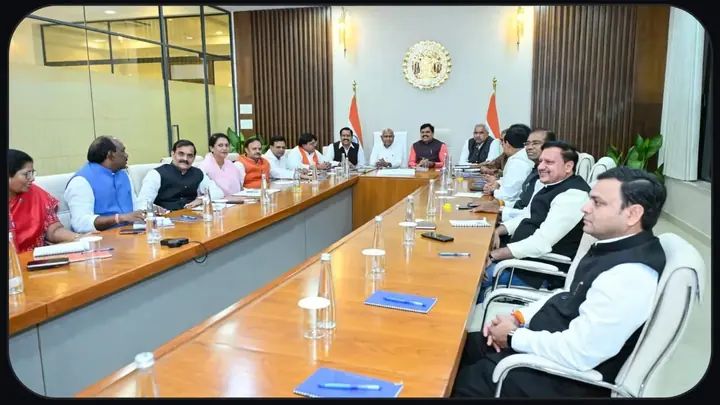
The debate over “generational change” has intensified within the Bharatiya Janata Party in Madhya Pradesh. The party appears to be following a strategy of giving more space to new faces in the organisation. At the same time, this has raised a question: in the process of making room for the next generation, are the political roles of older and experienced leaders being sharply reduced?
The BJP has changed its leadership from time to time. The party has regularly brought in new faces and assigned new responsibilities within the organisation. However, developments in Madhya Pradesh have intensified the internal discussion over how this change is being carried out and what place senior leaders will have in the party’s future structure.
Datia has emerged as the clearest example of this shift. Six-time MLA and former Home Minister Narottam Mishra was not given a ticket by the BJP in the by-election. Instead, the party fielded Ashutosh Tiwari, a new face associated with the organisation.
The decision led to opposition from Mishra’s supporters in Datia. Later, however, Mishra campaigned in support of the party candidate and conveyed a message of unity in favour of the BJP from the election platform.
The election result created another difficulty for the BJP. Congress candidate Ghanshyam Singh defeated the BJP candidate by 6,016 votes. After this defeat, the party dissolved the entire Datia district organisation.
These two developments are now being viewed in the context of the changes taking place inside the BJP. On one side, an influential old face was kept out of the ticket decision. On the other, a major organisational action followed after the election loss. Together, the decisions have increased discussion about whether the party is moving towards a new political arrangement in Madhya Pradesh.
The policy of generational change also raises questions about whether the standards of age and experience are being applied equally to all leaders. In politics, experience generally grows with age. For this reason, instead of completely sidelining senior leaders, changing their roles and making use of their experience is considered important for an organisation.
The Madhya Pradesh BJP has seen several changes at the leadership level over the past few years. In 2025, Hemant Khandelwal was made the state president in place of V.D. Sharma. After that, the process of bringing a new team to the forefront of the organisation became faster.
In September 2026, the BJP also gave Chandrashekhar the responsibility of organisational general secretary in Madhya Pradesh. The post had fallen vacant after Hitanand Sharma was removed from the position.
In a cadre-based party such as the BJP, generational change can be seen as an organisational requirement. Giving responsibility to a new generation can also be considered a natural process. The question, however, is whether the political usefulness of older leaders should be treated as having ended completely during this transition.
Leaders who strengthened the organisation over a long period, contested elections, handled responsibilities in governments and built influence in their respective areas carry political experience. Making that experience irrelevant suddenly can also become a challenge for the party.
The Datia developments offer an example of this difficulty. After the decision to change the ticket, the party had to handle the anger that emerged. Following the defeat, it also had to take a major decision at the organisational level by dissolving the district unit.
A comparison with the earlier period under Shivraj Singh Chouhan has also begun within the Madhya Pradesh BJP. During Shivraj Singh Chouhan’s long tenure, there was factional politics within the party and differences among leaders. Even so, several senior leaders continued to receive political roles at different times.
The question now is how inclusive the effort to build a “new team” will be. The issue is not only whether new faces are being brought forward, but also whether experienced leaders will continue to have a meaningful place in the organisation.
In politics, no face remains in power forever, and no face remains on the sidelines forever. A leader who is at the centre of the organisation today may have a different role tomorrow. This is why balance and dialogue are considered important in political organisations.
Giving the next generation more opportunities does not necessarily require older leaders to be pushed completely into the background. A more effective strategy could be to move forward by combining experience with new energy.
Otherwise, the effort to create space for new faces could weaken the political base of older leaders. The debate over generational change is therefore not limited to the promotion of new leaders. It also concerns the way the party manages leaders who have built influence over many years.
The challenge before the BJP is not only to bring new faces forward. It must also maintain a balance between influential senior leaders and the new generation. The Datia episode has brought this issue into sharper focus because the ticket decision, the reaction among supporters, the election defeat and the subsequent dissolution of the district organisation all became part of the same political discussion.
The political wheel keeps turning. A leader whose role is limited in the organisation today may become important again tomorrow. For the BJP in Madhya Pradesh, the question is how to pursue organisational change without allowing the process of bringing forward a new generation to completely reduce the space, influence and experience of the old one.
Frequently asked questions
Why did Datia become a key example of the BJP's generational change strategy?
The BJP denied a ticket to six-time MLA and former Home Minister Narottam Mishra and instead fielded new face Ashutosh Tiwari.
Who won the Datia by-election?
Congress candidate Ghanshyam Singh defeated the BJP candidate by 6,016 votes.
What organisational action did the BJP take after the Datia defeat?
The BJP dissolved the entire Datia district organisation.
What leadership changes took place in the Madhya Pradesh BJP?
Hemant Khandelwal replaced V.D. Sharma as state president in 2025, and Chandrashekhar became organisational general secretary in September 2026.
You may also like
 Politics
Congress Leader Claims Jitu Patwari Will Fly MP’s New ₹250-Crore Jet
 Viral
MP reports fever patients; concerns over antibiotic self-medication
 Madhya Pradesh
 TET Gets Just 34,200 Applications From 1.5 Lakh Eligible Teachers
 Madhya Pradesh
 Government's New Bombardier Challenger 3500 Jet Reaches Bhopal
Most read
- 1
Air China Adds Extra Flight for Passengers Stranded in Fuel-Starved Cuba
- 2
Western disturbance to bring rain, hail and strong winds across north India
- 3
Yogi Adityanath Directs No Occupied Houses Be Demolished for Achhalda Bridge
- 4
Gwalior Temple Truck Crash Kills 12, Injures 28-29 Devotees During Navratri
- 5
Schools Shut in Five Tamil Nadu Districts, Including Chennai, Amid Heavy Rain
Comments
No comments yet. Be the first to comment.