
Andhra Pradesh Set To Launch 3D-Printed Rural Housing Pilot
Andhra Pradesh will use 3D concrete printing to build 177 PMAY-G rural homes in Burripalem and Pothuru in a national pilot.

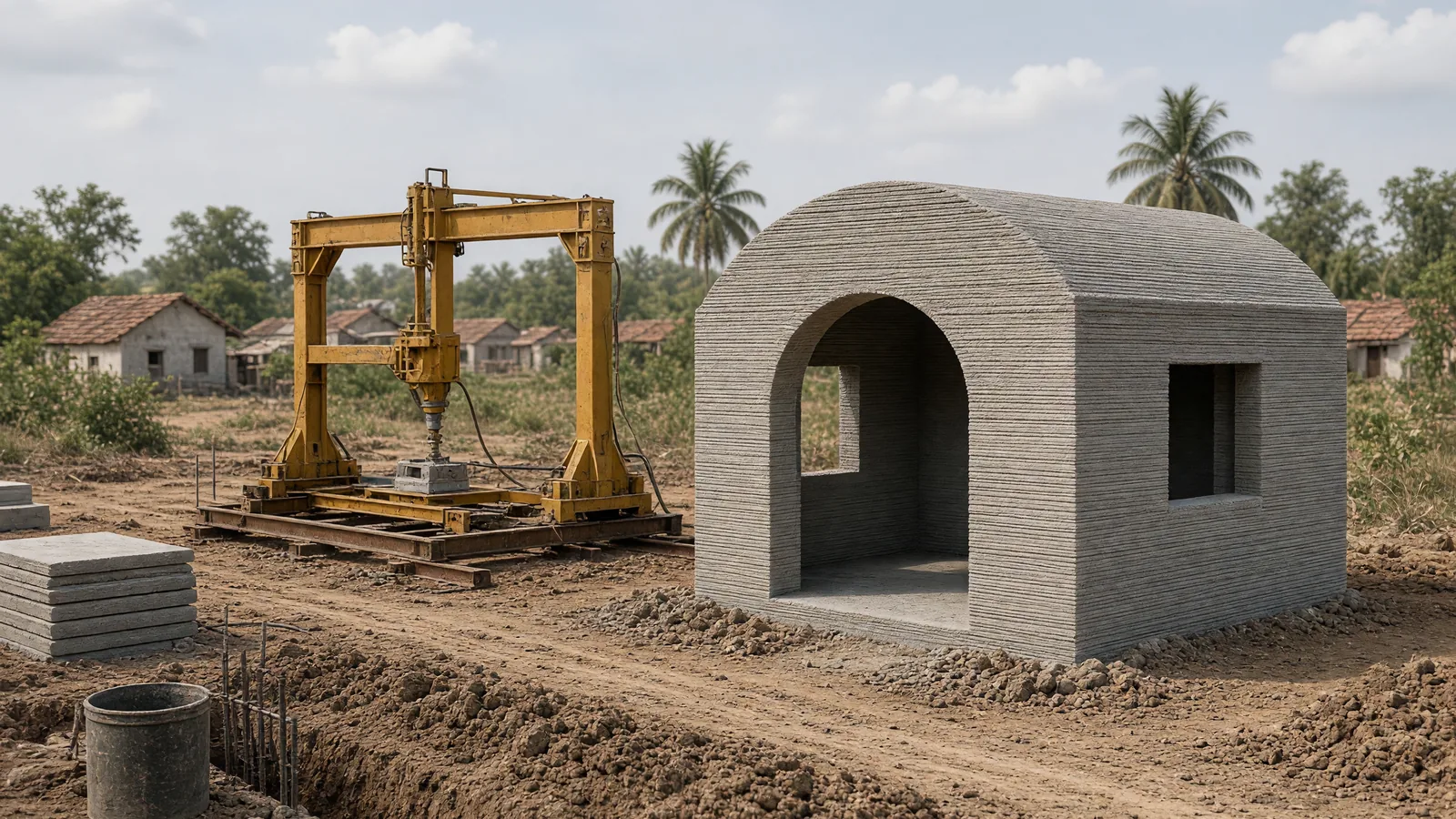
3D concrete printing houses breaking ground in Andhra Pradesh | Explained
Andhra Pradesh is set to launch a national-level pilot for rural homes built with 3D Concrete Printing under the Pradhan Mantri Awas Yojana-Gramin (PMAY-G) scheme, beginning with housing units in Burripalem and Pothuru.
The initiative will kick off on October 4 with 100 housing units in Burripalem in Guntur district and 77 units in Pothuru. It marks a significant step in applying construction-scale automation to rural housing under a government scheme.
What the Andhra Pradesh project involves
The project has an outlay of ₹13.93 crore, excluding taxes. The Union Ministry of Rural Development (MoRD) will contribute ₹9.44 crore, while the State government will contribute ₹4.49 crore.
The pilot brings 3D Concrete Printing into a public housing programme rather than limiting the technology to experimental or privately developed structures. Prof. P. Veerabhadra Rao, Professor of Practice in the Department of Civil Engineering at GVP College of Engineering, Visakhapatnam, told The Hindu that a shift towards automation could redefine national habitat development.
Prof. Rao and his research team have conducted extensive research on 3DCP models. The project therefore combines a government-backed housing application with research into the construction process, materials and automation required for such structures.
How 3D Concrete Printing works
Construction-scale additive manufacturing, commonly called 3D Concrete Printing, replaces traditional masonry and sequential manual labour with a computer-controlled system. A robotic printer translates a digital Building Information Modelling (BIM) design into a physical structure by extruding specially formulated cementitious materials through a nozzle.
The material is deposited in successive horizontal layers. The process depends heavily on material science and automation because the wet mix must have precise extrudability, buildability and rapid setting times.
These properties are necessary to ensure that each layer can be deposited and retained without the structure collapsing under its own weight. The method therefore involves more than simply operating a large printer, as the design system, robotic equipment and cementitious mix must work together.
From global experiments to India
The foundational roots of construction-scale printing lie in early academic and industry experimentation across the world. The technology then expanded across regions including the U.S., China, Europe and West Asia.
India’s entry into the field gained momentum in 2021. IIT Madras, alongside startup Tvasta, unveiled the country’s first 3D-printed single-storey house on its campus that year.
The technology has also moved beyond early experimental work in other countries. “Globally, landmarks such as Dubai’s multi-storey printing feats, ICON’s advanced Vulcan printers in Texas, and Japan’s seismically compliant structures in Miyagi Prefecture have steadily pushed the technology from experimental phases into heavily regulated commercial environments,” Prof. Rao said.
Dubai has emerged as one of the world’s prominent hubs for large-scale construction 3D printing. Prof. Rao said Dubai Municipality constructed a two-storey, 640-square-metre building using 3D printing technology in 2021.
Where the technology could be used
The potential applications extend beyond experimental residential units. Automated construction is presented as a possible response to critical infrastructure shortages.
In India, the technology is being tailored for affordable housing missions, disaster-relief shelters, remote-area deployments, defense fortifications and rapidly erected public facilities. Its use in remote communities could reduce dependency on localized masonry skills while enabling standardized, high-speed housing builds.
The relevance to public welfare lies in the possibility of deploying such construction where urgent housing or infrastructure needs exist. The Andhra Pradesh pilot places that possibility within a rural housing programme and provides a project through which the approach can be applied at a larger scale.
The advantages and the limits
The primary advantages of 3D printing include speed, reduced material waste and the elimination of traditional timber or steel formwork. Projects such as the upcoming Andhra Pradesh pilot are expected to reduce construction time per unit to roughly 45 to 60 days.
The printed structures also offer superior thermal comfort, with cooler interiors. These features make the technology relevant to housing programmes where construction time, material use and living conditions are important considerations.
However, 3D printing does not remove the need for conventional construction altogether. Foundations, structural reinforcement, roofing, electrical conduits, plumbing, doors and windows still require hybrid or traditional techniques.
Material durability remains a challenge, as do strict structural codes, printer mobility and regulatory approvals. The technology must therefore operate alongside established civil engineering practices rather than replacing every stage of construction.
What comes next
The future of architecture is expected to involve a collaborative hybrid system in which robotics, artificial intelligence, BIM and traditional civil engineering operate together. This model would combine automated printing with the conventional work that remains necessary for foundations, services, roofing and other building components.
Its development will require close coordination among research and academic bodies such as the CSIR-Central Building Research Institute, central and state Ministries and private innovators. Regulatory frameworks will also need to evolve to validate automated building components.
Large-scale deployment will depend on demonstrating long-term structural reliability and economic viability. The Andhra Pradesh pilot is consequently important not only for the homes it is intended to build, but also for establishing whether 3D Concrete Printing can meet the technical, regulatory and economic requirements of wider public housing programmes.
The source material was published on October 03, 2026 at 02:21 pm IST.
Source: The Hindu
Frequently asked questions
What is Andhra Pradesh launching under the PMAY-G scheme?
Andhra Pradesh is launching a national-level pilot for rural homes built with 3D Concrete Printing under the Pradhan Mantri Awas Yojana-Gramin scheme.
When and where will the 3D-printed housing pilot begin?
The pilot will begin on October 4 with 100 housing units in Burripalem, Guntur district, and 77 units in Pothuru.
What is the total outlay for the project?
The project has an outlay of ₹13.93 crore, excluding taxes, with ₹9.44 crore from the Union Ministry of Rural Development and ₹4.49 crore from the State government.
How does 3D Concrete Printing build houses?
A robotic printer translates a digital Building Information Modelling design into a structure by extruding specially formulated cementitious materials in successive horizontal layers.
You may also like
 Weather
Heavy rain hits Tirupati as low-pressure area forms off Tamil Nadu coast
 Politics
Jagan Mohan Reddy Calls YSRCP’s Support for 2023 Poll Law a Mistake
 Weather
IMD Predicts Wet Spell, Heavy Rain In Andhra Pradesh Till October 21
 Business
31 MoUs Exchanged as Ministers Pitch Andhra Pradesh as Global Manufacturing Hub
Most read
- 1
Air China Adds Extra Flight for Passengers Stranded in Fuel-Starved Cuba
- 2
Western disturbance to bring rain, hail and strong winds across north India
- 3
Yogi Adityanath Directs No Occupied Houses Be Demolished for Achhalda Bridge
- 4
Gwalior Temple Truck Crash Kills 12, Injures 28-29 Devotees During Navratri
- 5
Heavy Rain Waterlogs Bengaluru, Snarls Traffic; Ride-Hailing Fares Surge
Comments
No comments yet. Be the first to comment.