
Amid heavy rain, overall reservoir levels hold steady at 50% in A
Andhra Pradesh Reservoir Storage Holds at 50% Despite Heavy Rain Andhra Pradesh’s major reservoirs remained broadly steady at about half their combined …

Andhra Pradesh Reservoir Storage Holds at 50% Despite Heavy Rain
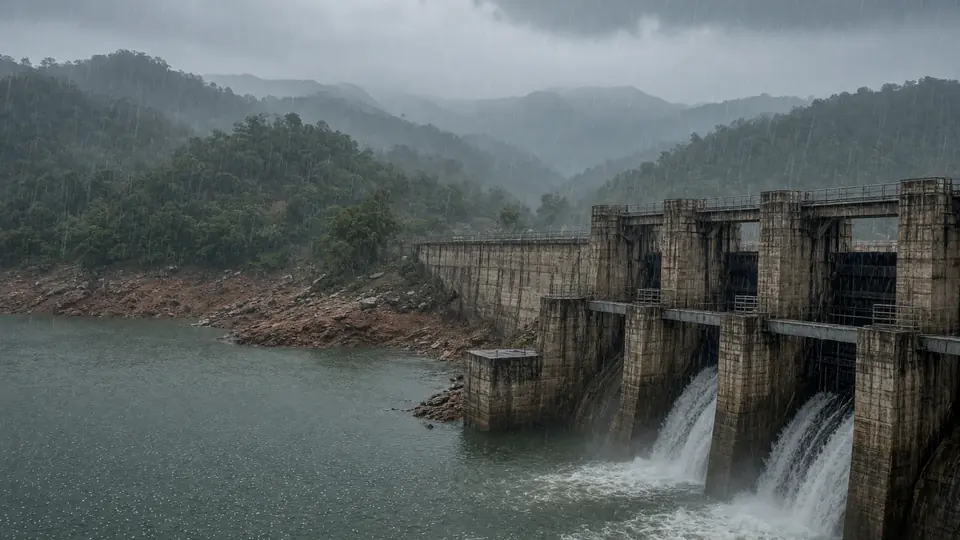
Andhra Pradesh’s major reservoirs remained broadly steady at about half their combined capacity on September 24, even after heavy rain over the past one-and-a-half days under the influence of a depression.
The State’s reservoirs held 552.81 TMC against a combined capacity of 1,106.36 TMC, which works out to about 50%.
The storage position did not change significantly because releases were being regulated in line with inflows and downstream conditions across the major dams and barrages.
Godavari, Krishna systems see strong movement
The Godavari and Krishna river systems witnessed substantial inflows, but this did not translate into a major rise in overall storage across the State.
Over the past 24 hours, storage across the five major dams and barrages remained virtually flat.
The stability came despite substantial movement of water through parts of the Godavari and Krishna systems.
The Godavari basin continued to receive heavy flows.
At the Sir Arthur Cotton Barrage at Dowleswaram, both inflow and outflow were recorded at 1,37,099 cusecs.
The barrage has a capacity of 2.93 TMC and recorded no change in storage during the last 24 hours, with the incoming flow being passed downstream, WRD officials say.
At the Donkarayi Reservoir, inflow and outflow were both 3,485 cusecs, and storage remained unchanged.
Srisailam flat, Nagarjuna Sagar rises marginally
In the Krishna basin, the Srisailam dam had 95.36 TMC against its 215.81 TMC capacity.
No instant inflow was recorded at Srisailam, while the downstream release was maintained at 7,250 cusecs.
There was no change in Srisailam’s storage during the period, the officials say.
At Nagarjuna Sagar, storage increased marginally from 180.09 TMC to 180.10 TMC.
The reservoir received an inflow of 6,051 cusecs and released 6,027 cusecs.
Its storage stood at about 58% of its 312.05 TMC capacity.
Further downstream, the Pulichinthala project in Palnadu district had 27.45 TMC against its 45.77 TMC capacity.
The water level at Pulichinthala was 161.61 feet.
The project received an inflow of 3,688 cusecs and released 400 cusecs.
Its storage remained unchanged over the 24 hour period.
At Prakasam Barrage in NTR district, inflow and outflow were both recorded at 11,588 cusecs.
The barrage recorded no change in its reported storage of 3.03 TMC, officials say.
Pennar basin and Rayalaseema remain low
The overall picture remained uneven because key reservoirs in the Pennar basin and Rayalaseema stayed well below capacity.
The storage position in the Pennar basin and Rayalaseema remained considerably lower than the major flow-handling systems.
Somasila Reservoir held 16.50 TMC against its 78 TMC capacity.
That left 61.50 TMC of available capacity at Somasila.
Kandaleru Reservoir had 17.27 TMC against its 68.03 TMC capacity.
That left 50.76 TMC of available capacity at Kandaleru.
The combined storage reported for the Rayalaseema region was 171.62 TMC against a total capacity of 372.37 TMC.
This left 200.75 TMC of unfilled capacity in the Rayalaseema region.
Uneven water spread across the State
The contrasting storage positions underline the uneven distribution of water across Andhra Pradesh.
While the Godavari and Krishna systems are handling substantial flows, reservoirs in the Pennar basin and Rayalaseema continue to remain well below their full-reservoir levels.
The latest storage data therefore shows a State-level balance that is steady overall, but sharply varied between river systems and regions.
The figures were published on September 24, 2026 at 06:26 pm IST.
Source: The Hindu
Frequently asked questions
What was the overall reservoir storage in Andhra Pradesh on September 24?
Andhra Pradesh’s major reservoirs held 552.81 TMC against a combined capacity of 1,106.36 TMC, or about 50%.
Why did reservoir storage remain steady despite heavy rain?
Storage did not change significantly because releases were regulated in line with inflows and downstream conditions at major dams and barrages.
What happened at the Sir Arthur Cotton Barrage at Dowleswaram?
The barrage recorded inflow and outflow of 1,37,099 cusecs, with no change in storage as the incoming flow was passed downstream.
How did storage change at Srisailam and Nagarjuna Sagar?
Srisailam remained unchanged at 95.36 TMC, while Nagarjuna Sagar rose marginally from 180.09 TMC to 180.10 TMC.
Which areas remained low in storage?
Key reservoirs in the Pennar basin and Rayalaseema remained well below capacity, including Somasila at 16.50 TMC and Kandaleru at 17.27 TMC.
You may also like
 National
Naidu, Sitharaman to lay foundation for ₹1 lakh crore Rayalaseema
 National
Andhra Pradesh extends A4 liquor shop renewal deadline by two days to September 23
 Politics
Naidu, Pawan Kalyan to launch rural employment programme in Nellore on Thursday
 National
Andhra Pradesh opens applications for theatre awards Nandi Natakotsavalu and Kandukuri Puraskaralu
Most read
- 1
Tesla audits Chinese suppliers to scale up Optimus robot production
- 2
Former minister Lakhan Singh Rajput to inaugurate temple bhandara at Shri Chakreshwar Mahadev
- 3
Firozabad BSA finds four government schools locked during inspection
- 4
Tamil Nadu dengue cases fall for third consecutive year to 17,049
- 5
Social workers stage silent protest at Fufund railway station for train halts
Comments
No comments yet. Be the first to comment.