
1862 Dog Memorial Links Cuddalore, Madras And Colonial Calcutta
A dog memorial at Fort St. David connects Cuddalore and Madras with Dr. H.E. Busteed, an early chronicler of colonial Calcutta.

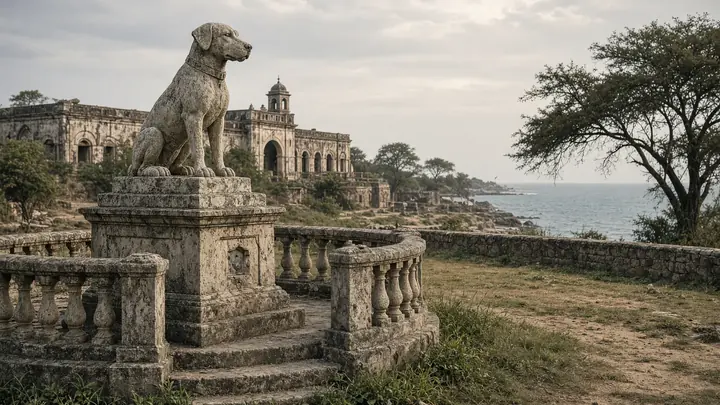
A 1862 memorial to a dog at Fort St. David has revealed an unexpected link between Cuddalore, Madras and colonial Calcutta. The stone, set into the rear wall of the former fort, was raised for a dog named Nettle by its owner, identified only by the initials HEB.
HEB was Dr. H.E. Busteed, one of the early chroniclers of colonial Calcutta. His connection with Fort St. David emerged during a visit to the property, which is now managed as a guesthouse by the Murugappa Group.
Fort St. David and the road to Cuddalore
The visit took place during a long weekend a fortnight ago, with Fort St. David as the destination. The property brought back memories of an earlier stay when it was a Murugappa guesthouse, and the latest visit was described as equally enjoyable.
Fort St. David commemorates by name the fort that the British built in Cuddalore. Its history, however, began with a much wider contest among European colonial powers for control of the area.
The place had been eyed repeatedly by colonial forces since the early 1600s. Elihu Yale, while serving as Governor of Madras in the 1690s, was the brain behind it.
The Dutch negotiated for the place with the Nayaks of Gingee, but the Portuguese refused to accept the arrangement. After Gingee became a Maratha stronghold, the British were more successful.
They were given as much land as could be covered by shooting cannonballs. The French then made repeated attempts to take the place, finally giving up only in the 1760s.
The colonial interest in Cuddalore was linked to the textile-weaving centres in the town and its surroundings. Under the British, however, the place developed more as a military stronghold.
That military role became particularly important when Madras fell to the French in 1746. Fort St. David served as a convenient bolthole for the British during that period.
While Fort St. George surrendered, Fort St. David did not. It remained the British headquarters of Madras up to as late as 1752, three years after the French had vacated the city referred to in the account as “our city”.
The capital that Cuddalore did not become
The history of the fort raises a counterfactual question: what would have happened if the British had never returned to Madras and had instead invested in developing Cuddalore as their capital?
Much of Fort St. David was ruined during Comte de Lally’s siege in the late 1750s. Today, apart from three or four colonial buildings and some graveyards, little remains to show how the site might have rivalled Madras.
Cuddalore Old Town, or OT, has preserved more visible traces of the British presence. By the river are a few old British warehouses, including the Parry sugar warehouse.
The Old Town also has Christ Church, though the church has been badly modernised. Thomas Parry is buried there.
The Fort St. David guesthouse itself is a 1930s art deco building overlooking the beach. Its setting and the surviving material inside it connect the site’s later history with the commercial and administrative worlds around Madras and Cuddalore.
Inside the building are Parry ledgers dating to the 1850s and several old maps that have been beautifully mounted. The place is described as a haven of peace, in contrast to the military struggles that shaped the fort’s earlier history.
The memorial to Nettle
The dog memorial might have remained unnoticed but for a suggestion from M.M. Murugappan, former Chairman of the Murugappa Group. When he was called from Fort St. David, he said: “Don’t miss the commemorative stone let into the rear wall.”
The stone is in Latin and dates to 1862. It was erected in memory of Nettle by the animal’s owner, whose identity is indicated by the initials HEB.
The initials led to Busteed, whose work on Calcutta had already established him as an early chronicler of that city. He was to Calcutta what H.D. Love was to Madras, although the comparison between their books has clear limits.
Busteed’s Echoes from Old Calcutta was first published in 1882. The book is more modest than Love’s monumental Vestiges of Old Madras, which ran to three volumes and included an index added for good measure.
Busteed’s book dealt with the lives of eminent people of 18th-century Calcutta. Despite its more limited scope, it is described as a good read.
The connection between Busteed and the three places was not previously apparent. His work was familiar, but his links to Madras and Cuddalore were not.
From medical service to the mint
Busteed was an MD and an MRCS. He joined the Madras Medical Service in 1855 and, two years later, saw active service during the First War of Indian Independence.
In 1861, he was posted as Civil Surgeon of Cuddalore. He served in that capacity until 1865, which accounts for the memorial to his dog at Fort St. David.
The Cuddalore posting was followed by a move into a very different area of work. In 1865, Busteed was appointed Assistant Assay Master of the Madras Mint.
The appointment raises the question of what a surgeon would have known about metallurgy or the minting of coins. The explanation offered is that such a transition was not unusual at the time because surgeons were considered men of science with skills in chemistry.
Busteed was transferred to Calcutta as Deputy Assay Master in 1870. He rose to become Assay Master in 1872.
His work at the mint appears to have been substantial. The numerous papers and articles he wrote on assaying are cited as evidence that he was good at his duties there.
His parent service continued to promote him even while he was minting coins. He retired in the 1880s with the rank of Brigade Surgeon.
In 1887, his services were recognised with the award of the Companion of the Order of the Indian Empire. Busteed died in England on February 1, 1912.
Although his links with Madras and Cuddalore were not strong, all records describe him as belonging to the Madras Medical Service. That official association helps explain why a figure remembered principally for his writing on Calcutta can also be traced through a medical posting in Cuddalore and service connected with Madras.
The memorial to Nettle was one among numerous tombstones found scattered across Fort St. David early in the 1900s. Its preservation reflected the British practice of considering even a memorial to a dog worthy of being retained and set into a wall.
The stone therefore links a quiet guesthouse overlooking the beach with the military history of Cuddalore, the institutional history of Madras and the literary history of Calcutta.
(Sriram V. is a writer and historian.)
Source: The Hindu
Frequently asked questions
What does the 1862 memorial at Fort St. David commemorate?
It commemorates a dog named Nettle, whose owner was identified by the initials HEB.
Who was HEB, the owner of Nettle?
HEB was Dr. H.E. Busteed, one of the early chroniclers of colonial Calcutta.
Why was Fort St. David important to the British?
It served as a British refuge and headquarters after Madras fell to the French in 1746.
What is the Fort St. David property used for today?
It is managed as a guesthouse by the Murugappa Group.
You may also like
 Weather
Schools Shut in Five Tamil Nadu Districts, Including Chennai, Amid Heavy Rain
 Tamil Nadu
Anbumani urges Tamil Nadu government to build new Secretariat outside Chennai
 Religious
Chennai artist recreates Tamil Nadu temple sculptures on pencil lead
 Politics
Tamil Nadu Chief Minister C. Joseph Vijay Featured in Navarathri Golu Dolls
Most read
- 1
Air China Adds Extra Flight for Passengers Stranded in Fuel-Starved Cuba
- 2
Western disturbance to bring rain, hail and strong winds across north India
- 3
Yogi Adityanath Directs No Occupied Houses Be Demolished for Achhalda Bridge
- 4
Gwalior Temple Truck Crash Kills 12, Injures 28-29 Devotees During Navratri
- 5
Heavy Rain Waterlogs Bengaluru, Snarls Traffic; Ride-Hailing Fares Surge
Comments
No comments yet. Be the first to comment.