
UP Village Worships Ravana Instead of Burning His Effigy on Dussehra
In Bihuni Kalan village of Hamirpur district, Ravana is not burnt on Dussehra. Instead, villagers decorate and worship a large statue of Ravana and respectfully offer coconuts to it.

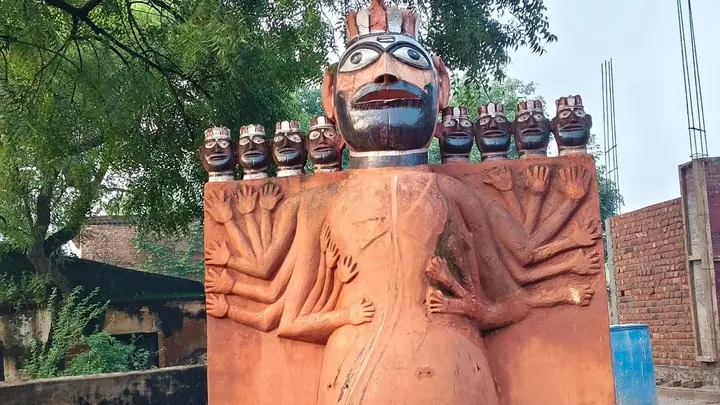
In Bihuni Kalan village of Hamirpur district, Ravana is not burnt on Dussehra. Instead, villagers decorate and worship a large statue of Ravana and respectfully offer coconuts to it. This unusual tradition has been continuing for years in Bihuni Kalan village of the Muskara development block in Uttar Pradesh.
Across the country, burning Ravana’s effigy on Vijayadashami is associated with the message of the victory of good over evil. But in this village, the custom is different. On Dussehra, villagers gather around Ravana’s statue, decorate it and perform worship instead of setting it on fire.
The villagers believe that Ravana was a great scholar and that, in his final moments, he gave knowledge to Lakshman, the younger brother of Lord Rama. Their belief is that if Lakshman received knowledge from Ravana, it would not be right to burn his effigy. This belief is the reason why Ravana is not burnt in Bihuni Kalan on Vijayadashami.
At the centre of the village is a Ramleela ground. Directly opposite it stands a large statue of Ravana, which is about 10 feet high. The statue shows Ravana in a seated posture. It has nine heads and twenty arms. A crown has also been made on his head, and a horse-shaped figure can be seen on the crown.
Villagers Omkar Maharaj and Brijlal Rajput said that the statue was made of cement and lime. The exact details of when and by whom it was built are not known. Even the elders of the village do not have accurate information about its construction. Villagers estimate that the statue could be about one thousand years old. However, there is no historical confirmation of its actual age.
Chhatrapal Rajput, the village head’s representative, said that there has never been a tradition of burning Ravana in Bihuni Kalan. The villagers look at Ravana as a scholar. According to their belief, after Lord Rama killed Ravana, Lakshman went to him and received knowledge from him.
The villagers say that Ravana was knowledgeable about the Vedas and Vedanta. For this reason, they respect his scholarship. On Vijayadashami, they worship the statue instead of burning it. The village gram panchayat looks after the statue.
On Dussehra, the statue is specially decorated. Villagers gather there, perform worship and offer coconuts to Ravana. In other places, the main event of the day involves burning Ravana’s effigy. In Bihuni Kalan, however, the statue is worshipped with faith and respect.
Because the statue of Ravana is located there, the neighbourhood of the village is known as Ravan Patti. This tradition has given Bihuni Kalan a distinct identity in the surrounding areas.
There is also a temple and a Ramleela ground in front of Ravana’s statue. A large fair is organised in the village every year in January. People from nearby villages and distant areas come to attend the fair. Traders set up shops, while large numbers of people visit for shopping and entertainment.
Ramleela is also staged during the fair. The performance continues for about one week and includes the scene of Ravana’s killing. Even after this scene is presented, Ravana’s effigy is not burnt. The artists perform Ravana’s killing symbolically, while the village continues to follow its long-standing tradition.
The tradition of Bihuni Kalan is linked to its religious beliefs and local culture. In the village, Ravana is not seen only as a symbol of evil but also as a scholar. That is why his statue is decorated and worshipped on Dussehra instead of being set on fire.
While Ravana’s burning is a major Vijayadashami event across the country, the tradition of worshipping and honouring Ravana in Bihuni Kalan gives the village a special identity.
Frequently asked questions
Where is Ravana worshipped instead of being burnt on Dussehra?
In Bihuni Kalan village of Hamirpur district in Uttar Pradesh.
Why do villagers in Bihuni Kalan worship Ravana?
They believe Ravana was a great scholar who gave knowledge to Lakshman after Lord Rama killed him, so they do not think his effigy should be burnt.
What does the Ravana statue in Bihuni Kalan look like?
It is about 10 feet high, shows Ravana seated, and has nine heads, twenty arms, and a crown with a horse-shaped figure.
What do villagers do to the Ravana statue on Dussehra?
They decorate it, perform worship and offer coconuts instead of setting it on fire.
What is the area around the statue known as?
It is known as Ravan Patti.
You may also like
Most read
- 1
Air China Adds Extra Flight for Passengers Stranded in Fuel-Starved Cuba
- 2
Western disturbance to bring rain, hail and strong winds across north India
- 3
Yogi Adityanath Directs No Occupied Houses Be Demolished for Achhalda Bridge
- 4
Gwalior Temple Truck Crash Kills 12, Injures 28-29 Devotees During Navratri
- 5
Heavy Rain Waterlogs Bengaluru, Snarls Traffic; Ride-Hailing Fares Surge
Comments
No comments yet. Be the first to comment.