
Truck Hits Devotees Near Gwalior’s Shitla Mata Temple, 15 Killed
The Shitla Mata temple accident in Gwalior has raised serious questions about security arrangements, traffic monitoring and crowd management.

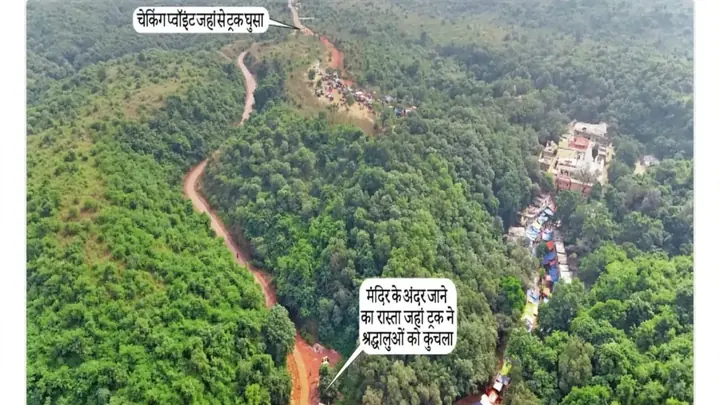
The Shitla Mata temple accident in Gwalior has raised serious questions about security arrangements, traffic monitoring and crowd management. A paddy-laden truck entered a crowd of devotees on the temple route during the intervening night of Saturday and Sunday, even though the road was reportedly being monitored to restrict the movement of two-wheelers.
According to the available details, the accident took place at around 1:30 am. The truck, reportedly travelling at a speed of about 50 kilometres per hour, moved into the crowd of devotees and continued hitting people. Fifteen people died in the accident, while several others were injured. The official confirmation of the truck’s speed will have to come through the investigation.
The incident has raised a basic but critical question: how did a heavy truck reach a route where restrictions were reportedly in place for the safety of devotees? The Shitla Mata temple road was being used by people visiting the temple, and the movement of devotees was continuing after midnight. Despite this, the paddy-laden truck entered the area where the crowd was present.
The accident was not only a vehicle crash. It has brought the entire system of traffic control and crowd management under scrutiny. Questions are being raised about whether heavy vehicles were prohibited from entering the route, whether effective barricading had been put in place and whether police deployment and monitoring were adequate.
The most important question is how the truck managed to reach the temple route if the entry of heavy vehicles was restricted. Investigators will have to examine whether there were barricades on the road, whether police personnel were deployed at the required points and whether the truck could have been stopped earlier at another location.
Another issue concerns the way vehicle restrictions were being enforced. At the local level, it is being said that the movement of two-wheelers on the route was being controlled. If two-wheelers were being stopped or restricted, it becomes necessary to find out who was responsible for implementing the restrictions and what arrangements were in place to prevent a heavy truck from moving forward.
The investigation will also have to establish whether the rules were being applied equally to all vehicles. If restrictions were active on the route, investigators will need to determine how a large truck passed through the same system. The answers will depend on the evidence collected during the inquiry and not on assumptions.
The exact cause of the accident is not yet clear. A technical investigation into the truck’s brakes, its speed, the condition of the driver, the vehicle’s fitness and the road conditions will be important. Only after these aspects are examined can it be established how the accident happened.
It would not be appropriate to conclude without an investigation that the crash was caused by brake failure or by the fault of one individual. The key issue is whether the truck’s brakes were working, whether the vehicle was fit to be on the road, what condition the driver was in and whether the road conditions played any role.
The accident also raises questions about crowd management during religious events. Such arrangements include stopping the entry of heavy vehicles, deciding alternative routes, installing barricades and keeping emergency passages open. The actual condition of these arrangements on the Shitla Mata temple route will have to be examined.
If there was a lapse at any level, responsibility will need to be fixed. The investigation will have to determine whether the problem lay in traffic control, police monitoring, barricading, route planning, vehicle enforcement or some other part of the system. At this stage, the available information raises these questions, but the answers have to come from a fair investigation.
After the truck entered the crowd, the situation at the spot turned chaotic. There were screams and panic as people were hit. Several devotees were injured, and relief work was needed both to take the injured to hospital and to remove people trapped under the truck.
Local people and relief workers helped in bringing out the injured and shifting them to hospital. Removing people trapped beneath a heavy vehicle was a difficult task. In such a situation, quick assistance and the availability of emergency resources played an important role in the relief operation.
The accident has left five major questions. How did the truck enter a restricted route? Was effective barricading and monitoring in place at the spot? What was the truck’s speed and what was the condition of the driver? Why and how were alternative routes for heavy vehicles decided during the religious event? At what level will responsibility be fixed, and what steps will be taken to prevent a similar incident in the future?
The deaths of 15 people have made accountability an urgent issue. The incident shows that controlling the crowd alone is not enough during religious events. Monitoring the movement of vehicles, enforcing strict control on restricted routes and keeping emergency assistance ready are equally necessary.
The central question after the accident is whether the heavy vehicle could have been stopped in time. If it could have been stopped, why was it not stopped? This answer should not be based on speculation or allegations. It should come through an impartial investigation, the available evidence and a process that fixes responsibility.
Frequently asked questions
Where did the accident take place?
The accident took place on the route to Shitla Mata temple in Gwalior.
When did the accident occur?
The accident occurred at around 1:30 am during the intervening night of Saturday and Sunday.
How many people were killed in the accident?
Fifteen people were killed, while several others were injured.
What type of vehicle entered the crowd?
A paddy-laden truck entered the crowd of devotees.
What will the investigation examine?
The investigation will examine the truck’s brakes, speed, driver’s condition, vehicle fitness, road conditions and traffic-control arrangements.
You may also like
 Education
GRMC Junior Doctors Strike Over Alleged Assault On Dean, OPD Services Hit
 Accident
Gwalior Temple Road Accident Triggers Magisterial Inquiry, Report Due In 7 Days
 National
Weapons of 745 Sadhus Who Sacrificed Their Lives Worshipped in Gwalior
 Politics
Jyotiraditya Scindia Follows 200-Year-Old Dussehra Tradition in Gwalior
Most read
- 1
Air China Adds Extra Flight for Passengers Stranded in Fuel-Starved Cuba
- 2
Western disturbance to bring rain, hail and strong winds across north India
- 3
Yogi Adityanath Directs No Occupied Houses Be Demolished for Achhalda Bridge
- 4
Gwalior Temple Truck Crash Kills 12, Injures 28-29 Devotees During Navratri
- 5
Schools Shut in Five Tamil Nadu Districts, Including Chennai, Amid Heavy Rain
Comments
No comments yet. Be the first to comment.