
Modi urges BRICS to jointly reshape global governance with 10-point reform roadmap
PM Modi proposes BRICS nations jointly develop 10 proposals for global governance reform, shifting from rule-takers to rule-shapers at 18th Summit.
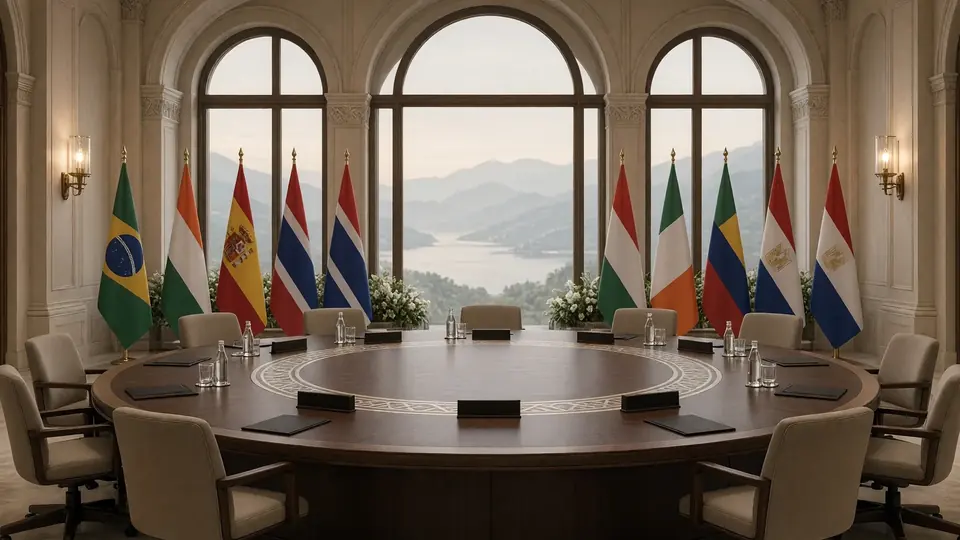
'From rule-takers to rule-shapers': PM Modi's big pitch to BRICS leaders in welcome address
Prime Minister Narendra Modi has called on BRICS nations to jointly prepare 10 proposals for global governance reform that can be developed into a BRICS Reform Roadmap by the next Summit, proposing a sweeping restructuring of how international institutions operate and make decisions.
Delivering his welcome address at the 18th BRICS Summit in New Delhi, Mr. Modi made a strong pitch for global reform, highlighting the current imbalance between decision-makers and those impacted by their decisions. The Prime Minister proposed that the leaders of the BRICS nations gathered in the capital use the opportunity to arrive at concrete proposals that would address longstanding inequities in global governance.
A grouping entering maturity
Mr. Modi took note of the fact that the BRICS grouping was now 20-years-old and, as such, was entering a new phase of maturity and responsibility. "Over the past 20 years, BRICS has strengthened its distinctive identity on the global stage," Mr. Modi said. "We respect each other's perspectives and move forward through consensus," he added.
The Prime Minister emphasised the collaborative approach that has defined the bloc's functioning. "We seek to move forward not against anyone, but with an approach of taking everyone along," he said. "Now is the time for us to translate our unity and consensus within BRICS into concrete outcomes on the global stage," he added.
An ambitious agenda for the next two decades
Mr. Modi said that, over the next 20 years, BRICS must work on a new and ambitious agenda. "This must begin with our own working systems," he said. The Prime Minister identified a structural challenge facing the grouping: "The BRICS presidency changes every year, but our institutional momentum should not stop because of this," he stated.
To address this continuity gap, Mr. Modi proposed a BRICS Continuity and Implementation Mechanism, which the BRICS Troika could use to follow up on all initiatives and outcomes. "We can create a secure digital repository in which, alongside every decision, the nodal point, deadline and implementation status can be recorded," Mr. Modi said.
Transforming the pyramid of privilege
Moving beyond internal BRICS functioning, the Prime Minister presented a pointed critique of existing global power structures. Mr. Modi noted that the current structure of global governance resembles a pyramid, with power and decision-making concentrated at the top, while at the bottom are countries that are affected by these decisions but are unable to shape them.
"The Global South is today on the front line of global crises, but in the back row when it comes to decision-making," he emphasised. "We must transform this pyramid of privilege into a platform of partnership, where every country has a voice, every member has a stake, and the development of humanity remains at the centre of every effort," the Prime Minister said.
"With this objective, I propose that we jointly prepare 10 proposals for global governance reform, which we can seek to develop into a BRICS Reform Roadmap by the next Summit," Mr. Modi added.
Three pillars of reform
The Prime Minister said that, while preparing this roadmap, the assembled leaders should focus on three key aspects: representation, responsiveness and rule-making.
Representation: UN and financial institutions
"First, on representation, I would like to say that reform of the UN Security Council can no longer be delayed," Mr. Modi said. "Text-based negotiations on this issue must be linked to a definite timeline and clear outcomes," he added.
Beyond the United Nations, the Prime Minister called for changes in how international financial institutions are structured. He said that voting power, leadership positions, and policy priorities in financial institutions must reflect today's economic realities. "Countries that are driving global economic growth should also have an appropriate role in shaping global economic governance," Mr. Modi emphasised.
Responsiveness: from promises to impact
Regarding responsiveness, Mr. Modi said that trust in global institutions will be established only when they are capable of providing effective solutions to problems. "We must focus on the speed, scale and last-mile impact of our collective response," Mr. Modi said, giving the example of how, despite making a significant contribution to global trade, seafarers often feel a lack of support during difficult times.
The Prime Minister offered a concrete proposal to address this gap. "My proposal is: can we create a Seafarers' Emergency Support Network," he asked the assembled leaders. "Through this network, the maritime authorities and missions of the concerned countries could be connected. This could provide support for distress alerts, medical assistance, informing families and evacuation," he explained.
Rule-making: shaping the future of technology
The Prime Minister said that it is important to ensure equal participation in determining the global rules of the future. He pointed to emerging domains where new norms are being established. "AI, cyberspace, outer space, biotechnology and critical technologies are not only creating future opportunities; they are also shaping the rules of the future," Mr. Modi said.
"We must work to transform the Global South from rule-takers into rule-shapers," he declared.
A clear message from Delhi
Concluding his welcome address, the Prime Minister framed the Summit's broader significance. "Friends, the message from the BRICS Summit being held in India should be clear: If our future is shared, then the right to shape that future must also be shared," he added.
"From voice to impact, from privilege to partnership: this should be BRICS's guiding resolve," Mr. Modi said.
The proposals outlined in the Prime Minister's address set the stage for substantive discussions during the 18th BRICS Summit, with the potential to shape how the bloc engages with questions of international governance as it enters its third decade.
Source: The Hindu
Frequently asked questions
What is the 10-point reform roadmap Modi proposed to BRICS?
PM Modi called on BRICS nations to jointly prepare 10 proposals for global governance reform that can be developed into a BRICS Reform Roadmap by the next Summit. These proposals aim to address longstanding inequities in global governance and reshape how international institutions operate and make decisions.
What is the BRICS Continuity and Implementation Mechanism?
It is a proposed mechanism to address the challenge that the BRICS presidency changes every year. The BRICS Troika would use it to follow up on all initiatives and outcomes, with a secure digital repository recording each decision's nodal point, deadline, and implementation status.
How does Modi describe the current structure of global governance?
Modi said the current structure resembles a pyramid with power and decision-making concentrated at the top, while countries affected by these decisions are unable to shape them. He noted that the Global South is on the front line of global crises but in the back row when it comes to decision-making.
What does Modi propose to replace the 'pyramid of privilege'?
Modi proposes transforming the pyramid of privilege into a platform of partnership, where every country has a voice, every member has a stake, and the development of humanity remains at the centre of every effort.
You may also like
 International
India hosts expanded BRICS summit with eleven nations in New Delhi
 Politics
Putin arrives in New Delhi for BRICS summit and talks with Modi
 Entertainment
Malaysia's PM courts India with charm and Kishore Kumar song at Brics summit
 Politics
BJP chief Nitin Nabin seeks Lord Ganesha's blessings for nation's progress
Most read
- 1
Tesla audits Chinese suppliers to scale up Optimus robot production
- 2
Former minister Lakhan Singh Rajput to inaugurate temple bhandara at Shri Chakreshwar Mahadev
- 3
Firozabad BSA finds four government schools locked during inspection
- 4
Tamil Nadu dengue cases fall for third consecutive year to 17,049
- 5
Social workers stage silent protest at Fufund railway station for train halts
Comments
No comments yet. Be the first to comment.