
Mahashtami, Mahanavami Rituals To Be Observed Together On October 19
Mahashtami and Mahanavami rituals, including Kanya Pujan and havan, will be observed together on October 19, 2026, in some traditions.

Navami
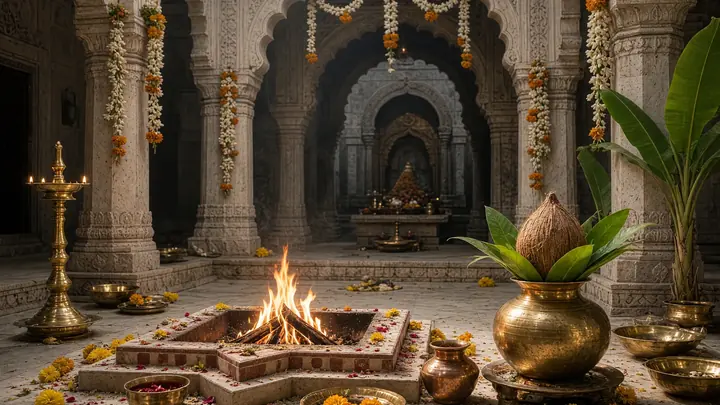
The 2026 Shardiya Navratri observance has brought rituals associated with Mahashtami and Mahanavami together on 19 October 2026 in some traditions because of the timing of the tithis. Devotees are observing Kanya Pujan, havan and other rituals, while worship is being offered to Maa Mahagauri on Mahashtami and Maa Siddhidatri on Mahanavami.
The timing has also created different practices for the completion of the Navratri fast. Those who perform Kanya Pujan on Ashtami can complete the ritual and open their fast according to their family tradition, while those who observe Kanya Pujan on Navami follow the corresponding Navami practice.
Why Ashtami and Navami rituals are being observed together
According to Drik Panchang, the Ashtami tithi of the Shukla Paksha of Ashwin will continue until 10 बजकर 51 मिनट in the morning on 19 October. The Navami tithi will begin after that and continue until 12 बजकर 50 मिनट in the afternoon on 20 October 2026.
The Mahashtami observance is being held on 19 October because of the contact with the Udaya tithi, according to the explanation cited by Aaj Tak. At the same time, the Navami tithi is also considered valid on the same date because of the tithi combination.
This is why devotees following the Ashtami tradition can perform Kanya Pujan on 19 October, while devotees who follow the Navami tradition can also carry out the ritual on that date. The arrangement applies to the worship, Kanya Pujan and other concluding observances linked to the two days.
A separate explanation published by Jagran states that, according to the Vedic calendar, Mahashtami will be observed on 19 October and Mahanavami on 20 October. It also notes that the practice of opening the Navratri fast differs among families and according to their religious traditions.
The two descriptions point to the importance of following the tithi and the custom used by a particular family or worshipper. The timing of a ritual may also vary according to location, so the local Panchang should be checked before beginning the worship.
Auspicious timings for Kanya Pujan
Kanya Pujan is traditionally performed on both Ashtami and Navami during Navratri. On 19 October, auspicious timings are available for devotees who wish to conduct the Ashtami-Navami Kanya Pujan.
The first listed auspicious period is Amrit Kaal, from 7 बजकर 28 मिनट in the morning to 9 बजकर 16 मिनट in the morning. Another opportunity is the Abhijit Muhurat, from 11 बजकर 43 मिनट in the morning to 12 बजकर 29 मिनट in the afternoon.
These timings can differ according to the location. Devotees have therefore been advised to confirm the time with the local Panchang before conducting the puja.
The local variation is significant for families that arrange Kanya Pujan around a particular muhurat. It also matters to those deciding whether to perform the ritual on the basis of Ashtami or Navami, since both practices are followed during the festival.
Worship of Maa Mahagauri on Mahashtami
Maa Mahagauri is worshipped as the eighth form of Maa Durga on the eighth day of Navratri. Religious belief describes Maa Mahagauri as a symbol of peace, purity and compassion.
Devotees worship Maa Mahagauri while praying for happiness, peace and prosperity in the family. The mantra associated with the goddess is “ॐ देवी महागौर्यै नमः”.
The puja begins with a bath in the morning, followed by wearing clean clothes. A picture or idol of Maa Mahagauri is then placed at the worship area.
White flowers, akshat, incense, a lamp and fruits are offered to the goddess. Devotees then chant the mantra and perform the aarti before praying for the well-being of the family.
The listed practices for seeking Maa Mahagauri’s blessings include offering white flowers and coconut. Devotees are also advised to provide food, rice or white clothes to people in need.
Another practice mentioned for the occasion is reciting the Durga Chalisa during the puja. These are described as religious measures and practices associated with the worship of Maa Mahagauri.
The use of white flowers, rice, coconut and white clothes links the listed offerings and charitable practices with the form of worship described for Mahashtami. The puja sequence remains centred on cleaning, preparing the worship space, making offerings, chanting the mantra and completing the aarti.
Worship of Maa Siddhidatri on Mahanavami
Maa Siddhidatri is worshipped as the ninth form of Maa Durga on the ninth day of Navratri. According to religious belief, Maa Siddhidatri is the goddess who grants knowledge, wisdom and siddhi.
Havan and Kanya Pujan are also traditionally performed on Mahanavami. The mantra associated with Maa Siddhidatri is “ॐ देवी सिद्धिदात्र्यै नमः”.
Flowers, fruits, incense, a lamp and naivedya are offered to the goddess during the puja. Items prepared with white sesame are offered as bhog to Maa Siddhidatri.
The ritual is followed by chanting the mantra and performing the aarti. Families may also conduct a havan according to their own tradition.
The measures listed for seeking Maa Siddhidatri’s blessings include offering fragrant flowers to the goddess. Devotees are also advised to chant the mantra with faith and to arrange food for people in need according to their capacity.
The worship of Maa Siddhidatri therefore includes offerings, mantra recitation, aarti and, for families that follow the practice, havan. The specific choice of offerings and the decision to conduct a havan may depend on the family tradition described in the source.
Kanya Pujan procedure
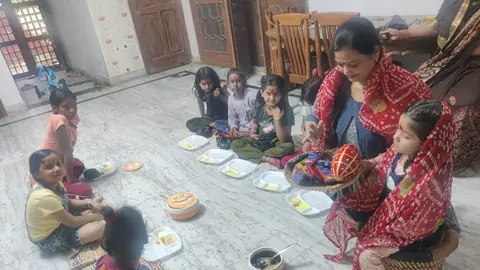
During Navratri, young girls are respected as forms of Maa Durga during Kanya Pujan. The ritual begins with cleaning the house and the place where the puja will be performed.
The girls are invited to the home respectfully and seated on clean seats. Their feet are washed before tilak is applied.
The girls are then served food as part of the ritual. Halwa, puri and black gram are traditionally prepared as the prasad for Kanya Pujan.
After the meal, the girls are given dakshina or gifts. Families seek their blessings after presenting the dakshina or gifts.
Some families also follow the practice of feeding one boy, treating him as a form of Bhairav. This practice is mentioned as an additional custom followed in some households rather than as a universal requirement of Kanya Pujan.
The sequence places emphasis on cleanliness, respectful invitation, washing the feet, applying tilak, serving food and offering dakshina or gifts. The details of the meal are also linked to the traditional preparation of halwa, puri and black gram for the occasion.
For devotees observing Kanya Pujan on Ashtami, the ritual can be conducted on 19 October according to the listed timing and tradition. Devotees who observe it on Navami may follow their family practice and the relevant tithi.
Havan and opening the Navratri fast
Havan is traditionally used to conclude the worship during the final days of Navratri. Offerings are made into the fire along with the chanting of mantras.
Those conducting a havan at home have been advised to take care of fire safety. The assistance of a priest may be sought when necessary.
Devotees who have kept the Navratri fast open it after Kanya Pujan and havan. The time for opening the fast can differ according to family traditions.
Some people open the fast after performing the Navami puja, while others open it on Dashami. The source therefore advises devotees to decide the timing according to the local Panchang before breaking the fast.
Jagran’s explanation similarly says that those who perform Kanya Pujan on Mahashtami can open the fast after the ritual. Those who perform Kanya Pujan on Mahanavami are advised to complete the fast after Navami ends and then carry out the paran according to the prescribed practice.
The calendar details cited by Jagran list 18 October, morning 08 बजकर 27 मिनट, as the beginning of the Ashtami tithi. The Ashtami tithi is listed as ending on 19 October at morning 10 बजकर 51 मिनट.
The same calendar lists the Navratri paran as 20 October. It gives the beginning of the Navami tithi as 19 October at morning 10 बजकर 51 मिनट and its end as 20 October at afternoon 12 बजकर 50 मिनट.
The calendar entry identifies 19 October as Monday and 20 October as Tuesday. These day names are part of the calendar information cited in the source.
Ujjain’s traditional Nagar Puja
In Ujjain, the centuries-old Nagar Puja tradition is being carried out during Mahashtami of Shardiya Navratri. The ritual begins at the Chaubis Khamba Mata Temple, where worship is offered to Mahamaya and Mahalyaa Mata.
Liquor is offered as bhog during the puja at the temple. After the worship, the government Nagar Puja group sets out on a 26-kilometre journey accompanied by drums.
According to the tradition, the group carries out worship at about 40 Devi, Bhairav and Hanuman temples. A stream of liquor is poured from an earthen pot as the group proceeds along the route.
The belief associated with the Nagar Puja is that it protects the city from misfortune, epidemics and natural disasters. The ritual is also linked to prayers for the happiness and prosperity of the citizens.
The Nagar Puja is conducted by the administration during Mahashtami of the Shukla Paksha of the Ashwin month. It is regarded as a tantric form of worship.
The source identifies Roshan Kumar Singh as the collector who performed the worship of Mahamaya and Mahalyaa Mata at the Chaubis Khamba Temple. Liquor was offered and the aarti was performed during the worship.
Sixteen adornment items, a chunari and balbakal were also offered to the goddess. The government group left for the journey after the worship was completed.
Members of the group follow the fixed route and perform puja at the temples along the way. Liquor is offered as bhog at the Devi and Bhairav temples, while a dhwaja is offered at the Hanuman temples.
The journey begins at about 8 am and continues from the evening into the night. The roughly 26-kilometre route is covered on foot.
The temples included in the route include Chamunda Mata, Bhukhi Mata, Kaal Bhairav and Chand-Mund Nashini, along with other Devi, Bhairav and Hanuman temples. The total number of places of worship is described as about 40.
After worship at each temple, the group performs the aarti before moving to the next stop. Residents welcome the travelling group at several points along the route.
The procession concludes after worship at the Garhkalika Mata Temple. It then moves to the nearby Handi Phod Bhairav Temple in the Ankapaat area, where the earthen pot is broken.
The pot-breaking ceremony is scheduled for about 8 pm. The breaking of the handi marks the completion of the traditional journey.
Administration’s role in the Ujjain ritual
The administration arranges the liquor and other puja materials required for the Nagar Puja. Patwari Bhagwan Singh Yadav, who looks after the arrangements for the puja materials, said that about 45 types of materials are collected two days in advance.
One day before the ritual, black gram and wheat are boiled near the Chaubis Khamba Mata Temple. About 35 kilograms of balbakal is prepared from the boiled ingredients.
Puri and bhajiya are also prepared as part of the arrangements. The materials are ready by about 6 am on the morning of Ashtami.
A letter is sent from the SDM office to the Excise Department about a week before the ritual for the liquor used in the puja. The department then provides 30 bottles of liquor free of cost for the worship.
The expenditure for the puja, which is conducted with the assistance of the Revenue Department, is reported to be about 18 thousand rupees. Patwaris, kotwars, the kasba patel and other concerned employees are responsible for conducting the arrangements.
The details show that the Ujjain observance involves both a public administrative arrangement and a religious procession. The administration’s role includes procuring the ritual materials, coordinating the liquor supply and supporting the group responsible for the route.
Sixteen adornment sets and local beliefs
During the Nagar Puja, sixteen adornment sets are offered at some prominent Devi temples in addition to other puja materials. The temples named in the account include Chaubis Khamba, Chausath Yogini, Nagarkot Maharani, Chamunda Devi, Padmavati Devi, Bahadurganj and Garhkalika.
The red cloth associated with the Nagar Puja is linked to a local belief that it can be tied in the home to protect children from the evil eye. This belief is described as part of the folk faith connected with the Nagar Puja tradition.
A separate local belief is associated with the Sati Mata Temple near the Vikrant Bhairav Temple in Ujjain. The place is known as Meldi Mata Temple.
The belief at the site is that worship is performed for the destruction of enemies. The account describes photographs of women and men hanging from trees, along with nails driven into some photographs and sandals and cloth-made figures hanging nearby.
These practices are presented as local beliefs connected with particular places in Ujjain. They are separate from the broader account of the Nagar Puja route, the offerings at the temples and the administration-led arrangements.
Government worship at Harsiddhi Mata Temple
After the worship at the Chaubis Khamba Temple, the district administration also conducts a government puja at the Harsiddhi Mata Temple at about 12 noon. Worship is performed for Maa Harsiddhi in the sanctum of the temple.
Adornment materials are offered during the ritual at the temple. On Mahashtami, families in the city also worship their family deity.
The Nagar Puja tradition therefore brings together administrative arrangements, religious rituals and folk faith. Its observance includes the government-led procession, worship at Devi, Bhairav and Hanuman temples, offerings of different kinds and practices followed by local families.
The Mahashtami and Mahanavami observances described for 2026 similarly combine formal worship, Kanya Pujan, havan, fasting and family customs. The exact choice of day for Kanya Pujan and paran depends on the tithi, the local Panchang and the tradition followed by the family.
The information on rituals, remedies and religious beliefs is presented as general information gathered from Panchangs, religious sources, astrologers, discourses, scriptures and legends. Jagran states that it does not endorse the claims in the feature and asks readers not to treat the material as the final truth or as a claim, while using their own judgment.
Frequently asked questions
When will Mahashtami and Mahanavami rituals be observed together in 2026?
In some traditions, the Mahashtami and Mahanavami rituals will be observed together on 19 October 2026 because of the timing of the tithis.
Which deities are worshipped during Mahashtami and Mahanavami?
Maa Mahagauri is worshipped on Mahashtami, while Maa Siddhidatri is worshipped on Mahanavami.
Why can devotees perform Kanya Pujan on 19 October?
The Ashtami tithi continues until the morning of 19 October, and the Navami tithi begins afterward, making the date valid for devotees following either tradition.
What are the listed auspicious timings for Kanya Pujan on 19 October?
Amrit Kaal is from 7:28 a.m. to 9:16 a.m., and Abhijit Muhurat is from 11:43 a.m. to 12:29 p.m.
How should devotees decide when to open the Navratri fast?
They should follow their family tradition and the practice associated with the Ashtami or Navami Kanya Pujan observance, while checking the local Panchang for location-specific timings.
You may also like
Most read
- 1
Air China Adds Extra Flight for Passengers Stranded in Fuel-Starved Cuba
- 2
Western disturbance to bring rain, hail and strong winds across north India
- 3
Yogi Adityanath Directs No Occupied Houses Be Demolished for Achhalda Bridge
- 4
Gwalior Temple Truck Crash Kills 12, Injures 28-29 Devotees During Navratri
- 5
Schools Shut in Five Tamil Nadu Districts, Including Chennai, Amid Heavy Rain
Comments
No comments yet. Be the first to comment.