
G C Chakravarty's Art Exhibition Explores Doubt and Belief at Birla Academy
Discover the profound themes in G C Chakravarty's exhibition at Birla Academy, showcasing a blend of art, critique, and introspection.

Inside the Long-Overdue Exhibition of G C Chakravarty
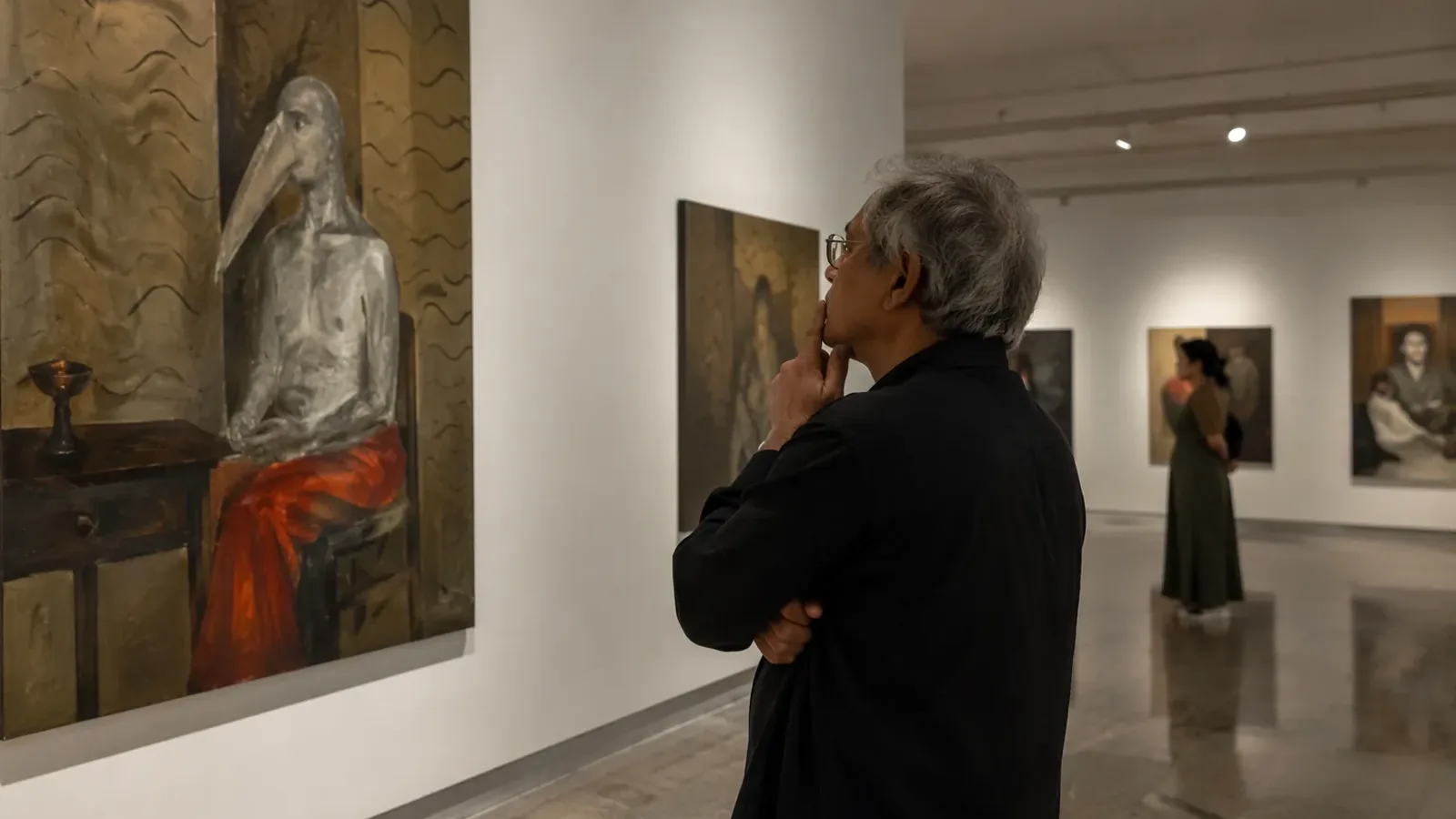
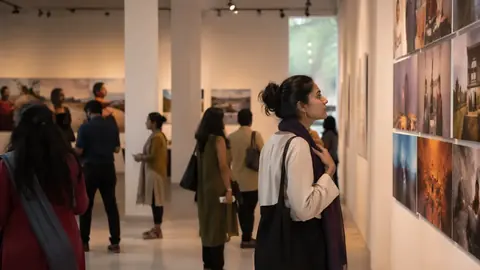
The exhibition Stranger Forms: The Forgotten Art of G C Chakravarty at the Birla Academy of Art and Culture opens with an arresting display. The walls are adorned with drawings, paintings, and illustrations that seem to engage in a dialogue across decades, presenting a deeply introspective world shaped by themes of doubt, belief, rupture, and reflection.
Rather than tracing a straightforward artistic evolution, the exhibition immerses visitors in a dynamic field of ideas. The artworks vary widely in tone and form, juxtaposing delicate line drawings with brooding, heavily worked compositions. Painterly surfaces oscillate between restraint and turbulence, while recurring figures remain elusive, resisting definitive interpretation.
Religious and mythic references intermingle with everyday human gestures, creating an uneasy coexistence that suggests interrogation rather than reverence. The works grapple with questions of faith, education, authority, and social conditioning, exposing tensions without offering resolution. The grotesque emerges as a deliberate visual strategy, not for shock value but as a means to provoke discomfort and sharpen perception. Illustrations, a key component of the exhibition, further enrich this visual narrative.
These illustrations blur the line between fine art and mass visual culture. Graphic and narrative-driven, they combine psychological unease with social critique, creating striking, compact images. Together with the paintings and drawings, they highlight Chakravarty’s commitment to storytelling through distortion, repetition, and symbolic density, rather than linear narration.
The opening evening extended this visual experience into a broader intellectual engagement. Mit Vyas of Dwija Gallery welcomed attendees and introduced the exhibition catalogue, a meticulously curated collection of Chakravarty’s works. His brief remarks ensured the focus remained on the artworks, and the catalogue was shared with the audience.
Scholar Ankan Kazi then led a guided walk-through, offering contextual insights into the works while encouraging viewers to interpret them intuitively and critically. Kazi emphasized the resistance of the artworks to singular meanings, inviting deeper engagement.
The evening concluded with a discussion between Kazi and art historian Sampurna Chakraborty, situating Chakravarty’s works within the shifting environment of the Government College of Art and Craft in the 1920s. Their conversation explored themes of institutional uncertainty, changing pedagogical models, and the role of conscious and subconscious processes in art-making. They also reflected on how these conditions shaped practices that later faded from mainstream art historical narratives.
An open-floor discussion followed, with attendees sharing reflections that echoed the exhibition’s broader themes of visibility, memory, and interpretation. Ultimately, Stranger Forms is more than an exhibition, it is an encounter. Running from June 16 to 28, it positions Chakravarty’s artworks as living propositions, continuously challenging belief systems, social norms, and artistic hierarchies long after the opening night’s conversations have ended.
Frequently asked questions
What is the title of G C Chakravarty's exhibition at the Birla Academy?
The title of the exhibition is *Stranger Forms: The Forgotten Art of G C Chakravarty*.
What themes does the exhibition explore?
The exhibition explores themes of doubt, belief, rupture, and reflection.
Who led the guided walk-through during the opening evening?
Scholar Ankan Kazi led the guided walk-through during the opening evening.
What kind of artworks are featured in the exhibition?
The exhibition features a variety of artworks including drawings, paintings, and illustrations.
What approach does the exhibition take towards interpretation of the artworks?
The exhibition encourages viewers to interpret the artworks intuitively and critically, resisting singular meanings.
You may also like
 National
Visakhapatnam DRM Lalit Bohra Inaugurates Millet Art Exhibition on World Food Day
 Delhi NCR
Emily Eden's Portraits of India Exhibition Opens in Delhi
 Education
K. Jayakumar Launches 25th Painting Exhibition 'Glimpses' in Thiruvananthapuram
 International
British Council to Host 'My World, My Story' Exhibition in Delhi
Most read
- 1
Air China Adds Extra Flight for Passengers Stranded in Fuel-Starved Cuba
- 2
Western disturbance to bring rain, hail and strong winds across north India
- 3
Yogi Adityanath Directs No Occupied Houses Be Demolished for Achhalda Bridge
- 4
Schools Shut in Five Tamil Nadu Districts, Including Chennai, Amid Heavy Rain
- 5
Gwalior Temple Truck Crash Kills 12, Injures 28-29 Devotees During Navratri
Comments
No comments yet. Be the first to comment.