
Delhi deploys 35 special aircraft for BRICS Summit amid tight security measures
Aviation authorities coordinate complex logistics for BRICS Summit, handling 35 special aircraft with VVIP passengers while maintaining commercial flight s

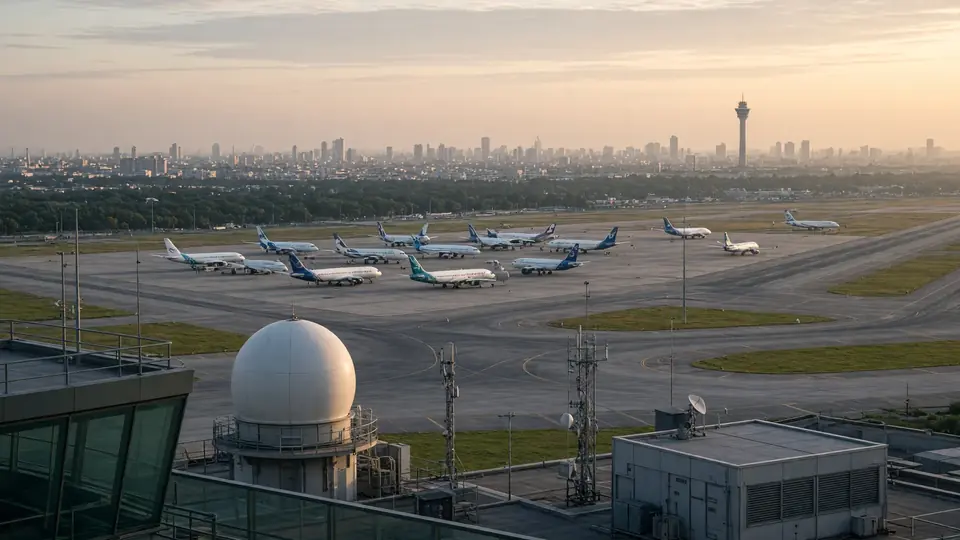
How Delhi is managing 35 special aircraft, air traffic during the BRICS Summit
Aviation authorities, security forces and airport operators are executing a complex logistics operation to handle approximately 35 special aircraft and their VVIP passengers during the BRICS Summit while keeping Delhi's commercial flight schedule largely intact.
The exercise involves multiple airports, restricted airspace extending 300 kilometres from the capital, staggered flight timings for scheduled carriers and a ground security protocol that includes fuel sampling and unpredictable convoy routes.
Separate pathways for VVIP movements
Regular passengers at Indira Gandhi International Airport follow the standard process of terminal check-in and boarding via aerobridges, but VVIP movements are handled through entirely separate channels. Senior visitors such as ministers and other high-ranking dignitaries use ceremonial facilities, while the highest-level visitors are processed through the Palam technical area operated by the Indian Air Force.
The Palam facility permits VVIP aircraft to arrive outside the regular passenger-terminal operation, with the principal and delegation transferred directly into a separately secured ground arrangement. A senior CISF official aware of the arrangements explained that the movement from the aircraft to the convoy is planned in a manner that prevents the final route from becoming predictable.
"Multiple exits and vehicles are kept ready, with the exit ultimately used for the VVIP movement decided towards the last stage," the source said.
The coordination effort brings together the CISF, Air Force, aviation authorities, the airport operator and other security agencies.
Extended airspace control windows
The air-traffic challenge is equally intricate. During a normal VVIP movement in major cities including Delhi, Mumbai, Chennai and Hyderabad, airspace is regulated for approximately three to four minutes to accommodate the special aircraft.
With several foreign leaders arriving and departing during the summit, these controlled windows have been extended and coordinated more extensively to provide clear movement windows for the special aircraft, the source said.
The Directorate General of Civil Aviation has imposed restrictions on non-scheduled flight operations within a 300-km radius of Delhi from September 11 to 13. Scheduled commercial flights are exempt, while special flights carrying BRICS dignitaries and related flights can operate with prior approval.
The restrictions are particularly relevant to non-registered private, light aircraft, whose movements are not part of the regular airline schedule. Such aircraft are being subjected to verification and specific conditions to reduce potential security risks during the summit, the source said.
Flying activities involving light and micro-light aircraft and unmanned aerial vehicles have been restricted within a 300-km radius of Delhi during the summit.
Adjustments to scheduled airline operations
Scheduled airlines are being fitted around the VVIP movements. Their arrival and departure timings have been adjusted by about 10-15 minutes ahead of the summit, where necessary, to prevent their movements from coinciding with a special aircraft.
If an overlap still occurs, an aircraft may be held in the air for some time or directed to land at another airport temporarily, depending on the traffic situation and operational requirements.
Multi-airport parking plan
Parking the special aircraft is another component of the exercise. Besides Palam and Delhi Airport, Noida International Airport, Safdarjung Airport, Hindon Airport and two other airports have been incorporated into the wider parking plan.
The aircraft will also arrive in different configurations. According to the CISF source, around 70-75 per cent of participating countries are expected to bring one dedicated aircraft, while 10-15 per cent could bring two aircraft. Another 10-15 per cent are expected to use scheduled flights.
Ground security and fuel checks
Security operations extend to the aircraft once they are on the ground. The CISF official said additional checks are carried out during ground handling, including testing two samples of the aviation fuel supplied to an aircraft, as part of measures to rule out tampering or other security concerns.
At the airport, CISF personnel operate within the aviation-security framework laid down by the Bureau of Civil Aviation Security, while the Air Force manages the technical-area operation and other agencies handle the diplomatic, intelligence, traffic and road-security aspects of VVIP movements.
A system built for parallel operations
The result is a carefully separated system in which dedicated aircraft can be received, parked and moved under enhanced security while Delhi's scheduled aviation continues around them.
The operation spans the Indira Gandhi International Airport, the Indian Air Force's Palam technical area and other airports being used to park visiting aircraft.
For the agencies involved, the task is therefore not simply to secure the arrival of special aircraft, but to sequence each movement, in the air, on the ground and through the airport, so that an exceptional concentration of VVIP traffic does not interrupt the routine flow of commercial aviation.
Behind the red carpets, motorcades and ceremonial welcomes for BRICS leaders is this tightly coordinated aviation operation involving around 35 special aircraft, multiple airports, controlled airspace and carefully timed movements to accommodate foreign dignitaries without disrupting Delhi's regular commercial flights.
Source: The Hindu
Frequently asked questions
How many special aircraft are being managed during the BRICS Summit in Delhi?
Approximately 35 special aircraft are being handled during the BRICS Summit, with aviation authorities coordinating their movement while maintaining Delhi's regular commercial flight schedule.
What airspace restrictions are in place for the BRICS Summit?
Restricted airspace extends 300 kilometres from Delhi from September 11 to 13. Scheduled commercial flights are exempt, but non-scheduled flight operations, light aircraft, micro-light aircraft, and unmanned aerial vehicles are restricted unless approved.
How are VVIP passengers processed differently at the airport?
VVIP movements use entirely separate channels from regular passengers. The highest-level visitors are processed through the Palam technical area operated by the Indian Air Force, where aircraft arrive outside the regular terminal operation and principals are transferred directly to secured ground arrangements.
What security measures are used for VVIP convoy routes?
Multiple exits and vehicles are kept ready, with the specific exit and route decided at the last stage to prevent predictability. This unpredictable convoy routing is part of the ground security protocol that includes fuel sampling.
How long are airspace control windows extended for BRICS arrivals and departures?
During normal VVIP movements, airspace is typically regulated for 3-4 minutes. For the BRICS Summit with multiple foreign leaders arriving and departing, these controlled windows have been extended and coordinated more extensively.
You may also like



Most read
- 1
Tesla audits Chinese suppliers to scale up Optimus robot production
- 2
Former minister Lakhan Singh Rajput to inaugurate temple bhandara at Shri Chakreshwar Mahadev
- 3
Firozabad BSA finds four government schools locked during inspection
- 4
Tamil Nadu dengue cases fall for third consecutive year to 17,049
- 5
Social workers stage silent protest at Fufund railway station for train halts
Comments
No comments yet. Be the first to comment.