
Chennai's inland fishing decimated by pollution, encroachments, and river neglect
Pollution and encroachment have decimated Chennai's inland fishing. Former river fishermen now work the sea or wait for monsoons.

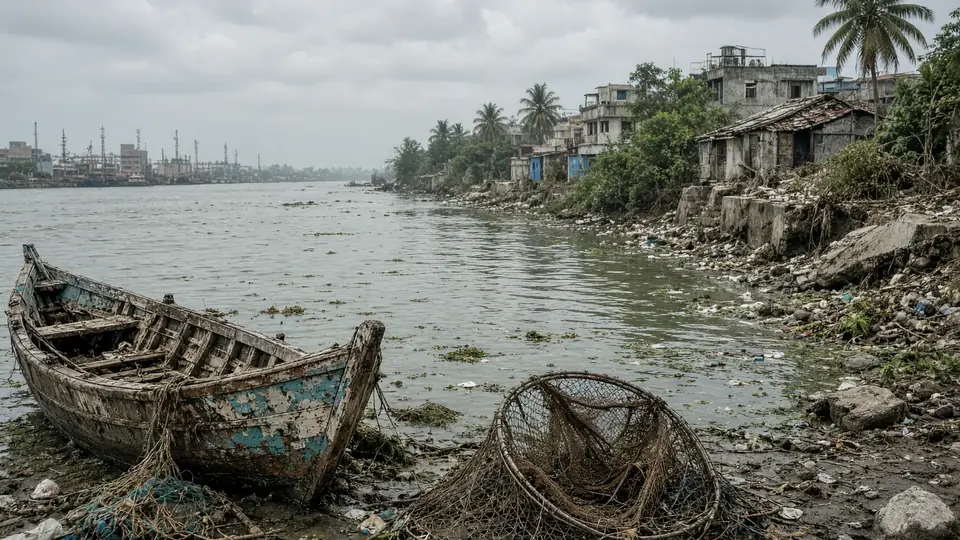
Encroachments, pollution and lack of desilting have killed Chennai's once-thriving inland fishing tradition, forcing families who caught freshwater varieties in the Adyar and Cooum to either register as sea-faring fishermen or wait for monsoon rains.
Until the 1980s, Madras residents routinely bought madava, keluthi, ooda, era and nandu, freshwater fish hauled from the city's rivers and estuaries, as vendors walked through Pattinampakkam, Adyar, Kotturpuram and Saidapet calling "meen, ma, meen" to households. Small nets and wooden catamarans were enough to bring in a catch from the pristine waters and nutrient-rich slush near river mouths, according to Krishnamohan, a former Fisheries Department staffer.
Rivers turned into sewage carriers
"We had very vibrant inland fishermen cooperative societies. But encroachments, pollution, and lack of desilting of rivers have led to them becoming mere sewage carriers and garbage bins," Krishnamohan said. Even the insects that once bred in the slush and served as fish feed have disappeared.
The handful of inland fishermen still working have registered as sea-faring fishermen and fish the Adyar only during the Northeast monsoon, sometimes casting lines from the Adyar and Kotturpuram bridges, said M.D. Dayalan, a fishing community leader. Inland fish sold in the city now come from reservoirs and lakes around Chennai.
Sea catch now dominates the market
Marine fish have filled the gap left by the collapse of river fishing. Greater Chennai Corporation's coastline, from Ennore in ward 1 to Nainarkuppam in ward 200, hosts over ten fishing hamlets that landed 52,134 tonnes in 2022, 23. Kasimedu Fishing Harbour in Royapuram alone shelters around 900 mechanised boats and hundreds of smaller vessels.
Wooden catamarans gave way to sturdier craft after ropes would come undone at sea, losing fish and nets, explained M.E. Raghupathi, another fishing community leader. The first fiberglass reinforced plastic boat arrived in 1990 with government subsidies; today FRP boats stretch 65 feet, carry double engines and stay at sea for a week.
"Treated as second-class citizens"
Fishing hamlets along the coast say the government overlooks their needs. "We don't get good rates for our catch. The harbour is dirty, has no toilets even. We are being driven out of our homes in the name of development," said Jones Spartegus, a Thoothukudi-based research scholar, pointing to Marina and Loop Road redevelopment. He argued fishermen need subsidies for boats, nets and engines, and space to dry fish, mend nets and build homes as populations grow.
The species profile has shifted, too. A 2010 survey by J.D. Marcus Knight and K. Rema Devi found eight of the 66 species recorded by the Madras Fisheries Bureau in 1916 were missing, while 17 new species, including tilapia, basa catfish, African catfish and pacu, had appeared, some introduced via the Telugu Ganga Project, according to IT employee and fish enthusiast Beta Mahatvaraj.
Source: The Hindu
Frequently asked questions
What happened to Chennai's inland fishing tradition?
Encroachments, pollution, and lack of desilting have decimated inland fishing in Chennai's rivers. Rivers that once provided freshwater fish like madava, keluthi, and nandu have become sewage carriers and garbage bins, forcing inland fishermen to either register as sea-faring fishermen or wait for monsoon rains.
What freshwater fish were commonly sold in Chennai until the 1980s?
Until the 1980s, vendors sold freshwater varieties including madava, keluthi, ooda, era, and nandu from the Adyar and Cooum rivers to households in neighborhoods like Pattinampakkam, Adyar, Kotturpuram, and Saidapet.
How has the fishing industry changed over time?
Wooden catamarans and small nets used for inland river fishing have been replaced by mechanized boats. The first fiberglass reinforced plastic (FRP) boat arrived in 1990; today FRP boats stretch 65 feet, carry double engines, and stay at sea for a week. Marine fishing now dominates, with over 52,000 tonnes landed in 2022-23.
What challenges do coastal fishermen face today?
Fishermen say they receive poor rates for their catch, face inadequate harbour facilities with no toilets, and are being displaced by development projects like Marina and Loop Road redevelopment. They lack sufficient subsidies for boats, nets, and engines, and need dedicated space to dry fish, mend nets, and build homes.
You may also like
 National
If there can be housewives, there can be house husbands also; let
 Politics
Tamil Nadu Congress leader says he told Chennai Police about Veer
 Accident
Delivery agent dies after container truck hits two-wheeler, flees scene
 Crime
Crime
Police bust drug smuggling ring with 600 narcotic tablets seized at railway station
Most read
- 1
Tesla audits Chinese suppliers to scale up Optimus robot production
- 2
Former minister Lakhan Singh Rajput to inaugurate temple bhandara at Shri Chakreshwar Mahadev
- 3
Firozabad BSA finds four government schools locked during inspection
- 4
Tamil Nadu dengue cases fall for third consecutive year to 17,049
- 5
Social workers stage silent protest at Fufund railway station for train halts
Comments
No comments yet. Be the first to comment.