
Bengaluru clay idol makers resist eco-friendly push as customers demand painted alternatives
Clay idol makers in Bengaluru face pressure from customer demand for Plaster of Paris Ganeshas despite eco-friendly alternatives ahead of Ganesh Chaturthi.
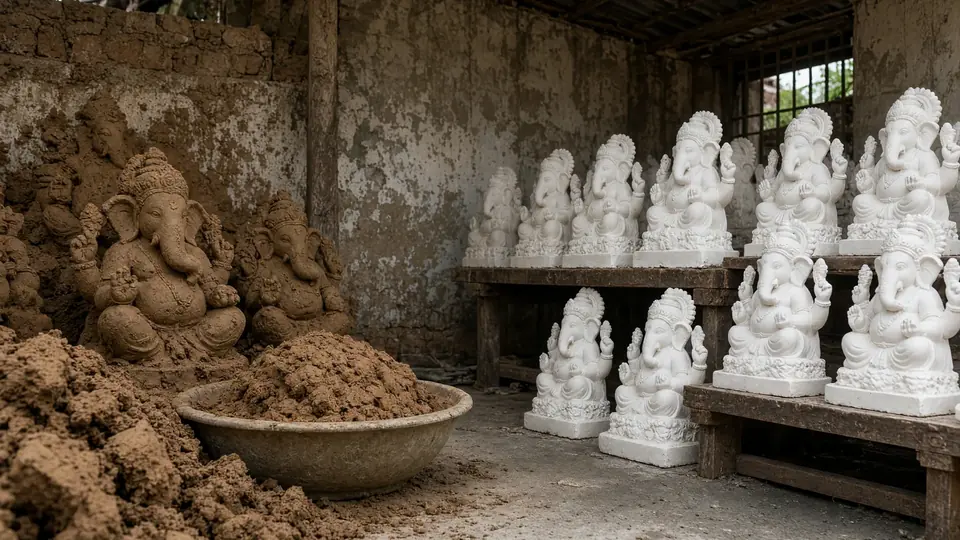
Clay idol makers in Bengaluru say customers continue to favour painted and Plaster of Paris Ganeshas despite government campaigns promoting eco-friendly alternatives ahead of Ganesh Chaturthi.
Demand drives inventory decisions
Shashikumar, a fourth-generation seller from the Kumbara community at Pottery Town, said he now sources idols from Hosur because of space constraints and shortages of clay and skilled labour. While acknowledging PoP idols harm the environment, he said many customers prefer them and makers invest crores in production. He argued awareness efforts must begin in November, immediately after the festival, when makers commit money to materials and labour, not at the last minute when stock has already entered the market.
Large idols measuring six to 12 feet cannot be made from clay because they become too heavy to lift and difficult to structure, so all such pieces use PoP and paper, Shashikumar explained. PoP materials mould easily into designs and dry within six hours, allowing colours to be sprayed immediately, whereas clay idols must be prepared three months ahead to dry properly before painting.
Economics of eco-friendly production
Fellow Kumbara community member Govardhan said only around 200 families traditionally buy clay idols from his shop, far fewer than those ordering moulded, coloured ones. Making a larger number of eco-friendly idols would result in losses, so his stock includes more coloured pieces than handmade plain ones.
Sourcing clay has become harder as lakes have shrunk, forcing sellers to buy soil from areas such as Bagalur Road and Hoskote; a small load costs ₹12,000. Govardhan said water paint has replaced poisonous oil paint and is chemical-free.
Nandeesh from Bettahalsuru, who makes only eco-friendly idols, disputed that claim, saying water paints do contain chemicals and leave residue in water bodies. To protect lakes, he produces plain clay idols priced between ₹50 and ₹500, limiting himself to 1.5-foot pieces.
Enforcement push
Forest, Ecology, and Environment Minister Ramalinga Reddy announced a Special Operation Team to prevent manufacturing and sale of PoP Ganesha idols, assisted by local police and other departments. The team inspected 214 shops and warehouses across 13 districts where idols were made without following guidelines, confiscating 1,283 pieces. Reddy urged the public to buy eco-friendly idols and help save lakes.
Source: The Hindu
Frequently asked questions
Why do Bengaluru clay idol makers continue to produce Plaster of Paris idols despite environmental concerns?
Customers strongly prefer painted and PoP Ganeshas over eco-friendly alternatives. Makers invest crores in PoP production, and switching to clay idols would result in losses for sellers like Govardhan, who reports only around 200 families traditionally buy clay idols compared to many more ordering coloured ones.
What are the practical differences between clay and PoP idol production?
Large idols (6-12 feet) cannot be made from clay as they become too heavy and structurally difficult. PoP materials mould easily into designs and dry within six hours, allowing immediate colour spraying. Clay idols require three months of advance preparation to dry properly before painting.
What challenges do clay idol makers face in sourcing materials?
Lakes have shrunk, making clay harder to source. Sellers must now buy soil from areas like Bagalur Road and Hoskote at high cost, a small load costs ₹12,000. Additionally, there are shortages of both clay and skilled labour.
What enforcement action has the government taken against non-eco-friendly idol production?
Forest, Ecology, and Environment Minister Ramalinga Reddy announced a Special Operation Team to prevent manufacturing and sale of PoP Ganesha idols. The team inspected 214 shops and warehouses across 13 districts, confiscating 1,283 pieces that were made without following guidelines.
When should government awareness campaigns for eco-friendly idols be conducted?
According to idol maker Shashikumar, awareness efforts should begin in November, immediately after the festival, when makers commit money to materials and labour, not at the last minute when stock has already entered the market.
You may also like
 Karnataka
Dharwad bans DJ music, plastic idols during Ganesh festival celebrations
 National
Raichur bans high-decibel DJ systems during Ganesh festival, threatens equipment seizure
 National
Bahraich's Brahmanipura locality celebrates 36 years of revered Ganesh tradition
 Karnataka
Bengaluru prison launches bakery training to help inmates build skills after release
Most read
- 1
Tesla audits Chinese suppliers to scale up Optimus robot production
- 2
Former minister Lakhan Singh Rajput to inaugurate temple bhandara at Shri Chakreshwar Mahadev
- 3
Firozabad BSA finds four government schools locked during inspection
- 4
Tamil Nadu dengue cases fall for third consecutive year to 17,049
- 5
Social workers stage silent protest at Fufund railway station for train halts
Comments
No comments yet. Be the first to comment.