
Australia 187/6 Against South Africa as Renshaw, Cummins Halt Batting Collapse
Australia reached 187/6 against South Africa in the Durban Test as Matt Renshaw and Pat Cummins resisted a strong pace attack before bad light.

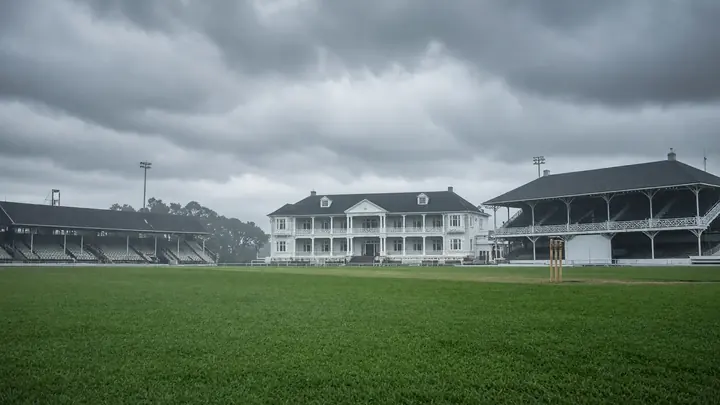
Australia closed a truncated opening day of the Durban Test on 187 for 6, with Matt Renshaw and Pat Cummins unbeaten after bad light ended play and South Africa’s seamers exposed familiar uncertainty in the reshuffled batting order.
The visitors had reached 84 for 2 before lunch, but three deliveries after the interval they were 84 for 4. Two more wickets fell later in the afternoon, leaving South Africa in a position to potentially move through Australia’s batting order inside two sessions.
Renshaw and Cummins prevented that possibility from becoming reality, carrying Australia to the early close on a surface offering assistance to South Africa’s pace attack, seam bowling and spin. Renshaw was unbeaten on 46 and Cummins on 33 when play ended prematurely because of bad light.
South Africa seize control after Australia choose to bat
Pat Cummins won the toss and opted to bat first, but Australia’s reshuffled batting line-up struggled against a disciplined South African seam attack. Nic Maddinson was bowled by Marco Jansen, leaving Australia under early pressure.
Maddinson’s dismissal came after a 33-ball duck, described as the longest by an Australian opener and the second-longest for Australia by any batter. His recall therefore raised questions beyond the failure of his first innings, while Australia’s uncertainty at the top of the order remained a central feature of the day.
Travis Head, the other opener, fell after South Africa successfully reviewed the decision. The early wickets meant Marnus Labuschagne and Steve Smith were together at the crease in the 11th over.
For a period, the pair gave Australia a chance to regain control. Smith attacked Keshav Maharaj and hit the spinner for two sixes during an early calculated assault. Labuschagne accumulated 37 runs before he was dismissed lbw by Wiaan Mulder on the final ball before lunch.
Australia reached 84 for 2 one ball before lunch, making the morning appear to have been a solid recovery after the loss of both openers. That position changed almost immediately after the interval, when Australia lost two wickets in three deliveries and fell to 84 for 4.
Labuschagne’s difficult period continues
Labuschagne came into the match carrying a prolonged run of poor Test form. He had gone more than three years without a Test century and had averaged under 26 during that period.
The match also carried a personal dimension because Labuschagne was trying to save his place back in the country of his birth. Early in his innings, South Africa appealed for lbw when Jansen swung a delivery into his pads.
Temba Bavuma called for a review, but the delivery was comfortably missing leg stump. Labuschagne then found an early boundary with a firm clip through midwicket.
After drinks, he drove Jansen straight down the ground. A thick edge later ran through the cordon in the same over, but overall Labuschagne appeared settled and played with a good tempo.
Before the match, Cummins had urged him to keep things simple and avoid trying to play the perfect innings. Labuschagne negotiated five deliveries in Mulder’s final over of the session, but the sixth was an expertly crafted wobble-seam delivery that moved back after a sequence of away-swingers.
The ball beat the inside edge of Labuschagne’s forward defensive and struck him around the knee roll of his front pad. Richard Kettleborough raised his finger, and Labuschagne reviewed the decision.
The review confirmed the dismissal with umpire’s call on impact and the ball striking the stumps. Smith had already headed towards the dressing room while Labuschagne watched the big screen, leaving Australia four wickets down at the interval.
Smith’s brief return ends quickly
Smith was playing his first Test in South Africa since the 2018 tour that derailed his career for a year. His arrival at the crease drew little reaction from the small crowd, although his standing in Australian cricket was underlined when he passed Steve Waugh among Australia’s leading run-scorers.
Only Allan Border and Ricky Ponting remained ahead of Smith on that list after he reached 25 and struck Maharaj for the first of his two sixes. Smith returned from the dressing room with Renshaw for company, but the partnership lasted only briefly.
Jansen’s first delivery of the session was wide outside off from around the wicket, allowing Smith to leave it comfortably. The next delivery was a back-of-a-length ball that reared sharply and struck Smith on his bottom glove.
Smith moved away from the pitch, dropped his bat and removed the glove. For a moment the incident appeared serious, but he composed himself quickly and Australia’s physio did not need to come onto the field.
Smith prepared to face Jansen again, but the fast bowler followed the blow by making him play. Jansen angled a good-length ball into Smith, who pushed from the crease and sent a thick edge to gully.
Smith left the field at a similar pace to the one at which he had departed for the lunch break. Australia had moved from 84 for 2 to 84 for 4 in the space of four balls, bringing another batting crisis into view.
Renshaw asked to rebuild from No. 5
Renshaw’s resistance became important because he had previously been an opener and had learned only on the eve of the match that he would bat at No. 5. His role reflected the uncertainty surrounding Australia’s top order.
Despite the rapid loss of Labuschagne and Smith, Renshaw helped prevent South Africa from completing a swift rout. He and Cummins rebuilt the innings and carried Australia through to the tea break, keeping the visitors’ first-innings hopes alive.
Renshaw’s unbeaten 46 and Cummins’ unbeaten 33 took Australia to 187 for 6 at the early close. Their partnership gave Australia the beginnings of a fightback and left open the possibility of a competitive total on a surface offering help to the bowlers.
South Africa’s attack had already shown several different methods of creating pressure. Nortje provided pace, Jansen offered the left-arm angle, Mulder generated swing and seam, and Maharaj and Simon Harmer represented the two spin options mentioned in the match coverage.
Renshaw said the variety of the attack created different challenges for Australia. “I think all five of them [the South Africa bowlers] show a lot of different challenges; [a] left-armer, Nortje bowling quick, Mulder bowling nice, swing and seam and then you've got the two spinners, so provides a lot of different challenges for us,” he said.
Nortje makes an impact on Test return
Anrich Nortje returned to Test cricket after three and a half years. His comeback immediately became significant when he removed Alex Carey and Beau Webster in the same over.
Carey was dismissed for 14 and Webster for 4. Another account recorded the two wickets as falling in the space of three balls against Nortje, reinforcing how quickly Australia’s lower middle order was exposed.
The dismissals came after Australia had already lost four wickets in a short period around the lunch interval. They suggested South Africa could rattle through the visitors inside two sessions, although Renshaw and Cummins held the innings together.
Renshaw later described Australia as having come close to putting South Africa under sustained pressure before Carey’s dismissal. “I think (there were) moments in the game there where I felt like we were getting close to having the foot on the throat, and probably Kez (Alex Carey) and I were very close (to that)," Renshaw told reporters afterwards.
He said Australia had come through a good spell from Jansen after lunch and then another good spell from Nortje. Renshaw added that Australia was very close to getting “the foot on the throat” before Carey was dismissed.
“Unfortunately, Kez got out there, and then with Patty (Pat Cummins), it was just about rebuilding and scoring when we could, Patty getting a few balls in his area and me probably being a bit more content with dot balls,” Renshaw said.
A surface offering help to the attack
The pitch offered assistance to Nortje’s pace and Jansen’s bowling, while Mulder provided nibble and seam. The coverage also noted a few hints of turn, particularly for Harmer.
That combination gave South Africa several ways to attack Australia across the opening day. Jansen dismissed Maddinson and later caught Smith at gully, while Mulder removed Labuschagne lbw and Nortje broke through the lower middle order.
South Africa’s disciplined seam attack therefore controlled the key phases of Australia’s innings. Australia’s top order failed to convert its brief recovery into a sustained partnership after Smith and Labuschagne had steadied the innings with a 60-run stand.
The contrast between that partnership and the collapse immediately after lunch defined the day’s first major shift. Australia’s total was still capable of improving through Renshaw and Cummins, but South Africa finished the day with the advantage.
Wider significance for the Test contest
South Africa and Australia were meeting in the longest format for the first time since last year’s World Test Championship Final at Lord’s. South Africa were the reigning champions and stood second in the World Test Championship standings, while Australia occupied the top spot.
The previous World Test Championship final had ended with South Africa beating Australia to seize the Ultimate Test. Aiden Markram and Kagiso Rabada led South Africa in that victory as the team claimed the World Test Championship mace at Lord’s.
That background added context to the first day in Durban, but the immediate contest was shaped by Australia’s batting frailties and South Africa’s varied attack. South Africa dominated the opening day, while Renshaw and Cummins remained unbeaten with Australia on 187 for 6 when bad light brought play to an early end.
Frequently asked questions
What was Australia’s score at the end of the opening day?
Australia ended the truncated opening day on 187 for 6.
Who remained unbeaten for Australia when play ended?
Matt Renshaw was unbeaten on 46 and Pat Cummins on 33.
Why did play end early in the Durban Test?
Bad light ended play prematurely.
Who won the toss, and what did Australia choose to do?
Pat Cummins won the toss and chose to bat first.
How did South Africa put Australia under pressure after lunch?
Australia lost two wickets in three deliveries after lunch, falling from 84 for 2 to 84 for 4.
You may also like
 Sports
South Africa Drop Stubbs, Call Up Breetzke for Second Australia Test
 Sports
Hasan Mahmud Hat-Trick: First Bangladesh Pacer to Take a Test Hat-Trick
 International
Razaullah's nine sixes power Pakistan to 129-run Edgbaston lead
 International
Babar Azam reaches 2,000 WTC runs as captain, century drought extends to 40 innings
Most read
- 1
Air China Adds Extra Flight for Passengers Stranded in Fuel-Starved Cuba
- 2
Western disturbance to bring rain, hail and strong winds across north India
- 3
Yogi Adityanath Directs No Occupied Houses Be Demolished for Achhalda Bridge
- 4
Gwalior Temple Truck Crash Kills 12, Injures 28-29 Devotees During Navratri
- 5
Schools Shut in Five Tamil Nadu Districts, Including Chennai, Amid Heavy Rain
Comments
No comments yet. Be the first to comment.