
Ancient Roman concrete's self-healing ability challenges pyramid construction theories
Ancient Roman concrete research reveals self-healing crystals that could support theories about Great Pyramid construction and longevity.

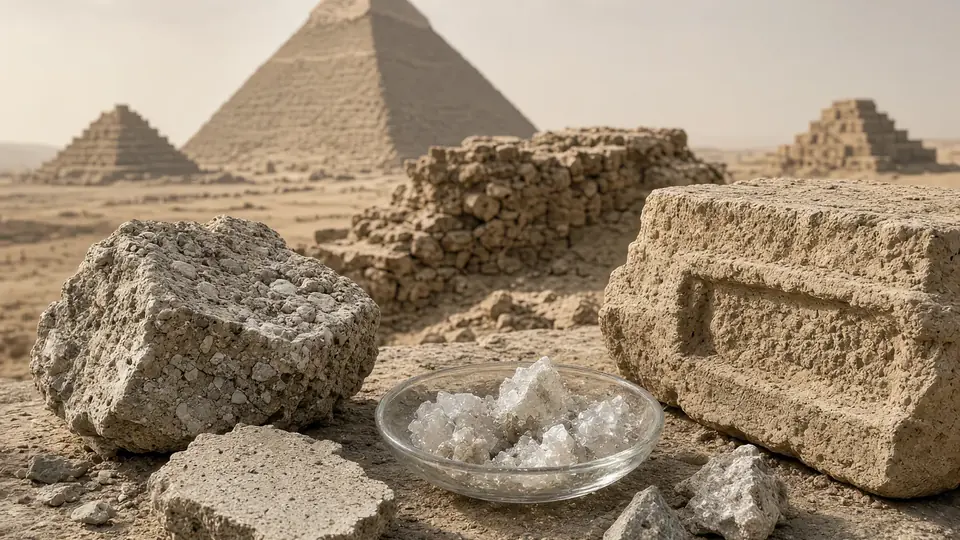
A fresh analysis of nearly 2,000-year-old Roman concrete has revealed a self-healing mechanism that could explain how an alternative theory about the Great Pyramid's construction remains scientifically plausible.
The research, published in the peer-reviewed journal Science Advances in July, shows that ancient Roman concrete does not merely resist decay but actually grows stronger over centuries through a process that fills internal damage.
How the Material Repairs Itself
A team led by Zhu Xiaohong of Beijing University of Technology, working with researchers from the University of California, Berkeley, the University of Michigan, Lawrence Berkeley National Laboratory and the University of Illinois Urbana-Champaign, analysed concrete samples from a communal latrine at Hadrian's Villa in Tivoli, Italy. High-resolution imaging revealed that the material's durability comes from the gradual formation of calcite crystals that fill pores and microcracks.
Implications for the Pyramid Debate
An alternative scientific theory proposes that the blocks of the Great Pyramid might have been cast from an early form of concrete rather than quarried stone. That hypothesis has long confronted a critical objection: how could such an artificial material survive for more than 4,500 years when some modern buildings suffer wear and damage in merely a few decades?
The new study on Roman concrete may provide a materials-science clue that breathes new life into the concrete hypothesis by demonstrating that ancient formulations can endure and self-repair over millennia.
The findings could also inform efforts to create a low-carbon modern version of the ancient material and help explain how the Great Pyramid has endured.
Source: South China Morning Post
Frequently asked questions
What self-healing mechanism was discovered in ancient Roman concrete?
High-resolution imaging revealed that ancient Roman concrete develops durability through gradual formation of calcite crystals that fill pores and microcracks, allowing the material to repair itself and grow stronger over centuries.
Where did researchers obtain the concrete samples for analysis?
The research team analyzed concrete samples from a communal latrine at Hadrian's Villa in Tivoli, Italy, which were nearly 2,000 years old.
How does this discovery relate to theories about the Great Pyramid's construction?
An alternative theory proposes that the Great Pyramid's blocks may have been cast from early concrete rather than quarried stone. The self-healing properties of ancient concrete address a major objection to this theory by demonstrating that artificial materials can endure and self-repair over millennia, potentially for 4,500+ years.
Which institutions contributed to this research?
The study was led by Zhu Xiaohong of Beijing University of Technology and included researchers from the University of California Berkeley, University of Michigan, Lawrence Berkeley National Laboratory, and University of Illinois Urbana-Champaign.
You may also like
 Technology
Chinese scientists achieve 100-fold breakthrough in next-generation memory technology
 Business
Make in India at 12: Manufacturing Share Sees Little Change
 International
US and China seek stability amid race for AI and semiconductor dominance
 International
China faces pressure to shape maritime law as Pacific islands sink beneath rising seas
Most read
- 1
Tesla audits Chinese suppliers to scale up Optimus robot production
- 2
Former minister Lakhan Singh Rajput to inaugurate temple bhandara at Shri Chakreshwar Mahadev
- 3
Firozabad BSA finds four government schools locked during inspection
- 4
Tamil Nadu dengue cases fall for third consecutive year to 17,049
- 5
Social workers stage silent protest at Fufund railway station for train halts
Comments
No comments yet. Be the first to comment.