
AI System Enhances Brown Bear Monitoring and DNA Collection Efficiency
Researchers use AI to monitor brown bear behaviour and enhance DNA collection efficiency in remote areas, improving conservation efforts.

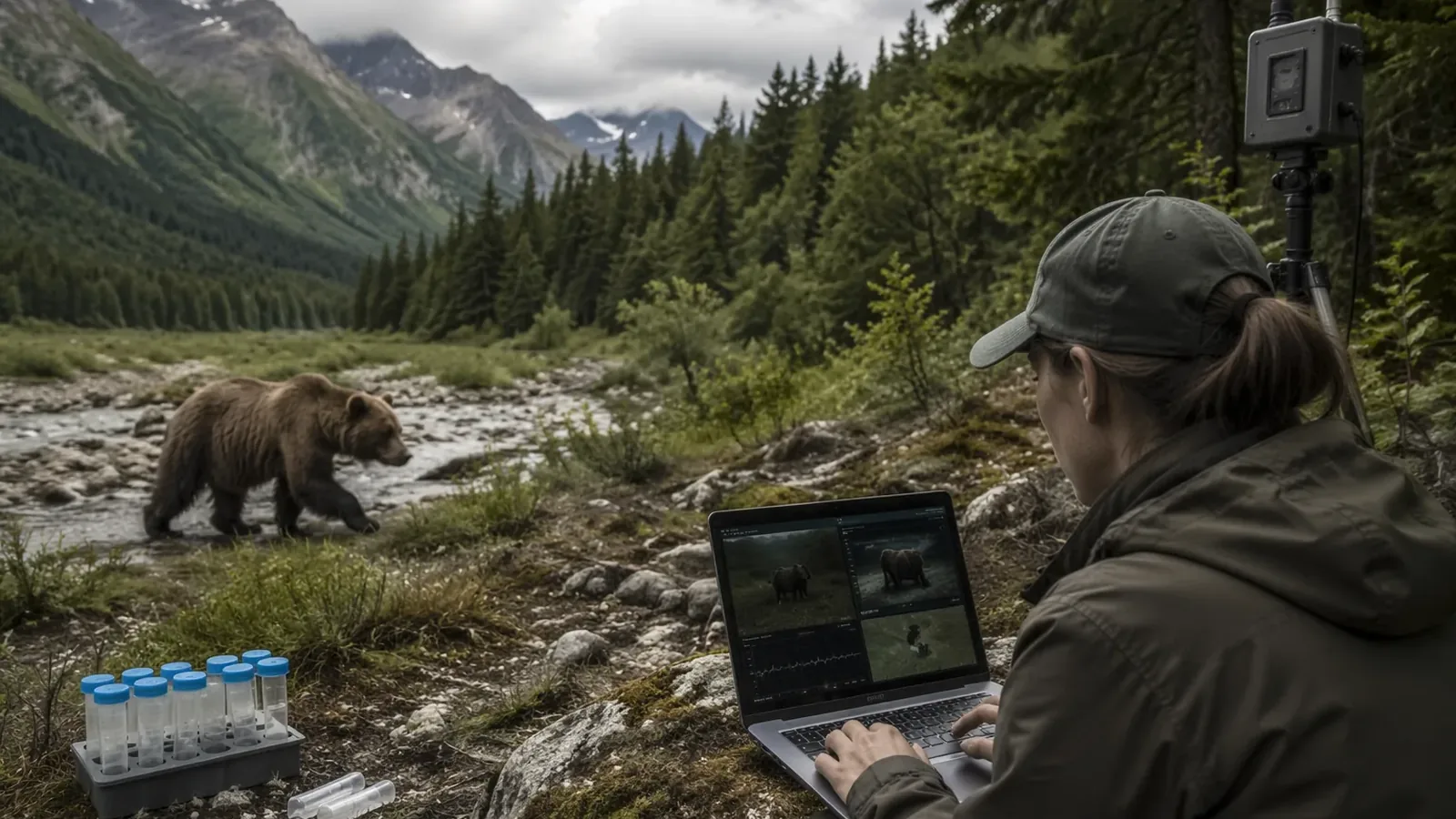
How Researchers Are Using AI to Track Brown Bear Behaviour and Enhance DNA Collection
Scientists have developed an artificial intelligence (AI)-based system to monitor brown bear behaviour and streamline DNA collection in remote regions. This innovative approach, detailed in a study by the Zoological Society of London, leverages AI models and camera-trap images to identify when bears stand on two legs near hair snares. Such behaviour often involves rubbing against trees, leaving behind fur samples crucial for DNA analysis.
Hair snares, which consist of barbed wire strands attached to trees, are a common non-invasive method for collecting bear fur. However, these setups require frequent site visits to retrieve samples and prevent contamination, a process that is both time-consuming and resource-intensive. In the Catalan Pyrenees, for instance, only 24% of visits to hair snare stations yield usable samples, underscoring the need for more efficient monitoring solutions.
The proposed AI system aims to address this challenge by analysing images captured by camera traps. Researchers trained the AI to distinguish between bears standing on two legs (bipedalism) and moving on all fours (quadrupedalism). Since no pre-existing dataset for bear poses was available, the team manually annotated 2,373 images collected between 2020 and 2023, marking 15 key anatomical points on each bear's body.
The system employs the YOLOv11 pose estimation model, which achieved a precision rate of 93.2% in detecting these key points. A separate multilayer perceptron (MLP) model then classified bear postures with 96.1% accuracy. This capability allows researchers to identify instances where bears likely interacted with tree-mounted hair snares, leaving fur samples suitable for DNA testing.
Designed for use in areas with limited or no cellular connectivity, the system transmits lightweight pose data and simplified visual representations via satellite links instead of full-resolution images. This reduces data transfer requirements from several megabytes to just about 100 bytes, making it more practical for remote applications.
By focusing field inspections on locations where bear activity is detected, the AI system could significantly reduce unnecessary site visits, saving time and resources. This efficiency boost is expected to enhance wildlife monitoring programmes.
The study concludes that AI-powered pose estimation offers a promising tool for ecological monitoring. Beyond automating parts of the DNA collection process, it provides valuable insights into bear behaviour that traditional hair snares alone cannot capture.
Frequently asked questions
What is the AI system designed to do?
The AI system monitors brown bear behaviour and streamlines DNA collection by analysing camera-trap images to identify when bears stand on two legs near hair snares, indicating they are likely rubbing against trees and leaving fur samples for DNA analysis.
How accurate is the AI system at detecting bear poses?
The YOLOv11 pose estimation model achieves 93.2% precision in detecting key anatomical points on bears, while the multilayer perceptron model classifies bear postures with 96.1% accuracy.
Why is this system particularly useful for remote regions?
The system is designed for areas with limited or no cellular connectivity. It transmits only lightweight pose data and simplified visual representations via satellite links instead of full-resolution images, reducing data transfer from several megabytes to about 100 bytes.
How does this improve DNA collection efficiency?
By identifying locations where bears have interacted with hair snares, the system allows researchers to focus field inspections on promising sites, significantly reducing unnecessary visits and preventing sample contamination, addressing the current problem where only 24% of hair snare visits yield usable samples.
You may also like
 Tamil Nadu
Conservationists warn Munnar viewpoint project could disrupt elephant habitat
 Technology
CEA Nageswaran Releases White Paper On AI, Automation And Jobs
 Technology
Joey Wong Returns to Screen in NetEase AI Reconstruction
 National
IGZP Begins Week-Long Wildlife Celebrations With Student Drawing Competition
Most read
- 1
Air China Adds Extra Flight for Passengers Stranded in Fuel-Starved Cuba
- 2
Western disturbance to bring rain, hail and strong winds across north India
- 3
Yogi Adityanath Directs No Occupied Houses Be Demolished for Achhalda Bridge
- 4
Gwalior Temple Truck Crash Kills 12, Injures 28-29 Devotees During Navratri
- 5
Schools Shut in Five Tamil Nadu Districts, Including Chennai, Amid Heavy Rain
Comments
No comments yet. Be the first to comment.