
Victorian physicists unraveled how cats twist mid-air to land safely on feet
From Victorian experiments to modern biomechanics, discover how physicists have studied the cat's remarkable ability to rotate and land safely.

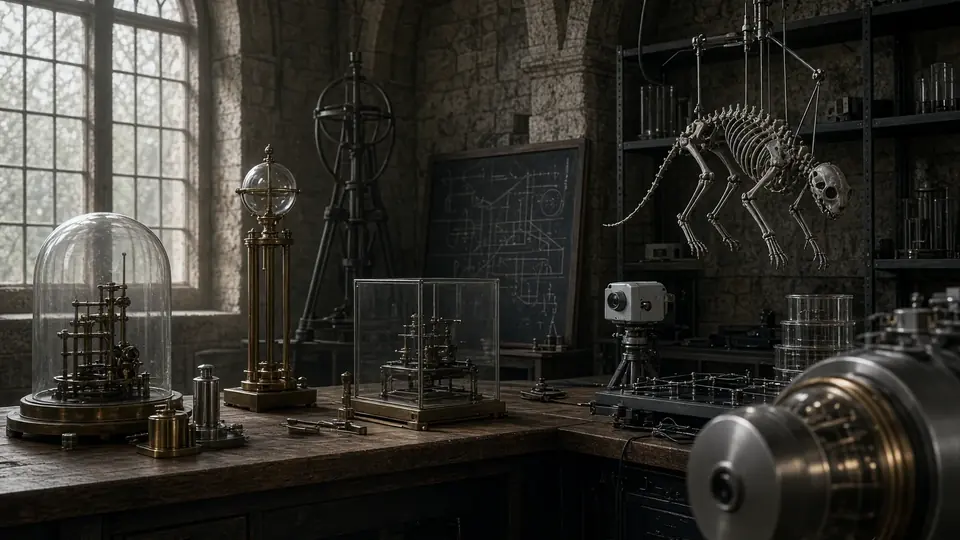
How Victorian physicists studied falling cats, and why the mystery still matters
Two giants of nineteenth-century mathematical physics turned their attention to an everyday marvel: the cat's ability to right itself mid-air. Sir George Gabriel Stokes and James Clerk Maxwell conducted what Maxwell later called "cat-turning" experiments in the 1850s, though Maxwell had to defend himself against accusations of cruelty.
"There is a tradition in Trinity that when I was here I discovered a method of throwing a cat so as not to light on its feet, and that I used to throw cats out of windows," Maxwell wrote. He clarified that his method involved letting cats drop onto tables or beds from about two inches, observing how quickly they could rotate.
From crude drops to high-speed frames
The experiments remained limited until photography caught up with feline reflexes. In 1894, Etienne-Jules Marey used a chronophotographic camera capturing 12 frames per second to produce a series of stop-action photographs showing the sequence of movements cats use to reorient themselves during a fall.
A puzzle that refuses to close
A dynamical model of cat-turning appeared in 1969, yet the subject continues to draw scientific attention. As recently as 2026, researchers published a study that moved beyond idealised hinges and cylinders to incorporate measured properties of a real cat's spine.
The persistence of this line of inquiry, from Maxwell's drawing-room drops to twenty-first-century biomechanics, suggests that something in the cat's mid-air twist still resists complete explanation, making it a durable test case for understanding how living bodies solve mechanical problems in real time.
Source: South China Morning Post
Frequently asked questions
What did Victorian physicists George Gabriel Stokes and James Clerk Maxwell discover about cats?
In the 1850s, Stokes and Maxwell conducted experiments to understand how cats can rotate and right themselves mid-air to land safely on their feet. Maxwell's method involved dropping cats from about two inches onto tables or beds to observe their reorientation movements.
How did photography advance the study of cat-turning?
In 1894, Etienne-Jules Marey used a chronophotographic camera capturing 12 frames per second to produce stop-action photographs showing the sequence of movements cats use to reorient themselves during a fall, allowing scientists to observe the process in detail.
Is the cat-turning mystery completely solved?
No. Although a dynamical model appeared in 1969, researchers continue to study the subject. As recently as 2026, scientists published studies moving beyond simplified models to incorporate measured properties of a real cat's spine, suggesting aspects of the mechanism still resist complete explanation.
Why do scientists continue researching how cats land on their feet?
The cat's mid-air twist serves as a durable test case for understanding how living bodies solve mechanical problems in real time, making it a persistent focus of inquiry from nineteenth-century physics to twenty-first-century biomechanics.
You may also like
 Uttar Pradesh
Sonalika hosts mechanic meet in Kanpur Dehat to showcase modern agricultural technology
 National
More People Fear Dogs Than Cats, Veterinarian Explains Why
 National
Lions vs Jaguars: Comparing Strength and Adaptations of Apex Predators
 National
Scientists Discover Deer Ked Fly Loses Wings and Vision After Finding Host
Most read
- 1
Tesla audits Chinese suppliers to scale up Optimus robot production
- 2
Former minister Lakhan Singh Rajput to inaugurate temple bhandara at Shri Chakreshwar Mahadev
- 3
Firozabad BSA finds four government schools locked during inspection
- 4
Tamil Nadu dengue cases fall for third consecutive year to 17,049
- 5
Social workers stage silent protest at Fufund railway station for train halts
Comments
No comments yet. Be the first to comment.