
Panama Hit By Second 6.6-Magnitude Earthquake After 7.7 Tremor
Panama was struck by a 6.6-magnitude earthquake after a 7.7 tremor caused building and road collapses in Herrera province.

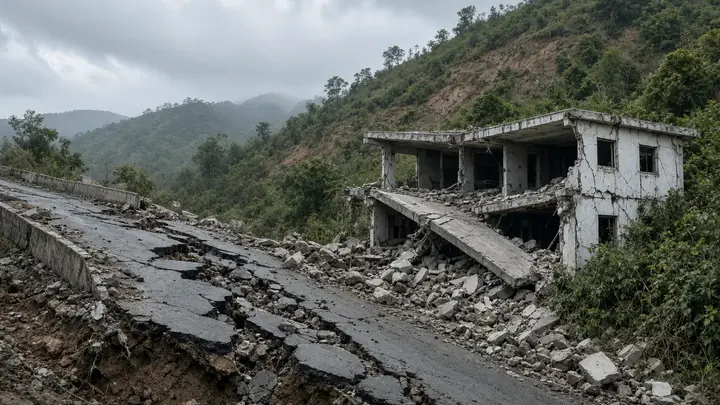
panama earthquake today
Panama was struck by a second powerful earthquake measured at magnitude 6.6 on Friday (October 9, 2026), after a magnitude 7.7 tremor and a series of aftershocks, the US Geological Survey said.
The follow-up earthquake came as authorities were assessing collapsed buildings and roads, evacuations and damage caused by the earlier quake in the Central American country.
Second earthquake follows magnitude 7.7 tremor
The first earthquake was initially estimated by the USGS to have a magnitude of 8.0 before being revised to 7.7.
It struck at 1756 GMT, with the epicenter about 10 kilometers (6 miles) from the small town of Pitaloza Arriba in central Herrera province, according to the USGS.
Another report placed the epicenter about 10 kilometers (6 miles) southwest of the remote community of Pitaloza Arriba, in Herrera, and said the earthquake struck at a depth of 10 kilometers (6 miles).
The Guardian reported a depth of 12.6km (7.8 miles), with the epicenter in a sparsely populated area about 200km (124 miles) from Panama City.
The different figures were reported by the sources while describing the same powerful earthquake and its effects across Panama.
The shallow tremor was felt across the country, which has a population of around 4.5 million people, according to Panama’s National Civil Protection System.
The earthquake was also felt as far away as neighbouring Colombia, the US Geological Survey said.
The Guardian reported that the quake lasted about a minute, while Nestor Luque, director of Panama’s national geosciences institute, said he counted 40 seconds of vibrations in Panama City.
Luque said other areas may have experienced even longer tremors.
The Hindu reported that the second magnitude 6.6 earthquake struck after a series of aftershocks, while its headline referred to a magnitude 7.6 earthquake.
Buildings and roads damaged
The magnitude 7.7 earthquake caused buildings and roads to collapse in central Panama, although there were no immediate reports of casualties.
The country appeared to escape widespread destruction or deaths, the Guardian reported.
President Jose Raul Mulino said, “We are facing a major disaster,” and added that some roads had “completely collapsed”.
The most affected areas were reported to be Herrera and Cocle provinces, along with Los Santos in the southeast.
Health Minister Fernando Boyd said the town of Tonosi in Los Santos was completely cut off.
He said authorities were trying to determine how to reach the town by air because “it's impossible by land”.
In Penonome, a city in central Cocle province, a church and a hotel suffered extensive damage, according to images shared by local media.
Former president Ricardo Martinelli posted pictures on Instagram showing that his house in the town of Sona in Veraguas province had collapsed.
The reports did not provide an immediate total for damaged buildings, collapsed roads or injuries.
Panic in Panama City
In Panama City, people rushed out of emblematic skyscrapers as the shaking triggered panic in the capital.
Salomon Andion, 46, told Agence France-Presse that he was scared because the shaking was “very strong and prolonged”.
“Heavy objects like dressers, the bed, and all the kitchen items were shaking,” Andion said.
He had evacuated his 15-storey building after the earthquake, and the NDTV report said he left it for the second time following aftershocks.
A video widely shared on social media showed water falling from the rooftop pool of a building over 20 storeys tall.
Another video showed a bridge over the Panama Canal shaking violently while vehicles continued to travel across it.
Some elderly residents were in tears as they evacuated into the streets, the Guardian reported.
The scenes were especially alarming because strong earthquakes are not common in Panama.
The USGS estimated that about 43,000 Panamanians lived in areas with at least severe exposure to the quake.
It also estimated that economic losses could amount to between 1% and 10% of Panama’s gross domestic product.
Residents describe fear and disruption
Juana Alveo, a 38-year-old cashier at a store in Penonome, described the earthquake as “horrible, like nothing we ever experienced”.
“My daughter was trapped in school,” she said.
The NDTV report attributed the same account to Alveo and identified Penonome as being in central Cocle province.
In the capital’s downtown business hub, office workers were concerned about how they would get home amid heavy traffic.
Juan Sanchez, a 37-year-old economy ministry employee, waited for a bus that he said he doubted would arrive.
“They evacuated all of these buildings. Everyone is outside. Now the problem is, how do we get home?” Sanchez said.
The disruption extended beyond the immediate shaking, as residents dealt with evacuations, aftershocks, traffic and interruptions to transport.
More than 40 aftershocks rattled the country in the hours after the main earthquake, according to the Guardian.
The local geosciences institute recorded over 80 aftershocks, including one above magnitude 6.0, according to NDTV.
The figures were reported separately by the sources as the aftershock sequence continued.
Canal operations reported normal
Despite the damage and evacuations, the Panama Canal was reported to be operating normally.
The Panama Canal Authority said shipping through the channel, which connects the Pacific and Atlantic oceans, was unaffected and operating “as normal”.
The Cobre Panama copper mine also reported normal operations.
The status of the canal mattered because the waterway is a major connection between the Pacific and Atlantic oceans, and the reports said shipping continued despite the earthquake.
Panama City’s Tocumen international airport initially suspended flights, but later lifted the suspension.
Another report said the city’s international airport was temporarily closed and that several flights were diverted to other airports as a precaution, according to the Civil Aeronautics Authority.
The sources therefore described changes in airport operations as authorities responded to the earthquake and its aftershocks.
Naturgy, the electricity provider, reported power outages in six provinces.
Tsunami warning lifted
A tsunami warning was issued for the eastern Pacific after the earthquake and was later lifted.
The lifting of the warning was reported alongside the assessment of damage and the response to the earthquake.
The available reports did not give a separate account of coastal damage linked to the warning.
The national response included the movement of President Mulino to Penonome to coordinate disaster operations.
The education ministry announced the suspension of classes in schools nationwide.
Mulino also said, “What happened should not be used to generate alarms and disorder,” and added that he had called for a report on the damage.
The statement came as authorities were dealing with reports of collapsed roads, damaged buildings, disrupted flights, power outages and continuing aftershocks.
International offers of support
The US secretary of state, Marco Rubio, wrote on social media that he was “closely monitoring reports” of the earthquake and that the United States was ready to help if needed.
The leaders of Colombia, Ecuador and Guatemala sent messages of solidarity and offered to send aid.
The international responses followed reports that the earthquake was felt beyond Panama, including in neighbouring Colombia.
The sources did not report that any of those offers had been accepted or that aid had already arrived.
Earthquakes are uncommon in Panama
Earthquakes are rare in Panama and usually occur in the western province of Chiriqui, which borders Costa Rica.
The Panamanian earthquake was described as at least the fourth earthquake of more than 7.0 magnitude in Latin America that year.
The other events cited were devastating back-to-back earthquakes in Venezuela’s Guaira in June and a powerful earthquake in western Colombia in August.
The earthquake also came shortly before a national evacuation drill that Panama was due to hold on Monday next week to test its emergency response.
The combination of the drill, the rarity of strong earthquakes in Panama and the scale of the evacuations placed the quake in a significant national emergency context.
At the time covered by the reports, authorities were continuing to assess damage while monitoring aftershocks and coordinating access to affected areas.
Frequently asked questions
What magnitude was the second earthquake in Panama?
The second earthquake measured magnitude 6.6.
When did the second earthquake strike Panama?
It struck on Friday, October 9, 2026.
What was the magnitude of the earlier earthquake?
The earlier earthquake was revised from an initial estimate of 8.0 to magnitude 7.7.
Which areas of Panama were most affected?
Herrera and Cocle provinces, along with Los Santos in the southeast, were reported to be the most affected.
Were there immediate reports of casualties?
No immediate reports of casualties were provided, although buildings and roads collapsed.
You may also like
 Weather
Heavy rain hits Tirupati as low-pressure area forms off Tamil Nadu coast
 National
Motorcycle Rider Injured After Colliding With Dog Near Transport Nagar
 National
Nagaland Declares Results Of Three Dear Lotteries, Each Offering Rs 1 Crore Prize
 Entertainment
Prashanth Carries Mysuru Dasara’s 750-Kg Golden Howdah In Debut
Most read
- 1
Air China Adds Extra Flight for Passengers Stranded in Fuel-Starved Cuba
- 2
Western disturbance to bring rain, hail and strong winds across north India
- 3
Yogi Adityanath Directs No Occupied Houses Be Demolished for Achhalda Bridge
- 4
Gwalior Temple Truck Crash Kills 12, Injures 28-29 Devotees During Navratri
- 5
Schools Shut in Five Tamil Nadu Districts, Including Chennai, Amid Heavy Rain
Comments
No comments yet. Be the first to comment.