
Legal Literacy Training Begins for Teachers from 37 Hathras Schools
A two-day training programme for nodal teachers of Legal Literacy Clubs began in Hathras on October 27, 2026.

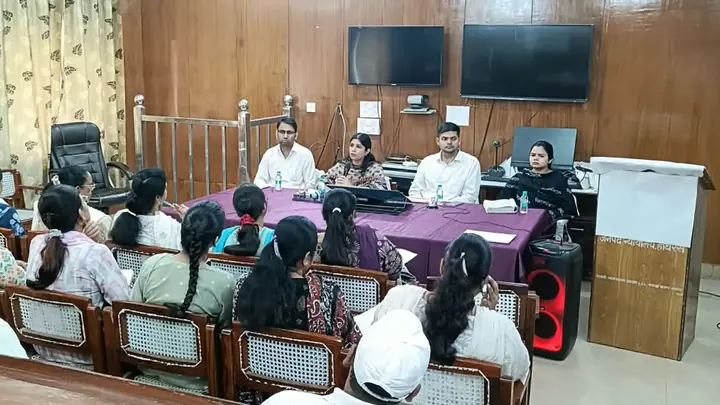
A two-day training programme for nodal teachers of Legal Literacy Clubs began in Hathras on October 27, 2026. The programme is being organised by the District Legal Services Authority, Hathras, in compliance with the directions of the Uttar Pradesh State Legal Services Authority, Lucknow, and on the orders of District Judge Vinay Kumar III.
The training is being held in the video conferencing room of the district court in Hathras. District Legal Services Authority Secretary Anu Chaudhary was present during the programme.
The main objective of the training is to make the Legal Literacy Clubs operating in all government and non-government higher secondary schools in the district more effective, active and focused on their purpose. Through these clubs, students are to be given information about the Constitution, laws, fundamental rights, civic duties and legal aid.
On the first day of the training programme, in the first phase, teachers-in-charge from 37 schools were designated as nodal teachers and trained for the responsibility. These teachers will work as an important link between their schools and the District Legal Services Authority.
The nodal teachers will share legal information with students from Classes 9 to 12. The information will cover the Constitution, the law, fundamental rights, civic duties and the legal assistance available to people. The training is intended to help teachers explain these subjects to students in a clear and useful manner through the Legal Literacy Clubs.
The first session focused on the Constitution, fundamental rights and civic duties. Judicial Magistrate Khushboo Chandra, Civil Judge (Junior Division)/FTC Second Arijit Singh and Civil Judge (Junior Division)/FTC First Robin Kumar gave the teachers detailed information about the making of the Constitution, the contribution of the makers of the Constitution, the Preamble, fundamental rights, constitutional remedies, the Directive Principles of State Policy and fundamental duties.
The judicial officers told the teachers that the Constituent Assembly gave the country its Constitution after two years, 11 months and 18 days of dedicated work. They described the Preamble as the soul of the Constitution.
The teachers were told that the Preamble contains the resolve to make India a sovereign, socialist, secular and democratic republic. It also carries the commitment to ensure justice, liberty, equality and fraternity for citizens.
The session also covered the six fundamental rights. These included the right to equality, the right to freedom, the right against exploitation, the right to freedom of religion, cultural and educational rights, and the right to constitutional remedies.
The importance of Articles 32 and 226 was also explained. The judicial officers told the teachers that when fundamental rights are violated, citizens can approach the Supreme Court and the High Courts. The courts can issue writs such as habeas corpus and mandamus to protect those rights.
The teachers were also informed about the Directive Principles of State Policy and the 11 fundamental duties of citizens under Article 51A of the Constitution. They were told that fulfilling duties is necessary along with enjoying rights.
The protection of the country’s unity and integrity and the safeguarding of public property were described as the responsibility of every citizen. The teachers were expected to pass this information on to students through the Legal Literacy Clubs.
The second session dealt with the role of the legislature, the executive and the judiciary. Chief Legal Aid Defence Counsel Rituraj Singh and Assistant Legal Aid Defence Counsel Ashutosh Gautam conducted this part of the training.
They also explained important laws related to the protection of children. These included the POCSO Act, the law prohibiting child marriage and provisions related to the elimination of child labour.
The teachers were encouraged to remain aware of these laws and to make students aware of them as well. The session focused on ensuring that students receive information about laws connected with the safety and protection of children.
The third session focused on the process of obtaining free legal aid. Mediator Advocates Ramesh Chandra Verma and Sandeep Verma explained the process in detail.
They said that Article 39A of the Constitution emphasises equal justice for all citizens. To ensure that no person is deprived of justice because of economic or other disabilities, eligible persons are provided free legal aid through the District Legal Services Authority.
The teachers were told that eligible women, children, members of Scheduled Castes and Scheduled Tribes, and people belonging to other prescribed categories can receive legal assistance under the rules. This assistance may include a free advocate.
The session also explained the benefits and working of the Lok Adalat. It was described as an accessible and speedy means of delivering justice. Cases are settled there on the basis of mutual consent and compromise.
The teachers were informed that decisions of the Lok Adalat are final and that there is no provision for an appeal against them. The process can save time and money. Court fees may also be refunded as per the rules.
The Lok Adalat has an important role in the settlement of pending civil, family and compoundable criminal cases. Information about this process was included in the training so that the nodal teachers can explain its benefits to students and, through them, to families and people in the community.
During the training, the nodal teachers were also informed about the National Legal Aid toll-free helpline number 15100. They were told that people can use this number to receive free legal assistance and guidance and to contact the concerned authority for their legal aid-related needs.
The teachers were requested to share information about the helpline number and legal awareness with students. The students can then help spread awareness about the law among people in their families and society.
The training programme placed particular emphasis on promoting legal awareness in schools and making students aware of their rights and duties. Through the two-day programme, the Legal Services Authority is seeking to strengthen the role of Legal Literacy Clubs and make the participating teachers more prepared to guide students on constitutional provisions, child protection laws, free legal aid and the Lok Adalat system.
Frequently asked questions
When did the legal literacy training programme begin in Hathras?
The two-day training programme began on October 27, 2026.
Who organised the legal literacy training programme?
The District Legal Services Authority, Hathras, organised the programme under the directions of the Uttar Pradesh State Legal Services Authority, Lucknow.
How many schools were represented by nodal teachers on the first day?
Teachers-in-charge from 37 schools were designated and trained as nodal teachers.
What subjects will the nodal teachers explain to students?
They will explain the Constitution, laws, fundamental rights, civic duties and available legal assistance to students in Classes 9 to 12.
You may also like
 Uttar Pradesh
NDRF Trains Over 600 Students, Teachers in Disaster Response at Hathras School
 Business
Hathras shopkeepers oppose proposed relocation of 15-year-old haat market
 Politics
Congress Holds Hathras Outreach Meet on Protecting Voting Rights, Voter Rolls
 National
Hathras Police Launch Anti-Encroachment Drive Across Sasni Markets To Ease Traffic Jams
Most read
- 1
Xi Orders Urgent Rescue Efforts After Tibet Earthquake Kills 16, Injures 54
- 2
Schools Shut in Five Tamil Nadu Districts, Including Chennai, Amid Heavy Rain
- 3
Hong Kong Insurance Authority Tightens Premium Financing Oversight as Risks Emerge
- 4
Madanpur Masters Beat Firozabad Fighters by Two Runs in T-10 Opener
- 5
eMudhra Certificate: 8 weak certificates raise Internet Security concerns as browsers act
Comments
No comments yet. Be the first to comment.