
Kuala Lumpur's old businesses battle modern makeover as heritage fades
Malaysia's capital faces pressure to modernize while preserving historic businesses and architecture. How can Kuala Lumpur develop without erasing its past

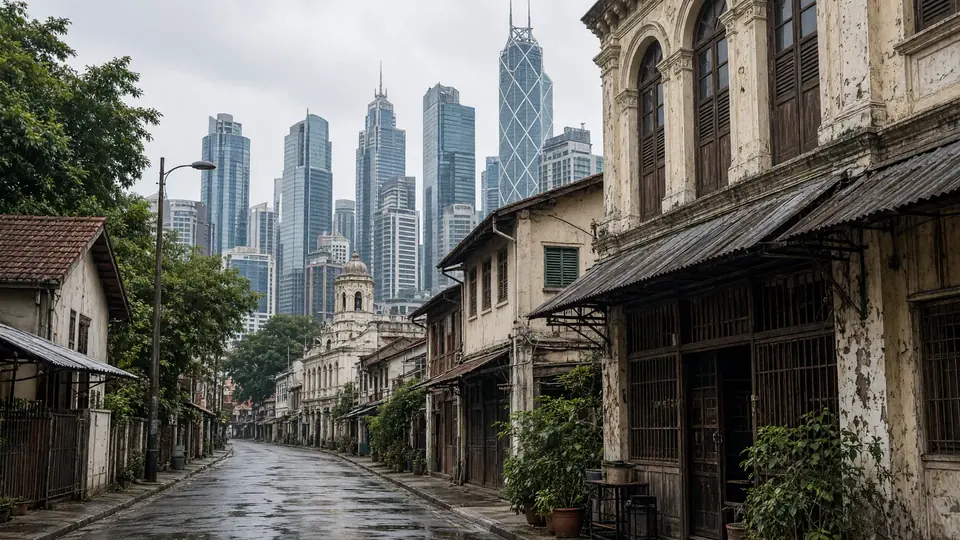
Malaysia's capital is caught between preservation and progress as urban renewal threatens to erase the texture of its historic centre, where family businesses that have survived six decades now confront a future shaped by competing visions of modernisation.
Abdul Razak Gold House on Lebuh Ampang offers a window into the trade-offs. The jewellery store displays a faded receipt behind glass listing an address that has ceased to exist officially, "63 Ampang Street, Kuala Lumpur (Malaya)", a relic from a time before the nation changed both its boundaries and its street names. The business has operated for 60 years, evolving from a goldsmith's counter tucked beneath old shophouses into a bright retail outlet now dwarfed by skyscrapers and elevated rail lines.
Mohd Razalie Abdul Rasul, 37, runs the operation today and has pushed it into bullion trading while acquiring the adjacent property. Yet even as he expands, he acknowledges a generational rift in how the business adapts. "My dad is still a mentor, but the way he thinks and I think is totally different," he told reporters. "We have to think very modern. We have to stay one step ahead".
That tension, between honouring heritage and embracing change, now defines Kuala Lumpur's urban renewal efforts, which aim to regenerate the capital's historic core. Many of the businesses Mohd Razalie recalls from childhood along Lebuh Ampang have already disappeared. The challenge his family faces mirrors the broader dilemma facing the city: how to preserve identity while pursuing development.
Urban planners warn that polish and authenticity rarely coexist easily on the same street. As renewal projects advance, the risk grows that gentrification will price out the small enterprises and vernacular architecture that give neighbourhoods their character, replacing lived history with sanitised replicas.
The Abdul Razak Gold House receipt, yellowing behind its frame, captures what is at stake, a tangible link to a city that no longer appears on any map, preserved by a family preparing to hand the business to yet another generation.
Source: South China Morning Post
Frequently asked questions
How long has Abdul Razak Gold House been operating in Kuala Lumpur?
Abdul Razak Gold House has operated for 60 years in Kuala Lumpur, evolving from a goldsmith's counter beneath old shophouses into a bright retail outlet.
What is the main challenge facing Kuala Lumpur's historic businesses during urban renewal?
The main challenge is balancing preservation and progress. Urban renewal threatens to erase the texture of the historic centre, with risks that gentrification will price out small enterprises and vernacular architecture that give neighbourhoods their character.
How is Mohd Razalie Abdul Rasul adapting the family business?
Mohd Razalie, who runs Abdul Razak Gold House at age 37, has pushed the business into bullion trading and acquired the adjacent property, while acknowledging generational differences in how the business adapts to modern times.
What does the faded receipt at Abdul Razak Gold House represent?
The faded receipt, which lists the address '63 Ampang Street, Kuala Lumpur (Malaya)', is a relic from before Malaysia changed its boundaries and street names. It represents a tangible link to a city that no longer appears on any map.
You may also like
 Crime
Crime
Najib Razak must pay 50 million ringgit fine to leave prison
 Entertainment
Malaysia's PM courts India with charm and Kishore Kumar song at Brics summit
 Business
Kerala CM and Malaysian PM explore investment ties in healthcare and tourism
 Defence
Johor and Singapore build cross-border economic zone mirroring Hong Kong-Shenzhen model
Most read
- 1
Tesla audits Chinese suppliers to scale up Optimus robot production
- 2
Former minister Lakhan Singh Rajput to inaugurate temple bhandara at Shri Chakreshwar Mahadev
- 3
Firozabad BSA finds four government schools locked during inspection
- 4
Tamil Nadu dengue cases fall for third consecutive year to 17,049
- 5
Social workers stage silent protest at Fufund railway station for train halts
Comments
No comments yet. Be the first to comment.