
J&K Government Revives Annual Darbar Move, Shifts Capital From Srinagar To Jammu
J&K offices will shift from Srinagar to Jammu on October 31 and November 1, with buses, security convoys and support arrangements in place.

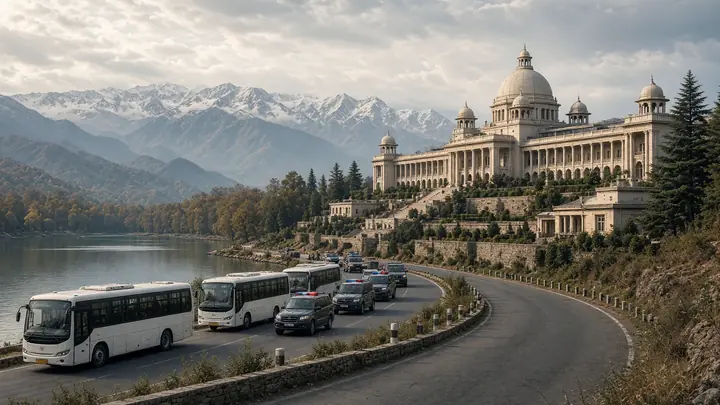
The Jammu and Kashmir Road Transport Corporation (JKRTC) has been directed to arrange buses for employees as government offices prepare to move from Srinagar to Jammu under the annual ‘Darbar Move’ arrangement.
The J&K government announced the decision on Tuesday (October 20, 2026), reviving a practice that the Lieutenant Governor’s administration had stopped after 2021 and that the Omar Abdullah government resumed in 2025.
Buses, convoys and advance tickets
The JKRTC has been asked “to arrange an adequate number of buses in good condition to transport employees on October 31 and November 1.”
A government spokesman said tickets for the journey would be issued in advance from October 27.
The government has also directed the transport corporation to ensure that every bus convoy is accompanied by a crane, two empty buses and mobile workshops.
These arrangements are intended to help deal with any eventuality during the journey, according to the government’s directions.
The Jammu and Kashmir Police will provide security to the convoys and ensure their precedence at the Banihal-Qazigund Tunnel and the Dr Syama Prasad Mookerjee Tunnel, the order said.
Offices to reopen in Jammu on November 2
Under the ‘Darbar Move’ calendar, offices are scheduled to reopen in Jammu, the winter capital, on November 2.
Offices in Srinagar, the summer capital, will start closing from October 30 and October 31.
The order said offices moving in camp mode would carry up to 33 per cent of their staff strength or 10 officials, whichever is lower, unless specified otherwise.
The arrangement therefore involves a designated transfer of staff rather than the movement of the full strength of every office.
A practice dating back to 1872
The ‘Darbar Move’ was introduced in 1872 by Dogra Maharaja Gulab Singh.
It allowed government offices to shift from Jammu to Srinagar when summers peaked there and return to Jammu as winter peaked in the Valley.
The practice was stopped by the Lieutenant Governor’s administration in 2021 because of the burden on the exchequer.
J&K’s regional parties, including the ruling National Conference, had supported the practice.
It also acts as a bridge between the diverse cultures of Kashmir and Jammu, according to the source.
More than 9000 government employees from around 51 government departments would relocate every year between the twin capitals as part of the practice.
Source: The Hindu
Frequently asked questions
What is the Darbar Move arrangement?
It is the annual shifting of J&K government offices between Srinagar, the summer capital, and Jammu, the winter capital.
When will government offices reopen in Jammu?
Government offices are scheduled to reopen in Jammu on November 2, 2026.
How will employees travel during the Darbar Move?
The Jammu and Kashmir Road Transport Corporation will arrange buses on October 31 and November 1, with advance tickets issued from October 27.
How many employees will relocate under the arrangement?
More than 9,000 government employees from around 51 departments are expected to relocate between the two capitals each year.
You may also like
 Crime
Kulgam Police Arrest Five Alleged Terrorist Associates, Recover Arms, Ammunition
 Haryana
J&K Vocational Trainers Continue 12-Day Protest Over Job, Salary Demands
 Politics
J&K’s Revised Industrial Policy Nears Final Stage, Deputy CM Says
 Politics
PDP Calls Omar Abdullah's Statehood Resolution Vague, BJP Alleges Pakistan Link
Most read
- 1
Air China Adds Extra Flight for Passengers Stranded in Fuel-Starved Cuba
- 2
Western disturbance to bring rain, hail and strong winds across north India
- 3
Yogi Adityanath Directs No Occupied Houses Be Demolished for Achhalda Bridge
- 4
Gwalior Temple Truck Crash Kills 12, Injures 28-29 Devotees During Navratri
- 5
Schools Shut in Five Tamil Nadu Districts, Including Chennai, Amid Heavy Rain
Comments
No comments yet. Be the first to comment.